



Production and pest update brought to you by the OMAFRA Apple Team:
Erika DeBrouwer, Tree Fruit Specialist and Kristy Grigg-McGuffin, IPM Specialist
Table of Contents
Orchard Activities
Across the province growers continue to plant and prune, with chemical thinning being top of mind throughout the province.
Growth Stages


Staging across the province is variable, mostly due to proximity to water, where growth staging is roughly 7 to 10 days earlier than a normal year. County wide updates are listed below:
- In Essex fruitlets are sizing! Ranging from 5 to 14mm, with early varieties sitting at the latter end (10 – 14mm), where Ambrosia and Gala are roughly at 6 and 7mm.
- Chatham-Kent, Lambton, Middlesex, Elgin, Norfolk and Brant cultivars are ranging from 5 to 10mm sizing, with Ambrosia and Gala showing 5 and 7mm, respectively.
- Niagara, Waterloo and Wenworth are showing petal fall to early sizing.
- In Grey, most cultivars are at the beginning of petal fall.
- Durham, Northumberland and Quinte are in full bloom.
- Further along the St. Lawrence and into the Ottawa Valley, are also in full bloom to petal fall stages.
Thinning
Nibble Thinning
Many growers are familiar with the nibble thinning approach, but it is important to reaffirm the benefits of this practice. Taking a little off at every opportunity to get to that ideal crop load will aid you in the long term and may save you money and time dependent on when you reach your target.
There are other options to aid in your decision-making process. For further information about tools and strategies please refer to the Bud to Bin – Targeting Your Crop Load article found in the February 2023 Issue of ONcore (previously Orchard Network Newsletter).

Chemical Thinning
Timing for chemical thinner applications at bloom have surpassed for most growers, but fruitlet thinning is just beginning for most. Please take into account the products available to you along with looking ahead at the upcoming weather forecast to aid in any decision-making (Thinner Effectiveness Table below).
Chemical thinners are listed in the table below, along with timings related to each thinner. For more detailed information about volumes and rates, please refer to the following links:
- The Apple Section of the Thinning of Tree Fruit webpage at Ontario.ca
- The Apple Landing Page found on the Crop Protection Hub website
- The Pesticide Label Search for specific product searches
Chemical Thinner Overview
Active Ingredient(s) | Tradename | Application Timing |
1-ACC (1-aminocyclopropanecarboxylic acid) | Accede | Bloom – 25mm |
6-BA & GA4,7 (6-benzyladenine & gibberellins A4A7) | Perlan, Promalin | King bloom – early petal fall |
Ethephon | Ethrel1 | Bloom – only non-fruiting trees |
Ammonium thiosulphate | ATS2 | Bloom |
Lime Sulphur | Lime Sulphur2 | Bloom |
1-NAA (1-naphthaleneacetic acid) | Maintain, Fruitone-L | Bloom – fruitlet sizing, bloom to 30 days after bloom |
6-BA (6-benzyladenine) | Cilis Plus, Maxcel | Petal fall – fruitlet sizing, up to 20mm |
Carbaryl | Sevin XLR | Petal fall to 25 days after bloom |
2. ATS and Lime Sulphur are fertilizers and therefore will not be found in the pesticide label search
Thinner Effectiveness
Climate Conditions | Prediction |
Warm Conditions (>18oC) | All thinners work best |
Dark Cloudy Weather | Greater stress Greater thinning response Greater drop |
High Night Temperatures (>18oC) | Great stress High demand and use of energy for night respiration Greater drop |
Very High Day-Time Temperatures (>29oC) | Great stress High energy demand Greater drop |
Very Cool Temperatures (<18oC) | Reduced stress Reduced energy demand Greater set |
High Light | Increased supply: harder to thin |
Low Light | Reduced supply: easier to thin |
Low Temperatures | Low demand: harder to thin |
High Temperatures | High demand: easy to thin |
Low light and warm temperatures | Worst |
Disease Development
Scab
Most areas have reached – or nearing – the end of primary apple scab maturation period. We’ve had some good rain events in earlier areas that have likely released the last of these spores but be sure to maintain a regular protectant program for a few weeks following the last scab infection event and monitor for signs of lesions.
The table Relationship of Temperature and Moisture to Apple Scab Infection (also summarized below) provides the number of days after infection before lesions will become visible.
Number of days required for apple scab lesions to appear following an infection event
Average temperature (C) | Lesion appearance (days) |
|---|---|
0-5 | – |
6-9 | 17 |
10 | 16 |
11 | 15 |
12-13 | 14 |
14-15 | 12-13 |
16-24 | 9-10 |
25+ | – |


Fire blight
Blossom blight
The Ontario fire blight prediction maps continue to be updated regularly. With the warmer weather predicted this weekend, conditions have become optimal for fire blight infection.
Regions that are at fruit set should be diligent and monitor their orchards closely for new plantings that may still be blooming or for secondary, or “rat tail” blossoms. There have been a number of reports of fairly substantial straggling bloom or rattail bloom in many varieties including Honeycrisp, Ambrosia, Gala, Empire, Cortland and Crimson Crisp.

Take necessary action to remove or protect open blossoms from infection. Generally, continuing a protective program for a couple of weeks following petal fall will help ensure any late blooms are covered. Keep in mind, the antibiotics (Streptomycin, Kasumin) provide control for only 24-72 hours prior to a rain event. So for extended infection periods, a subsequent spray may be needed. Also be mindful of preharvest intervals when using these products. For instance, Kasumin has a preharvest interval of 90 days.
However if there are a few days of dry weather and labour allows, it may be best to go through the orchard and pinch off the rat tail blooms altogether since the fruit produced by the late blossoms are more of a risk than they are an asset.
Powdery mildew
Unfortunately, after last week’s update commenting on no signs of powdery mildew, the first infected new terminals have now been observed on Gala and Idared.
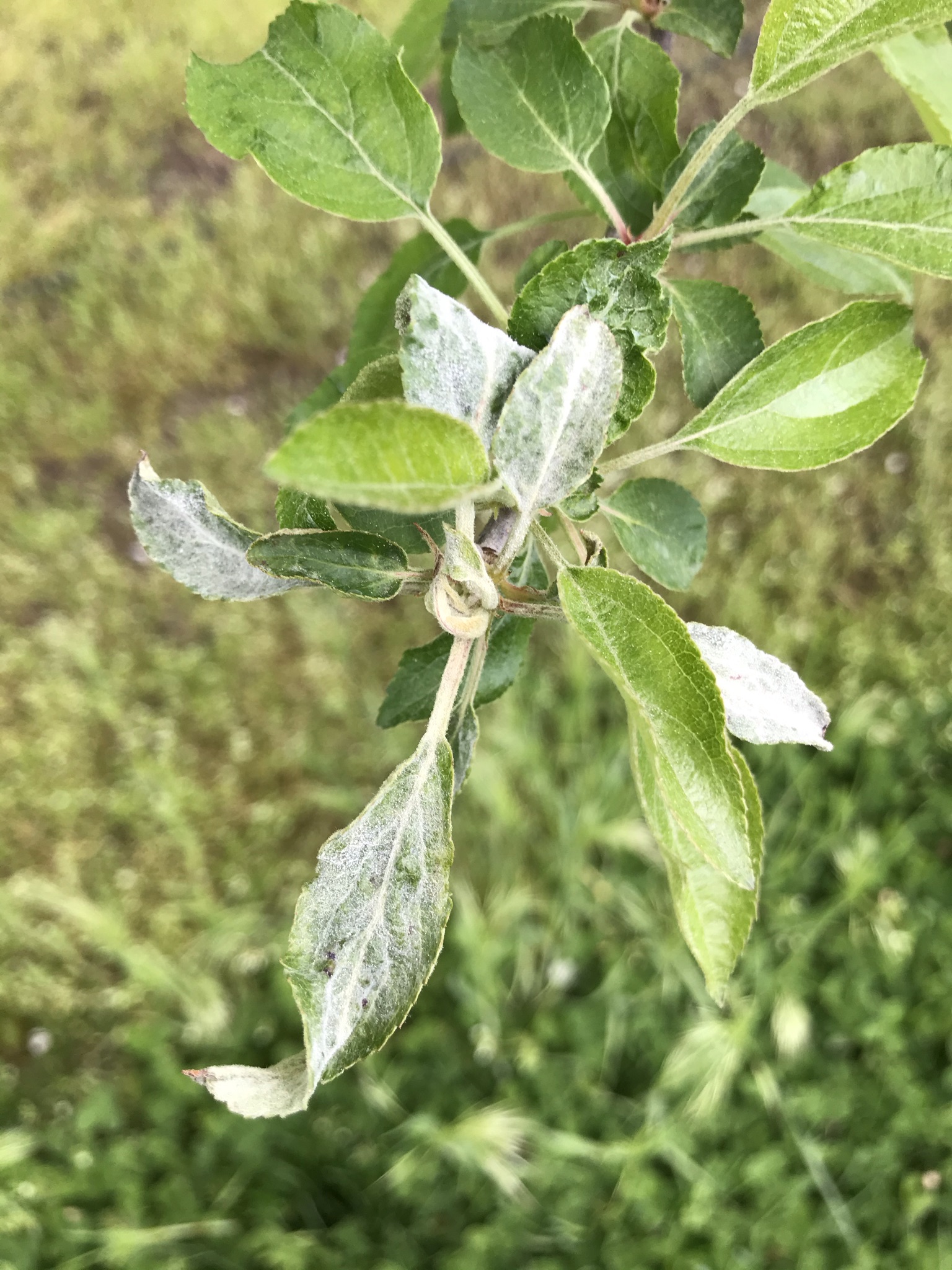
Mildew thrives in dry weather and high relative humidity. In fact, rain deters powdery mildew development by washing off spores. So, protectant sprays may still be required during dry periods when there is little risk from apple scab. Be careful how long the interval between sprays become, especially in mildew susceptible blocks.
Some key points for effective powdery mildew control to consider:
- Maintain a tight spray schedule with high rates during primary scab infection period. Powdery mildew does not invade mature leaf tissue, so spread of mildew ceases when trees stop producing new terminal leaves.
- Getting good mildew control following an outbreak will take several seasons. Mildew infected white shoots from last year’s failure will persist through the season, but does not indicate current fungicides are failing. The current season mildew program is designed to prevent spread that would lead to primary infection for next year.
- Where they are working, include sterol inhibitors, strobilurins or SDHIs during the critical infection period, generally at pink through petal fall.
Insect
Caterpillars
The spray window for oriental fruit moth is quickly approaching in most early regions. Some growers are opting for insecticides with good efficacy on mullein bug, spring-feeding caterpillars, European apple sawfly and/or apple leafcurling midge if monitoring had indicated they had reached threshold or have high pest pressure.
European apple sawfly have been caught in traps where monitoring for this pest is on-going. Early petal fall spray timing will be critical for areas with sawfly pressure, especially if a prebloom spray was not applied. Delaying this spray may result in extensive damage. While this is a pest east of Toronto, into Georgian Bay and throughout the GTA, damage has been suspected in regions further southwest.
Spring-feeding caterpillar activity can still be found. Of the caterpillar complex, spongy moth can be found causing significant damage to flower clusters in some orchards that have a history of this pest.
Mullein bug
Increasing numbers of mullein bugs are being tapped out in various orchards across the province, exceeding the threshold of 7-9 nymphs per 25 taps. No damage has been reported yet in those areas where fruit are sizing. Growers seeing numbers above threshold are applying (or planning to apply) insecticides with activity against this pest particularly on susceptible varieties such as Red Delicious, Spartan, Spy, Ambrosia, Empire, Cortland, Gala, Jonagold and Golden Delicious.
It’s recommended to continue monitoring after the insecticide has been applied to determine if a follow-up spray is required. Delegate, Minecto Pro, Altacor and Exirel do not have efficacy on this pest.
The critical time for damage from mullein bug is generally dime to quarter-sized fruit.


Plum curculio
Warmer temperatures may increase activity of plum curculio into the orchard. During cooler weather, these weevils tend to move slower, opting to crawl in from surrounding woodlots; however, on warmer days, they’ll fly in which is often when there is an increase in observed damage during these periods.
Apple leafcurling midge
Apple leafcurling midge egg hatch continues. Infested terminals are becoming quite apparent already in orchards with a history of this pest.

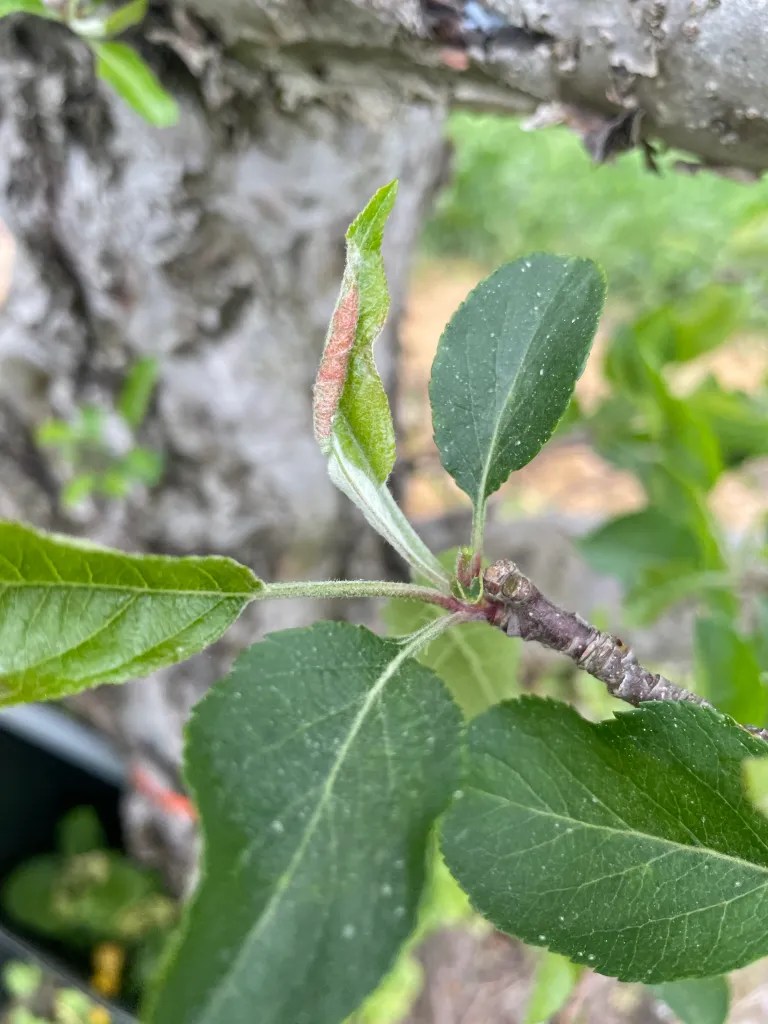
While Movento is registered for suppression, the timing for leafcurling midge is often earlier than for scale and woolly apple aphid so would have to be chosen based on which pest is of greater concern in your orchard. However, there are other petal fall insecticides such as Delegate, Closer and Exirel (and for that matter Minecto Pro) that may provide some efficacy as well, which could help delay the Movento application. Pyrethroids are registered but have greater efficacy earlier to target adult midges and can be very harsh on the numerous beneficial insects that are now active in the orchard. Summer oils will also help to smother eggs so long as good coverage is achieved to reach within the newest terminal leaves.