
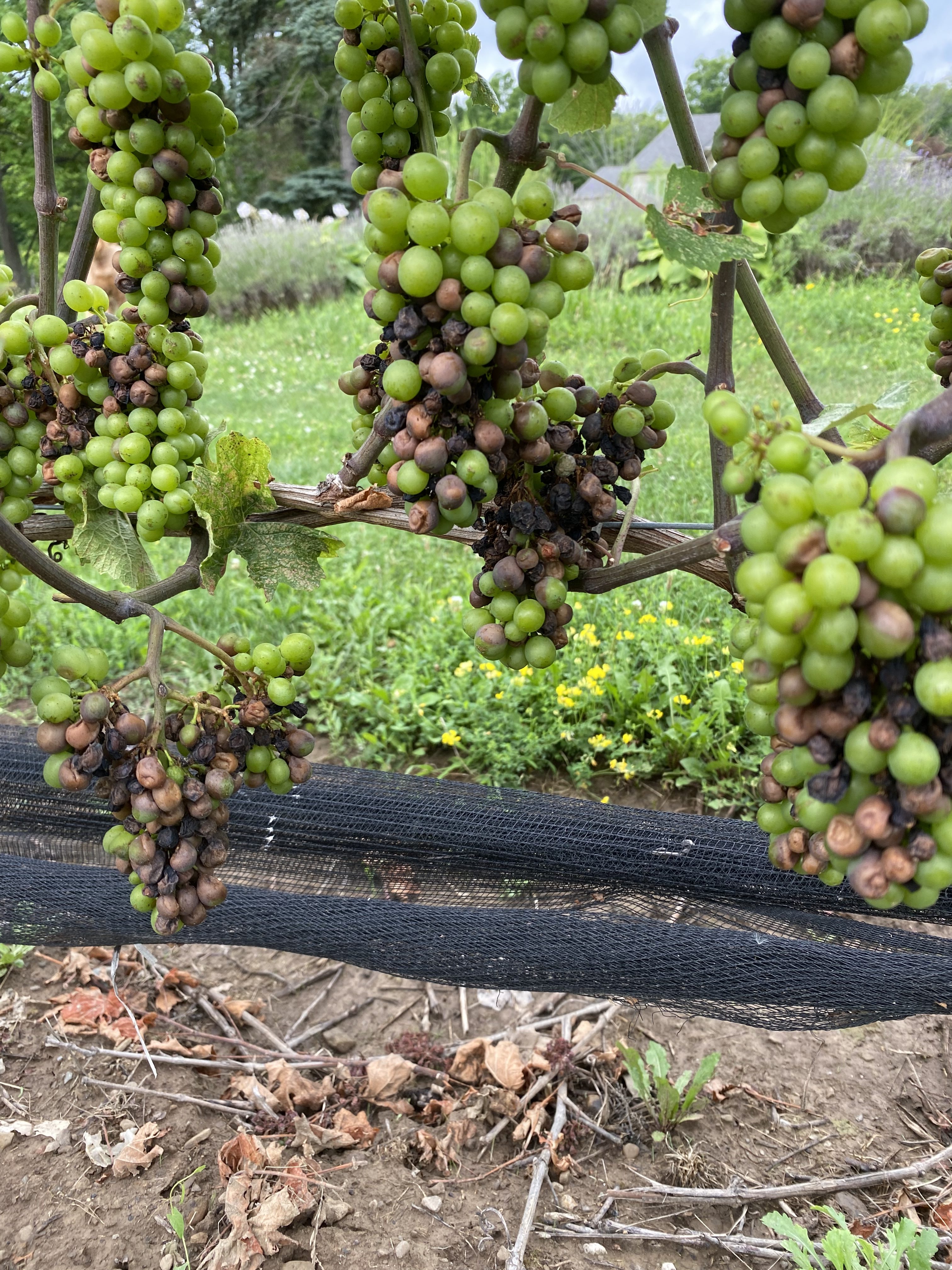
The frequent windy rains, high humidity and warm temperatures of the growing season have been optimal for the development of black rot and symptoms have become obvious in the past 2 weeks.
Table of Contents
Black rot last year, means inoculum this year
The black rot fungus overwinters in mummified grape berries, rachises and canes that were infected last year. Spores produced in these tissues can be wind borne (ascospores) or rain splashed (conidia) to infect leaves, shoots, tendrils and berries. The figure below shows infected debris (rachis and mummified berries) from the previous season that remained in the head and provided inoculum to infect this year’s growth.

The conditions for infection depend on temperature, rainfall and wetness duration. For release, ascospores require at least 3 mm of rainfall and conidia require 10 mm of rain. Infection occurs fastest with at least 6 hours of tissue wetness at 18.5 to 26.5°C. Above or below this temperature range, a longer period of wetness is required. Ascospores are wind dispersed and rain-splashed conidia can spread rapidly in wind-driven rain.
Berries are most susceptible to infection 3 to 5 weeks after bloom and susceptibility decreases until 6 to 7 weeks after bloom. Initial symptoms on berries are faded spots that rapidly turn brown within 24 to 48 hours. The surfaces become wrinkled and black pimple-like pycnidia develop and eventually the berries are completely mummified. The figure below shows berries at various stages of infection.

Young leaves and shoots are susceptible to infection. Symptoms first appear as small yellowish-tank spots on leaves.

Enlarged lesions have tan to dark brown centers. As the infection develops, tiny black dots appear in the lesion, usually in a ring pattern near the border of the lesion. These are pycnidia, which produce conidia.

Symptoms on shoots are oval with a dark margin and greyish centre.

Conidia (spores) are produced in the pimple-like structures on all infected tissues and these can spread black rot throughout the canopy if warm rainy weather persists. They require free moisture to release be released and an extended wetness period to infect. Wind associated with rain assists in the dispersal of spores. The disease cycle below shows how a black rot epidemic occurs (photo credit https://www.mdpi.com/2311-7524/9/2/130)

Based on data from eGrape weather stations, infection periods occurred May 28, June 29 and July 10-11. These were periods of heavy rain and warm temperatures followed by extended high humidity. If effective, locally systemic products were applied before these events, berries and foliage should have been protected. Berries should be resistant to future infections; however, infections that occurred late in the berry susceptibility period (July 10-11 infection period) could take longer to express so you may see what seem to be “new” infections that actually occurred 2 weeks ago.
If infected lesions with black fruiting bodies are present on berries, leaves or shoots, it is important to continue using products that have activity against black rot. While it won’t reverse infections on clusters, this will serve to reduce inoculum for next year.
For relative activity of fungicides see: Activity of Fungicides on Grape Diseases and Impact on Honeybees (gov.on.ca)
Sanitation is critical
If equipment is moving from a vineyard with black rot, it is recommended that all debris from equipment be removed to avoid further dispersal of black rot.
I’ve been able to find infected old rachises and berries in the head of vines as well as canes with black rot lesions in vineyards with severe black rot. It is critical that all infected debris be removed from vines before next spring. Research in Pennsylvania showed that when rachises and unharvested berries were dropped to the ground in October or November, the number of spores produced was significantly reduced compared to removal in January or March. While this may not be economical, in vineyards with severe black rot, it is a good way to avoid this problem again next year. If this is not practical, rachises, berries and canes with black rot lesions should be pruned out and either shredded and cultivated into the row middles, or completely removed and burned. Despite some rural myths, burning black rot does not spread spores.
Protect from early infections next spring
Next spring, make sure to use fungicides effective against black rot no later than 3 to 5 leaves. This will protect both leaves and shoots from infection. Maintain black rot protection until at least 4 weeks post bloom to protect fruit. For relative activity of fungicides see: Activity of Fungicides on Grape Diseases and Impact on Honeybees (gov.on.ca)
0 comments on “Why is black rot so bad in some Ontario vineyards in 2024?”