
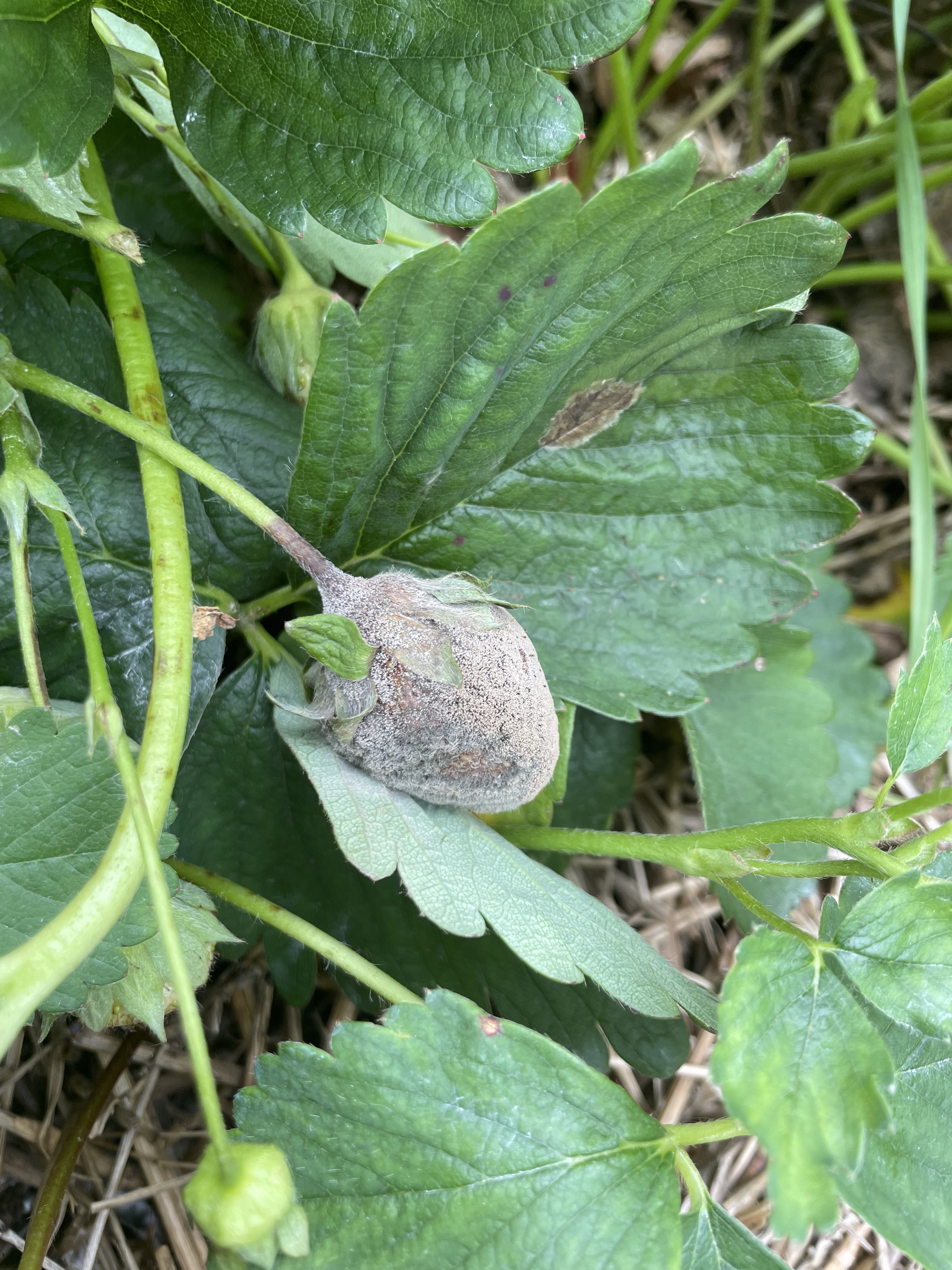
Botrytis grey mould is a widespread disease affecting strawberries in both field and covered production in Ontario. Botrytis grey mould can be caused by multiple species of Botrytis, with Botrytis cinerea being the most dominant species infecting strawberry in eastern North America.
Recently, a new species of Botrytis, B. fragariae, was identified on strawberry in the United States. Botrytis fragariae is more specific to strawberry, and seems to often cause blossom blight, as opposed to B. cinerea, which is detected more often as fruit rot and has over 200 crop hosts. Additionally, B. fragariae differs in fungicide susceptibility from B. cinerea, and fungicide resistance has been reported in both species, which could affect the level of disease control and management options.
In 2024 we began a survey to determine if the new species of Botrytis, Botrytis fragariae, was present in Ontario, and if so, it’s distribution in strawberries.
Through the 2024 season we visited 26 June bearing, day-neutral, and table top strawberry farms across the province, collecting infected flower buds, green fruit, and ripe berries. 66 botrytis samples were sent to the University of Guelph Agriculture and Food Laboratory to confirm the Botrytis species- B. fragariae or B. cinerea. All samples were identified as Botrytis cinerea.
The dominant species infecting Ontario strawberries still appears to be Botrytis cinerea. However, keep an eye on botrytis infections this season- look for blossoms turning brown early in the spring, which may indicate B. fragariae infection. The presence of B. fragariae may require growers to change their fungicide rotation. Botrytis cinerea is often resistant to thiophanate-methyl (group 1: Senator, Thief), fenhexamid (group 17: Elevate), boscalid (group 7: Cantus, part of Pristine), and cyprodinil (group 9: part of Switch, part of Inspire Super), while B. fragariae is less often resistant to these products (except for thiophanate-methyl), but more often resistant to fludioxonil (group 12: part of Switch and Miravis Prime), and polyoxin D (group 19: Diplomat). No resistance of B. fragariae to group 7s has been detected, including isofetamid (Kenja), fluxapyroxad (Sercadis, part of Merivon), penthiopyrad (Fontelis) and fluopyram (Luna products). Group 7s may be good options for either botrytis species.
General resistance management recommendations for botrytis include:
- Using broad spectrum/multisite fungicides when possible
- Use multiple FRAC groups that are active on botrytis in one application when possible
- Rotate fungicides between different active ingredients
- Limit the number of applications of a FRAC group per season
- Know the resistance profile on your farm
We are pursuing funding to continue running the strawberry disease decision support system in 2025. Check out the Strawberry Disease Decision Support System on the onfruit.ca blog this season for disease prediction models for anthracnose and botrytis.
Check out Strategies for Effective Management of Botrytis and Anthracnose Fruit Rot in Strawberries for an excellent summary of strawberry disease management from the mid-Atlantic. Note that some of the pesticides listed are not registered in Canada. Always read and follow the Canadian label. Check out the Ontario Crop Protection Hub for a list of fungicides registered for botrytis in Canada.
Whether the species causing botrytis grey mould is B. fragarie or B. cinerea, fungicide resistance is a concern. In addition to identifying the species present, identifying fungicide resistance in Ontario will allow growers to make informed decisions about product options and when to use them. Fungicide resistance profiles can differ between farms; testing for fungicide resistance will help individual growers choose effective fungicides and inform disease management priorities for the industry. The Berry Growers of Ontario have received funding through the Ontario Agri-Food Research Initiative, funded by SCAP, for Botrytis resistance testing for Ontario strawberry growers.
Strawberry samples will be collected and tested for Botrytis species and resistance to multiple fungicides:
Group 7s:
- Boscalid (Cantus, group 7 in Pristine)
- Fluopyram (part of Luna tranquility, group 7 in Luna Sensation)
- Pydiflumetofen (group 7 in Miravis Prime)
Group 9s:
- Cyprodonil (group 9 in Switch and Inspire super)
- Pyrimethanil (Impala, Scala)
Group 11s:
- Trifloxystrobin (Flint Extra, group 11 in Luna Sensation)
Group 17:
- Fenhexamid (Elevate)
Funding for this project is available in 2025 for 15 farms: first come, first serve.
If you are interested in participating in this project and receiving fungicide resistance profiles for your farm please contact Erica Pate, OMAFA, (erica.pate@ontario.ca) or Victoria Buma, BGO, (research@ontarioberries.com) for instructions on collecting and submitting samples.
Participating growers will receive fungicide resistance profiles for their farms and Botrytis species identification. Generalized survey results will be shared with the berry industry.
References:
Dowling, M.D., M.-J. Hu, and G. Schnabel. 2017. Identification and characterization of Botrytis fragariae isolates on strawberry in the United States. Plant Disease. 101:1769–1773.
Dowling, M.D., M.-J. Hu, and G. Schnabel. 2018. Fungicide resistance in Botrytis fragariae and species prevalence in the Mit-Atlantic United States. Plant Disease. 101(5): 964–969.
Fernández-Ortuño, D., F. Chen, and G. Schnabel. 2013. Resistance to cyprodinil and lack of fludioxonil resistance in Botrytis cinerea isolates from strawberry in North and South Carolina. Plant disease. 97 (1): 81–85.
Fernández-Ortuño, D., A. Grabke, P.K. Bryson, A. Amiri, N.A. Peres, and G. Schnabel. 2014. Fungicide resistance profiles in Botrytis cinerea from strawberry fields of seven southern U.S. states. Plant disease. 98 (6): 825–833.
Hu, M.-J., K. Cox, and G. Schnabel. 2016. Resistance to increasing chemical classes of fungicides by virtue of ‘selection by association’ in Botrytis cinerea. Phytopathology. 106 (12): 1513–1520.
0 comments on “Determining Botrytis species in strawberries”