



Production and pest update brought to you by the OMAFA Apple Team:
Erika DeBrouwer, Tree Fruit Specialist and Kristy Grigg-McGuffin, IPM Specialist
Table of Contents
Grower Grind
Across the province growers continue to hand thin, irrigate, manage pests and prepare for harvest! Early cultivars in the southwest regions are quickly approaching harvest timing. Further, the sun continues to shine meaning protection for you and your fruit is pertinent!
Growth Stages
Terminal bud set continues. Be sure to provide your trees with enough nutrients and water necessary to aid in floral induction.
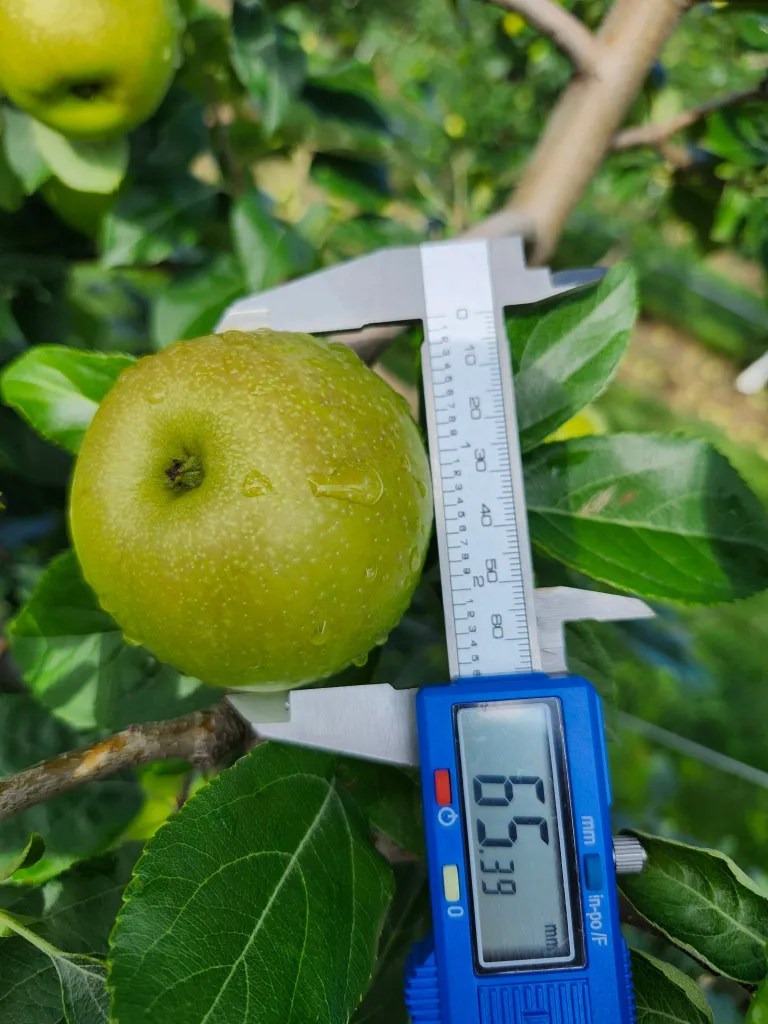
At the Simcoe Research Station, fruitlets and terminals are sitting at the following:
Honeycrisp | Ambrosia | Gala | |
|---|---|---|---|
Fruitlet Size | 66.0 mm | 54.6 mm | 53.0 mm |
Terminal Growth | 28.6 cm | 27.2 cm | 33.7 cm |


Rain, Rain, (Don’t) Go Away
Noting the low precipitation that continues across the province (Figure 1), be sure to provide water to your trees, not only to enable fruit size, but also to encourage resilience to heat stress.

Maps of current agroclimate conditions – Agriculture and Agri-Food Canada
SPF: Sun’s Pretty Fierce
As we get closer to harvest be sure to consider the potential for sunburn on apples. Sunburn can occur at various temperatures and is affected by many environmental factors.
Sunburn can be more damaging if there is a week of cool, windy, overcast weather followed by a hot (over 30°C) calm day with full sunshine.
Water stressed trees are even more prone to sunburn damage.
Types of Sunburn
Type of Sunburn | What Is It? | How Does It Happen? | What Happens to the Fruit? |
|---|---|---|---|
Sunburn necrosis (Fig 1A&B) | When the fruit surface temperature exceeds 50°C for as little as 10 minutes, causing cell death. | Caused by excessive heat and is exacerbated by low humidity. | Cell death occurs, causing brown or black lesions. |
Sunburn browning (Fig 1C&D) | Combination of UV-B radiation and high fruit surface temperature causing degradation of cell membranes. Sunburn browning can contribute to storage/delayed sunburn. | Typically occurs between fruit surface temperatures of 45 – 49°C, although this can change based on the variety (i.e. Honeycrisp is more sensitive than Red Delicious or Braeburn). Higher risk occurs between the hours of 11am and 5pm when maximum daily air temperature and mean maximum hourly temperature are high. | Yellow, bronze or brown spot develops on the sun-exposed side of the peel but may not appear for a few days. |
Photo-oxidative sunburn (Fig 1E&F) | Shock exposure to visible light due to light intensity, which can occur at low temperatures (17°C). | Risk factors include hand thinning, tree training, selective picking, summer pruning, branch movement and postharvest transit. Photo-oxidative sunburn has been seen in the province where areas that have had ‘overcast’ conditions due to the smoke, with a sudden break and intense sunlight could have led to fruit sunburn. | Bleaching and eventual darkening of the peel. |
Storage sunburn | Symptoms develop after harvest within the first few months of cold storage. | Exposure to excess heat and light stress during the growing season. | Fruit appears normal at harvest but develop brown discolouration during storage. |

Strategies to Mitigate Sunburn
Adequate Moisture
Frequent, shallow watering during heat waves helps maintain soil moisture near the root zone in high-density systems. Use drip irrigation for precision and efficiency. Consider pulse irrigation to avoid water stress midday. This allows trees to continue natural physiological growth patterns.
- Under Tree Mulching: organic mulches (e.g., straw, wood chips, spray on mulches – paper fibre) can help retain soil moisture and reduce surface temperature.
Field Activity Adjustments
Delay non-urgent tasks like pruning or heavy equipment use to cooler periods. Avoid stress-inducing sprays during peak heat.
- Summer pruning: delay if possible and only perform on cool days with 3 or 4 days of cool weather following.
- Harvest management: fruit should be moved quickly out of the sun, preferably into storage as soon as possible.
Monitoring & Record-Keeping
Use soil moisture sensors and weather stations to make timely decisions. Track GDDs and stress days to refine your response year to year.
Nutrient Support
Ensure adequate potassium and calcium to help with plant stress tolerance and fruit integrity. Foliar feeds may be used when uptake through roots is impaired.
Evaporative Cooling
Use overhead sprinklers or misters during peak heat hours to reduce canopy and fruit surface temperatures. Especially useful to prevent sunburn on fruit.
Protective Netting
Overhead netting that reflects/absorbs sunlight can reduce the impact of sun on exposed fruit. Colour of the net can influence growth, colour and quality of fruit (positivity or negatively), but can also prevent wind and/or hail damage.
Sunburn Protection Products
Apply fruit protectant, kaolin clay or calcium carbonate sprays to reflect sunlight and lower fruit surface temperatures. These often require reapplication, but can be utilized for spot treatments.
*Most sunburn protectants (kaolin clay, calcium carbonate) have limited compatibility for tank-mixing with other products; consult product labels regarding best practices for product use.
End of the Line
As trees begin to set terminal buds, you can breathe a small sigh of relief – at least when it comes to some insect and disease pressure. Terminal bud set signals the end of shoot growth, and with that comes a shift in how we approach orchard pest management.
Many insects such as aphids and apple leafcurling midge target young, tender growth and move elsewhere or become less of a threat once shoots harden off. Be sure not to let root suckers get away from you though – these pests will just move down to this new growth.
Diseases respond to this shift as well. Movement of fire blight within a shoot slows down significantly after terminal bud set, since the bacteria rely on active growth to spread. Powdery mildew is also closely tied to new shoot growth, needing actively growing tissue to infect and loses momentum once elongation stops. Watch for late season reversal and new shoot growth that sometimes occurs as mildew risk will pick back up again. A reminder though, fruit cannot be affected by powdery mildew at this stage. Fruit infection occurs over bloom.
Fly Time
Apple maggot have been caught throughout the province. Emergence is closely linked to soil moisture with flushes in flight often following periods of significant rainfall loosening soil. Those areas receiving good amounts of rain with the events rolling through may see a flush of apple maggot emergence in the coming days to weeks. On the other hand, those areas that have seen little to no rain over the last weeks may see a delayed emergence of this pest. Apple maggot has the ability to remain in the soil until conditions are right.
With catch on yellow sticky boards, it is important to differentiate between male and female adult flies. Males generally begin emerging before the females, but by peak emergence (August), the sex ratio is about 1 to 1.

(Photo: Dr. Rob Smith, retired, AAFC Kentville)
Timing for management depends on the type of trap:
- Sexually immature males and females are attracted to the yellow sticky boards, which mimic nectar sources. Insecticides are not needed until 7-10 days after first fly, particularly a female, is captured.
- Sexually mature females ready to lay their eggs are attracted to red spheres, which mimic ripe apples and indicate an insecticide should be applied immediately as damage is imminent.
For more information on registered products or those with efficacy against apple maggot, see Apple Maggot on Ontario Crop Protection Hub.
Imidan has worked well for years as a border spray option for many growers. However, with the new label changes, all hand thinning activities must be finished before Imidan can be used. The main reason why Imidan can be used effecively as a border spray is its activity as a contact adulticide, killing adults as they fly into the orchard from surrounding areas. Not all alternative products registered for apple maggot have this same activity and therefore are not recommended in a border spray program.
In the table below, adapted from Dr John Wise at Michigan State University (2021), summarizes the characteristics of apple maggot products. Organophosphates (Imidan) and neonicotinoids (Assail, Calypso) are the only insecticide groups that have strong long-lasting activity on the adults as well as a curative effect on the eggs and larvae due to their ability to penetrate into the flesh of the fruit.
Summary of Insecticides Used to Control Apple Maggot
Chemical Group | Life-Stage Activity | Efficacy | Residual Activity | Mite Flaring Potential |
OP (1B) | Egg Larva Adult | Excellent | 14+ days | Low |
Pyrethroid (3) | Adult | Fair-Good | 7-10 days | High |
Neonicotinoid (4A) | Egg Larva Adult | Good – Excellent | 10-14 days | Low-Moderate |
Spinosyn (5) | Adult | Fair | 7-10 days | Moderate |
Diamide (28) | Adult | Fair-Good | 10-14 days | Low |
Surround | Adult (deterrent) | Fair | 7-10 days | Low |
Beetlemania Continues
Japanese beetle populations have been quite high in many orchards. Check out the July 11th ‘What the Crop?! Apple Update’ for management strategies.
The Second Wave Crawls In
Based on the degree day model, crawler emergence for second generation San Jose scale has started in the earliest areas of the province.
San Jose scale degree day accumulations based on March 1st biofix and base temperature 10C
| Region | Current Degree Day Celsius (DDC) | Predicted Crawler Emergence 2nd Gen (806 DDC) |
|---|---|---|
| Harrow | 903 DDC | on-going |
| London | 743 DDC | July 29 |
| Delhi | 836 DDC | on-going |
| Grimsby | 799 DDC | July 25 |
| Clarksburg | 640 DDC | 14+ days |
| Durham | 696 DDC | 14+ days |
| * as of July 24, 2025 |
Damage from the 1st generation crawler activity can be found. Those that have a history of damage from this pest may want to consider managing the 2nd generation to prevent fruit damage close to harvest, especially since activity can continue well into September.


For more information on registered products or those with efficacy against scale, see San Jose scale on Ontario Crop Protection Hub.
For good resistance management, always rotate to a different chemical group than what was used for the earlier generation.
As mentioned earlier, crawler activity is typically 4-6 weeks. In previous years, I have seen new scale damage on Ambrosia at the end of September. Applying two consecutive sprays 14-days apart will extend the length of coverage to avoid this late-season damage. However, be aware of the preharvest interval particularly on any early varieties.
If you are planning to make one application only, you may want to consider holding off a week or two from start of predicted emergence timings to target peak crawler activity. There is the possibility of fruit damage occurring during the gap in spray timing, particularly in a year like this where generations may be overlapping.
Small But Mite-y
The hot, humid weather has resulted in an increased activity of European red mite (ERM), two-spotted spider mite (TSSM) and apple rust mite (ARM) in some orchards. Those growers that are seeing populations reach threshold quickly are opting for miticides with relatively quick knock-down.
Keep in mind – larger, established trees can withstand higher thresholds for mites throughout the season as the tree canopy becomes more dense. Be cautious of large populations on younger or less vigorous trees.


When choosing a product, consider the abundant life stages that are present in your orchard. For instance, if you are seeing mainly eggs, Envidor may be an option as it is slower acting. However, if the population is mainly nymphs or adults, you may opt for a product that offers a faster knock-down. Products like Nealta or Kopa should be applied as populations are building.
For more information on registered products or those with efficacy against mites, see Mites on Ontario Crop Protection Hub.
Despite the lush, dense foliage this time of year, do not let mite populations cause extensive damage. Late-season mite pressure and leaf bronzing can result in poor fruit finish and reduce winter hardiness.