
By Kathryn Carter, OMAFA
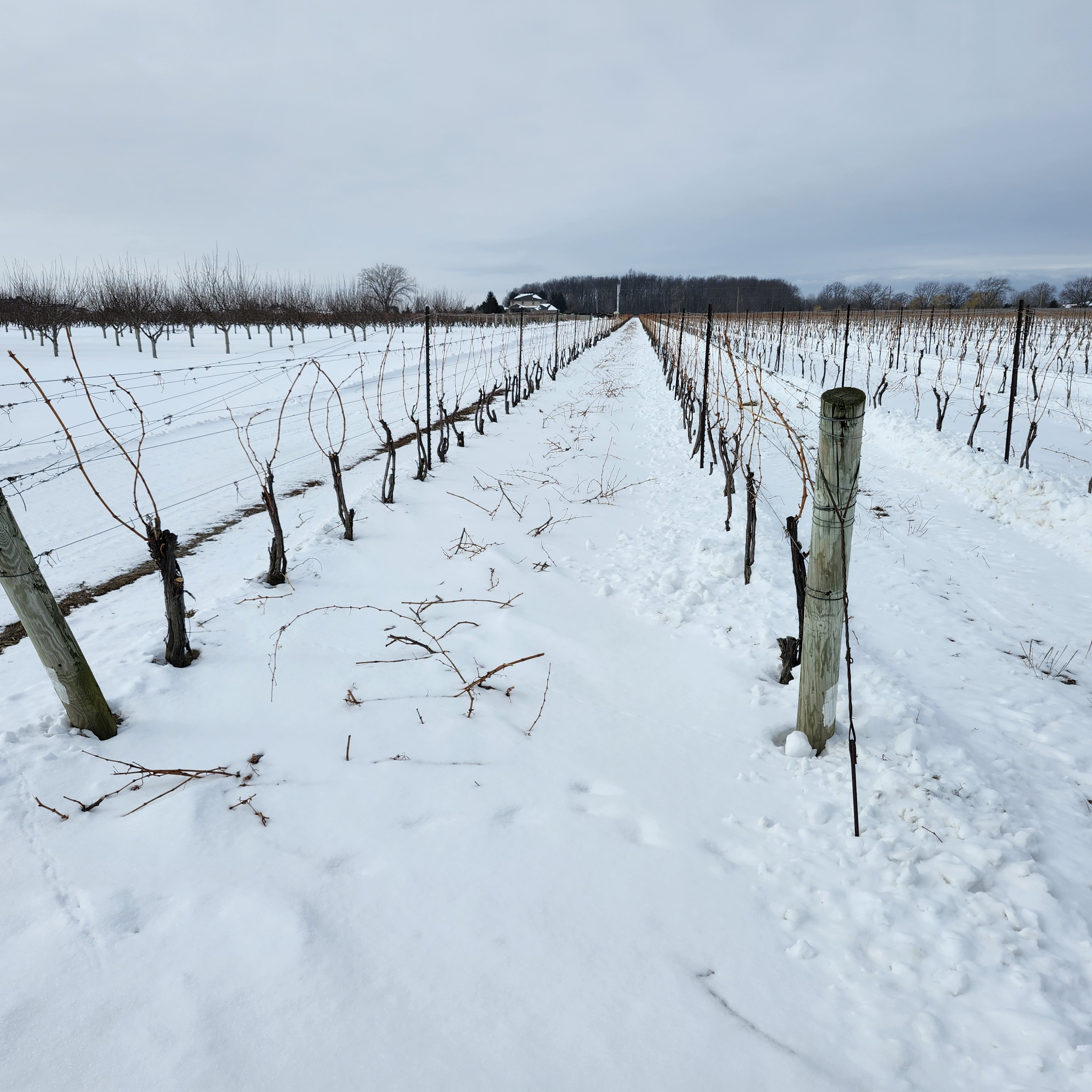
Winter 2025-26 has been a return to a classic Ontario winter, with long stretches of freezing temperatures, and frequent snow events. By early February Lake Erie had reached nearly 100% ice coverage, its highest level since the late 1990’s, while Lake Ontario was roughly 34% ice coverage. As ice cover increases, the Great Lakes lose their influence on air temperatures, heightening the risk of cold injury in vineyards.
Ontario has already experienced several significant cold events this winter, with temperatures in some regions dropping to -23 °C or lower. With additional cold weather likely before the spring, now is an ideal time to review best practices for assessing and managing cold injury in vineyards.
Table of Contents
What is cold injury?
Cold injury in grape vines occurs when temperatures drop below the threshold (maximum cold hardiness) that the vine can tolerate, resulting in damage to bud, canes, or vascular tissue (trunk). Injury can occur in the late fall, winter or in the spring (frost) and can lead to reduced yields, non-uniform crops maturation, structural damage to the vine and vine stress. Severe cold injury may kill the vines outright, while chronic damage to woody tissue can shorten a vine’s lifespan and increase susceptibility to diseases such as crown gall.
How do grape vines prepare for winter?
As temperatures decline in the fall, grapevines begin to acclimate in preparation for the winter. During this phase water content in vine tissues decreases, and the concentration of cryoprotectants (sugars) increase, enhancing the vine’s ability to withstand cold temperatures. Continued exposure to increasingly cold temperatures improves the cold hardiness of the vine, until the vines reach their maximum cold hardiness in mid-winter. Extreme cold events where temperatures drop below the vine’s maximum hardiness level result in cold injury.
In late winter and spring, warm temperatures can trigger de-acclimation, as vines gradually lose their cold hardiness and transition from dormancy to an active state in the spring. At this stage the vines are more susceptible to sudden drops in temperature, or a return to cold temperatures that would have been harmless in midwinter.
What factors impact cold hardiness?
Many factors can reduce the cold hardiness of a vine including:
- Cropping level: Excessively high or low crop loads the previous season
- Vine health: Weak or diseased vines
- Vine vigour: Vigorous vines with bull wood or canopy shading
- Growing season: Warm or wet falls which can delay cold acclimation or reduce maximum cold hardiness
- Site: Temperature, winds, and air drainage will vary within and between vineyards
- Water: Drought stress, or excess water (poor drainage, or excess rainfall in the fall)
- Vineyard management: Excessive leaf removal, and excessive or late season hedging
- Training systems: Systems that produce fruit closer to the ground (VSP) have increased risk of exposure to cold air.
- Species, cultivar and clones: Maximum midwinter cold hardiness for buds of Vitis vinifera is usually around -23° C, while European hybrids (Baco noir, or North American hybrids (Frontenac) is -25° to -28°C. Some cultivars are less cold hardy (Merlot), while others (Baco noir) de-acclimate early increasing their susceptibility to cold injury in the spring. Clone and rootstocks can also have an impact on cold hardiness.
- Pruning practices: Making large cuts (cordons and trunks) during dormant pruning (cordons and trunks) removes carbohydrates and sugars reserves, decreasing cold hardiness. Pruning 24 to 48 hours prior to extreme cold events (<-18° C) creates fresh wounds that can be more susceptible to cold injury.
- Age of vine: Young vines are more susceptible to cold injury due to their smaller root systems, and high vigour growth that can delay cold acclimation.
Cold injury
Generally woody tissue such as trunks, canes and cordons are more tolerant of cold temperatures than dormant buds or roots. Damage to wood tissue may not become apparent until the summer when stress from heat, drought, excessive crop load, or the demand of maturing a large crop causes weakened vines to collapse.
Buds are more susceptible to cold injury than woody tissue. Each grape vine bud is a compound bud consisting of three buds: primary, secondary and tertiary buds. The primary bud is the most fruitful, but also the most vulnerable to cold injury. The secondary bud usually serves as a back up, if the primary is killed, and it produces smaller and fewer fruit clusters. Tertiary buds have the highest cold tolerance, but will only produce leaves and shoots, and are a last resort for the vine to survive.
Assessment
In vineyard blocks where damage is suspected it is important to assess primary bud survival for each cultivar prior to pruning. Pruning without evaluating bud survival can lead to reduced yields, increased labour costs, and unbalanced vines, which can have long- term impacts on vine health and profitability. Primary bud survival (Figure 1) is used to guide pruning decisions as they provide the most accurate estimate of yield potential.
Select one cane per vine from 10 to 12 different vines for each cultivar. Ensure the sample is representative of the block. If there is considerable variation in vine size or topography, collect additional samples from each area. Choose canes that could reasonably be retained for tying in the spring and originating from the arm–do not select lateral shoots. Prune off the selected cane, then count 12 to 15 buds up from the base of the selected cane and remove the upper portion of the cane. Buds near the base of the cane are typically the hardiest and are most representative of next year’s crop potential.
If the freeze event occurred recently, hold the selected canes at room temperature for 24 to 48 hours to allow the buds to thaw, which makes cold injury (browning) easier to detect.
After 48 hrs, cut each bud horizontally using a sharp razor blade to remove the top one third of the bud, exposing the primary bud. Look for green tissue which indicates the primary bud is alive, or brown/black tissue indicating it is dead (Figure 1). Record the # of dead and live buds for each cane and each cultivar/block, as well as the position of the live/dead buds on the cane.

Figure 1 Bud cross section showing damaged secondary bud with primary and tertiary alive. (Willwerth et al, 2014)
Pruning strategies after cold injury
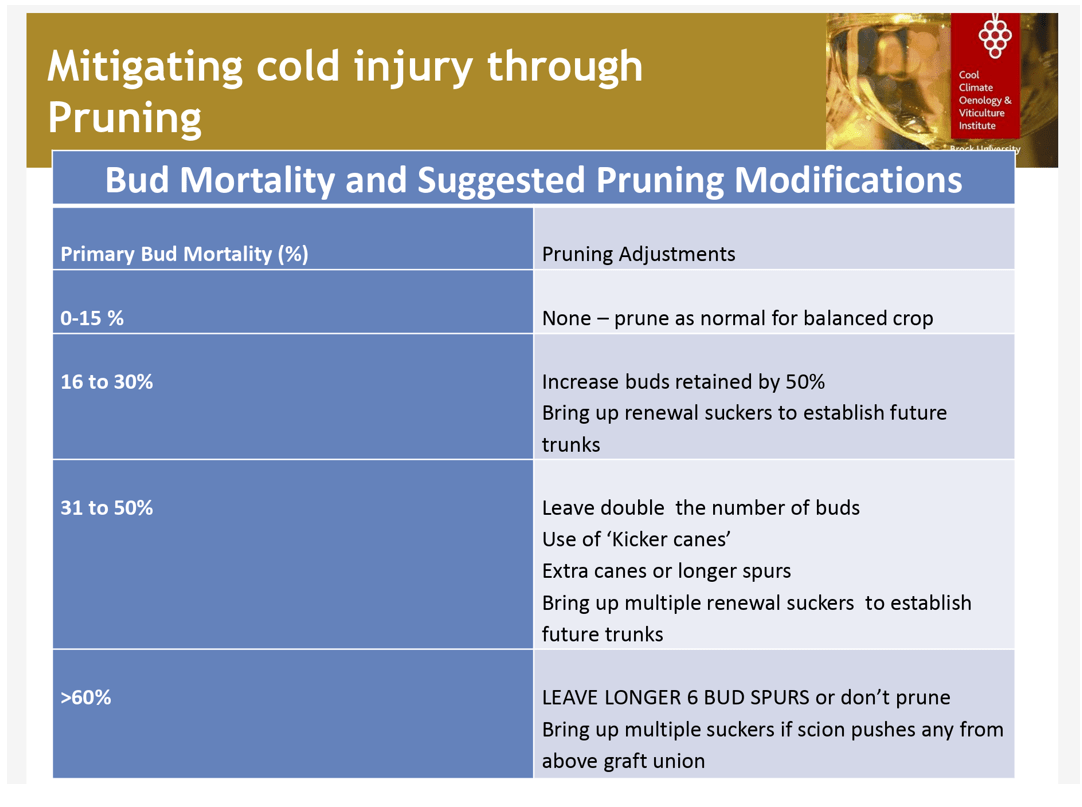
Understanding the bud mortality in a vineyard provides the opportunity to adapt pruning strategies accordingly as shown in Table 1. If bud mortality is <15% prune normally. If bud mortality is 16%-50% consider leaving more buds or an extra cane during pruning to increase the chances of producing a crop. Avoid overcropping injured vines by assessing crop loads on a vine‑by‑vine basis rather than by yield per acre.
When bud mortality is high (>60%), focus on renewing cordons or trunks to support stronger growth and future productivity. Remove damaged wood, as it can serve as an entry point for pathogens. On vines with significant vascular tissue damage, base buds (latent buds) near the base of the trunk or pruning cuts have the potential to produce new shoots. These can be used to increase the number of shoots per vine, preventing excessive vigour (bullwood) in established vines with large root systems and good carbohydrate reserves (permanent wood). After cold injury, the priority is to keep vines alive, healthy, and minimize stress.
Table 1 Pruning Modifications for cold injured grape vines (Willwerth, 2014)
Conclusion
Ontario is a cool-climate grape growing area and cold injury has a significant impact on fruit productivity, quality, and longevity of the vine. Evaluate cold injury in vineyard blocks where cold injury is suspected prior to pruning to help mitigate cold injury.
Currently it is difficult to predict the full impact of cold injury on crop yields and vine health. If the primary bud dies, sometimes the secondary bud may have survived the cold injury and may produce a reduced crop. Cold injury is cumulative, and a series of cold events that result in small amounts of cold injury, can build up over the winter to result in significant injury.
Where cold injury has occurred, it is important to focus on keeping vines alive, healthy, and minimizing stress.
Sources
Hébert-Haché, A., Inglis, D., Kemp, B., & Willwerth, J. J. (2021). Clone and rootstock interactions influence the cold hardiness of Vitis vinifera cvs. Riesling and Sauvignon blanc. American Journal of Enology and Viticulture, 72(2), 126–136. https://doi.org/10.5344/ajev.2020.20025
Ker, K., Brewster, R., & Willwerth, J. (2014). Dealing with cold injury to grapevines. Research-Dealing-with-Cold-Injury.pdf
Sabbatini, P. (2014). Pruning severely winter-damaged grapevines in Michigan – MSU Extension. Michigan State University Extension.
Willwerth, J., Der, K., & Inglis, D. (2014). Best management practices for reducing winter injury in grapevines.
Willwerth, J. (2014). Recovering from cold symptoms: Grapevine cold hardiness and mitigating the effects of freeze injury.
0 comments on “Assessing cold injury grapes”