
By Kathryn Carter, Fruit Specialist (Tender fruit and Grape), OMAFA
What is cold injury?
Cold injury occurs when grape vines are exposed to temperatures below their maximum cold hardiness threshold. When this happens, buds, canes, or vascular tissue of the trunk can be damaged.
What are the symptoms of cold injury?
Bud Injury: Cold injury to buds can significantly impact yields. Bud survival assessments are the best tool for evaluation potential crop loss. Both the number of buds, and type of buds (primary, secondary or tertiary) that survive can impact yield.
- V. vinifera cultivars generally have poor productivity on secondary buds, often producing 25% or less of a normal crop.
- French-American hybrids usually have greater secondary bud fruitfulness and may produce up to 50% of a crop.
The full extent of injury becomes clear at budbreak, when it is easier to distinguish whether surviving buds are primary (highly fruitful), secondary (less fruitful, with fewer and small clusters), or tertiary (fruitless). Vines with high levels of bud damage may respond with a flush of basal suckers in the spring. Weak, stunted, or uneven shoot development (Figure 1 a) can also be an indication that vascular tissue of the vine (cordon or trunk) has been badly damaged. There is increased risk of trunk injury in vines that have with high levels of bud injury (>80%).
Trunk and cane injury: Cane injury is often visible during pruning, appearing as browning of the xylem and/or phloem. Trunk damage is the most difficult to assess as damage to the internal vascular tissues in the trunk may not result in visible symptoms until vines collapse later in the season when stressed by high temperatures, water stress, or the demands of supporting a crop.
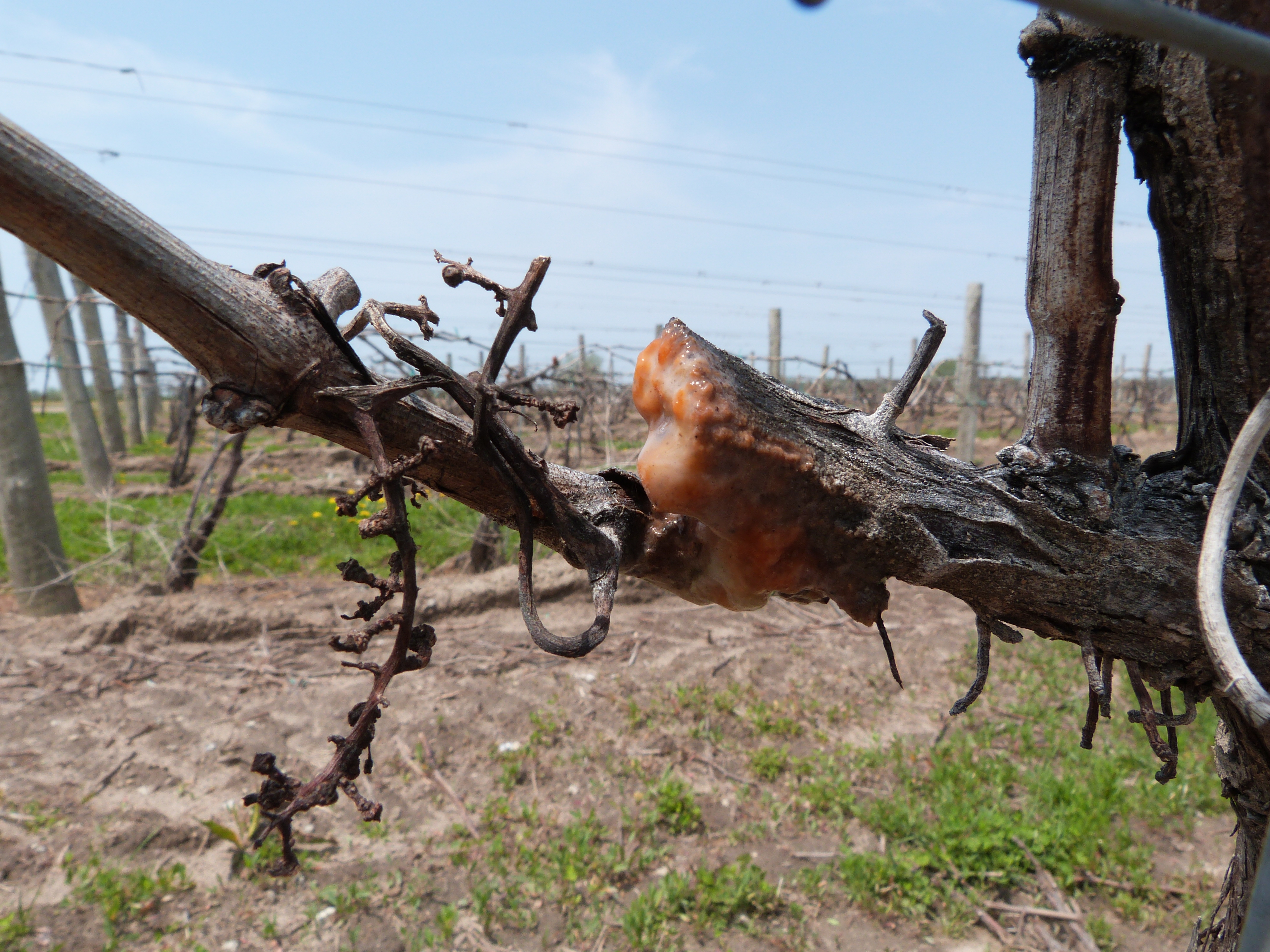
Visible symptoms of trunk injury include trunk splitting, discolouration of the wood, or the presence of orange, slimy growth on pruning wounds in the spring. Injured vines may also show poor or uneven growth along the cordon in the spring. When cordons fail to push shoots in the spring (Figure 1b), cut them back to the head of the vine (where the trunk and cordon meet). Green or cream coloured tissue indicates living tissue; brown tissue indicates injury. If the xylem and phloem are dead, the trunk has been severely damaged and should be replaced. Older vines with trunk injury may fail to produce suckers and require replanting.

Figure 1.a) Cold injured buds on grape vine (arrows indicate dead buds)
Managing cold injured vines
Cold injury rarely occurs uniformly across a vineyard block, which complicates pruning, training and vineyard management and results in increased labour costs.
Document damage before making decisions: Arrange for crop insurance to inspect and document the injury before removing vines or cutting back trunks.
Adjust pruning and crop load: Use bud survival counts to modify your pruning practices accordingly. Adjust the crop load on a vine-to-vine basis according to the level of cold injury and vine health. Avoid over-cropping cold injured vines—this increases the risk of vine collapse and delays long term recovery.
Trunk Renewal: If bud damage is close to 100%, or trunk injury is suspected, retain approximately five healthy suckers that arise from the scion (not the rootstock) at the base of the trunk for possible trunk replacements. They will help to manage excessive vigour (bull wood) and distribute the excess energy stored in the vine’s root system. It’s important to tie up suckers up so they’re off the ground. Suckers can break off easily before they harden off, so leave more than you think you need to ensure that you have enough.
Protect these suckers from herbicide injury, by using grow tubes. Remove the grow tubes in late summer or early fall to allow enough time for the shoots to acclimate for the winter. A vine with no sucker growth even at the base of the vine, is likely dead. While it may be tempting to remove trunks immediately when bud mortality exceeds 90%, the trunk tissue may still be alive. Removing the trunk when not required can increase the time and costs required to get into fruit production. Unless physical damage is obvious, delay trunk removal decisions until closer to bud break. Dead trunks can be retained temporarily as they provide support for the suckers used for trunk renewal.
Where shoot growth appears weak or uneven in the spring, retain a few suckers that can be used to renew the trunk. Older vines that fail to break bud or produce suckers will need to be replaced,
Things to consider
Vine growth: Vines with reduced crop load, will produce more vegetative growth this season, which can lead to the production of bullwood, which is less fruitful and more susceptible to cold injury. Additionally excess vigour can increase shading which can reduce the number of fruitful buds for next years crop and make disease management more challenging. Leave enough shoots to help distribute the growth potential and minimize excess vigour. N fertilizer applications should be reduced or eliminated to help reduce excess vigour in damaged vines. Adjust your sprayer to make sure fungicides reach the sucker leaves and shoots.
Symptoms of cold injury or crown gall: Continue to monitor for symptoms of cold injury throughout the growing season (vine collapse). Cold injury can also activate latent crown gall infections which will start to become evident around July. Often galls appear near the graft union, trunks or cordons, and can appear the year the winter injury occurred, or in subsequent years. Foliar symptoms of crown gall are similar to trunk injury: stunted shoot growth, wilting and eventual collapse during the heat of summer. Cold injury can also predispose vines to trunk infections and can mask underlying trunk disease symptoms.
Vines health: Even without a crop, it is important to manage disease pressure in the vineyards and ensure vines are healthy and reduce stress. Maintain appropriate shoot density and shoot positioning to maintain airflow through the canopy and manage disease pressure. Reduce stress to vines by irrigating as required.
Multiple trunks: Using double or multiple trunks for cold tender vines especially in high-risk locations.
Plan before replant: Prior to replanting blocks of vines with cold injury, take the time to assess the site, variety and training systems as well as cold mitigation strategies.
0 comments on “Managing vines after cold injury”