
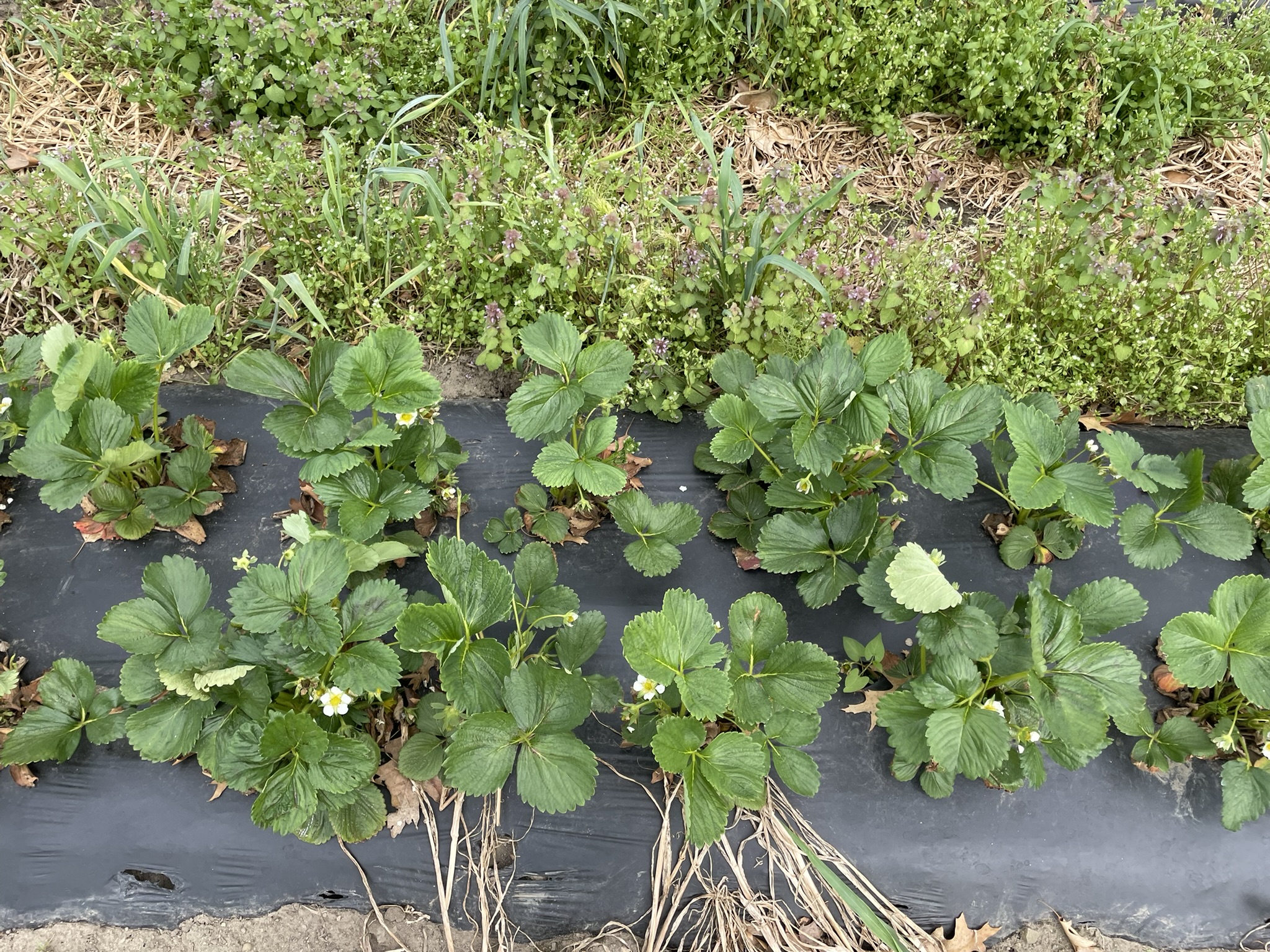
Weed management for strawberry growers may be a little bit different in 2026. For some areas in Ontario, early snow in 2025 meant that mulch was not put down or the window to apply Chateau was missed. If this applies to you, what should you do now?
First, if you were not able to apply mulch, the generous snowfalls last winter likely helped minimize damage from cold temperature, since snow is an excellent insulator. However, if you did not apply a pre-emergent herbicide in the fall, you should plan on an early spring application. A post-emergence application may still be necessary, but the residual effect of the pre-emergent herbicide from a spring application will last longer into the growing season and might delay the timing of any post-emergence herbicide applications.
The best time for a pre-emergent herbicide application is shortly after you remove the mulch (or if you did not add mulch, when soil temperatures reach 5 °C) before weeds start to emerge. Many of the pre-emergence herbicide options for fall application can still be applied in early spring, just be aware of the preharvest interval (PHI). For example, during a fruiting year, Goal 2XL (oxyfluorfen) (group 14) can only be applied in fall before mulching due to a 150 day PHI. There is one big caveat, most herbicides, like Chateau EZ (flumioxazin) (Group 14), can only be used one time per season. So, if you use Chateau EZ now, you are not able to apply it again in the fall before you put down mulch. Also, strawberry plants are generally more sensitive to spring applications of Sinbar WDG (terbacil) (group 5) than they are to fall applications. Sinbar WDG should only be used if strawberry plants have over-wintered well. The lower rate of Sinbar WDG will result in less crop injury for more sensitive cultivars, like Kent, Mira, Bounty, Annapolis, Glooscap, and Cavendish. Other spring pre-emergent options are:
Product | Active ingredient | WSSA group | PHI (days) | Notes |
Authority 480 SC | sulfentrazone | 14 | 70 | Max of one application every 48 months |
Devrinol 2-XT | napropamide | 15 | – | Do not apply from bloom to harvest |
Dual II Magnum | s-metolachlor | 15 | 30 | Consult your supplier for information on the tolerance of specific strawberry cultivars to Dual II Magnum |
For effective springtime pre-emergent sprays:
- Ensure mulch has been completely removed from the rows as leaf litter or straw in the field at application may result in reduced control.
- Check the forecast as cool wet conditions increases the risk of crop injury.
- If strawberry plants are out of dormancy, use a spray hood to reduce any contact with the plants.
- Most products require rainfall after application to be activated but you want to avoid extreme rain events, so check the forecast.
- Always consult the most up to date product label to ensure you are following all the requirements.
Again, you may have to follow up the early spring pre-emergent spray with a post-emergence spray. Remember that some products, such as Venture L (fluazifop-p-butyl) (group 1) should not be applied within 2 weeks of applying Sinbar WDG.
If this year will be the last season that the field will be harvested, remember to check the product label for rotational restrictions. This is especially important for spring herbicide applications. For more information on herbicide persistence and rotational restrictions, see this blog post by Cesar Cappa (Weed Management Specialist – Horticulture) and Kris McNaughton (Horticulture IPM Specialist).
Herbicide resistant weeds have been identified in the province. It is important to rotate between products with different groups and to monitor your fields after spraying. For more information on the distribution of herbicide resistant weeds and weed resistance testing in Ontario, see this newly launched interactive database. If you suspect that weeds in your field are resistant, there is resistance testing that is available at no cost to you! If you suspect herbicide resistance in your field, contact Cesar Cappa (cesar.cappa@ontario.ca), Weed Management Specialist – Horticulture, or Jason Lemay (jason.lemay@ontario.ca) Fruit Crop Specialist – Berries (Acting).
0 comments on “Weed management for strawberries in 2026”