Have You Registered? IPM Workshops Start Next Week
The 2026 Integrated Pest Management (IPM) workshop series is just around the corner. REGISTER NOW to secure your spot!
Our first session, Introduction to IPM, kicks off next week, launching another season of practical, science-based learning designed to support scouts, growers, advisors, and industry professionals across Ontario. Whether you’re new to IPM or looking for a refresh, this workshop series provides valuable tools you can apply right away in your crop.
To register, please follow the registration link or call the Agriculture Information Contact Centre at 1-877-424-1300.
This is an introductory workshop that covers the basic information that scouts need to know. Topics that will be covered: the importance of integrated pest management, disease causal agents, symptoms and damage of insects and mites, scouting for weeds in horticulture crops, pesticide safety, soil diagnostics, symptoms of nutrient deficiencies, tissue sampling, invasive species and farm visit biosecurity. Other scouting workshops will build on this information and will be tailored to the specific crops.
Workshop Leader – Denise Beaton
Location – In person (Auditorium, Ontario Crops Research Centre – Simcoe, 1283 Blueline Rd., Simcoe ON)
Over this 3 hour virtual workshop, participants will learn about the basics of apple IPM, common pests to look out for over the season as well as orchard scouting tips and tricks. This is a condensed version of the in-person workshop, ideal for those looking for a refresher.
Workshop Leader – Kristy Grigg-McGuffin
Location – Virtual (link will be provided after registration)
Reference materials will be provided to attendees
Pre-recorded presentations posted on Apple IPM Resources. Come with pest-specific questions for Q&A.
This in-person workshop will cover the basics of apple IPM, identification and biology of common pests, as well as proper orchard scouting techniques. Portions of this workshop will be held outdoors, weather permitting.
Workshop Leader – Kristy Grigg-McGuffin
Location – In person (Auditorium, Ontario Crops Research Centre – Simcoe, 1283 Blueline Rd., Simcoe ON)
In-person spaces are limited so registration is restricted to potato scouts only. All other attendees are asked to register for the concurrent hybrid Zoom meeting.
Production and pest update brought to you by the OMAFA Apple Team: Erika DeBrouwer, Tree Fruit Specialist and Kristy Grigg-McGuffin, IPM Specialist
Grower Grind
Across the province, growers are in the later stages of pruning. No reports yet of any winter damage. The significant rainfall over the last 7-10 days has left soils saturated, making it difficult to get sprayers through without lightening the spray load. Despite the challenges, critical sprays are still getting on where they can. Meanwhile, apple staging has substantially changed over the past week due to warm temperatures.
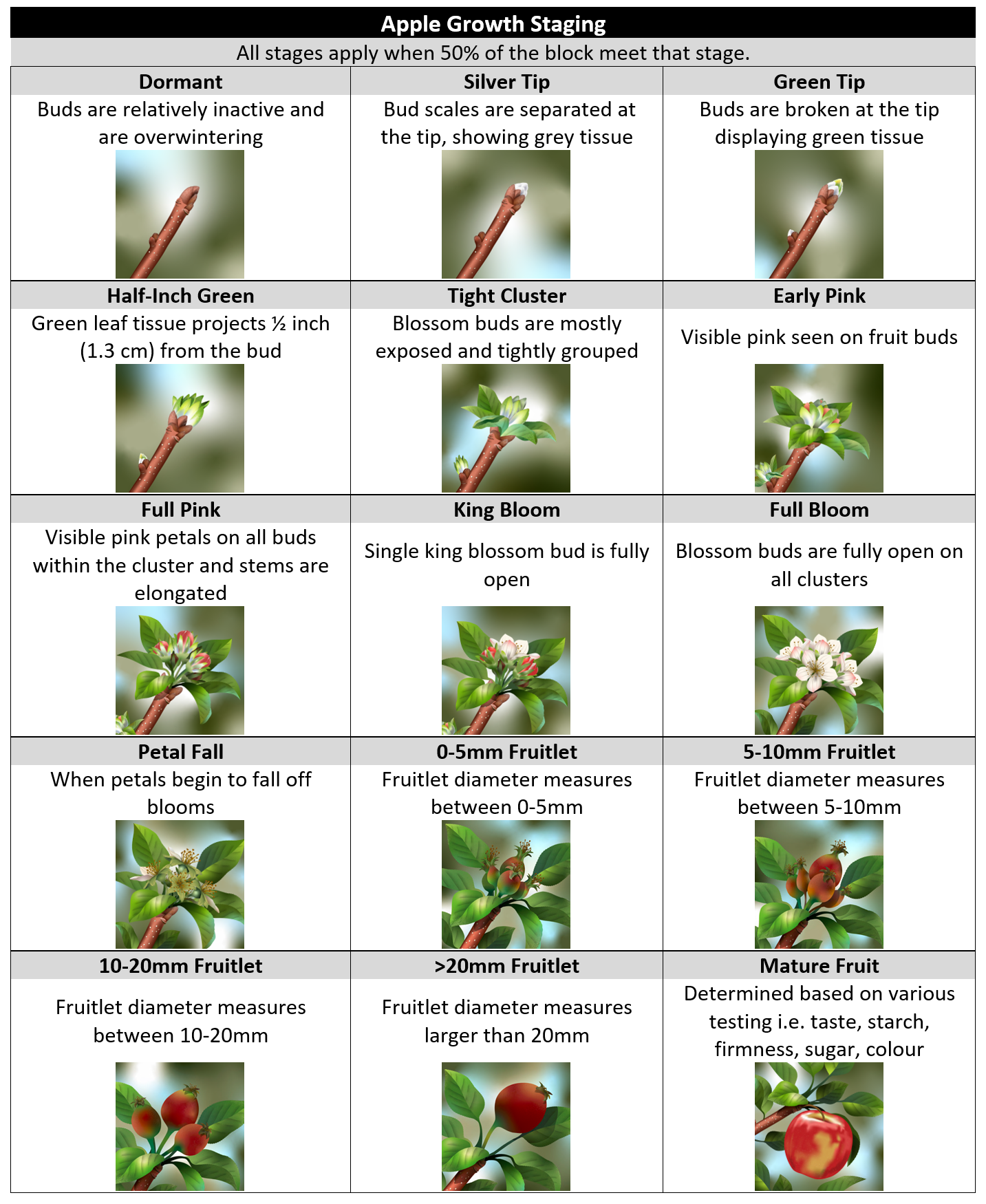
For a reminder of apple growth stages:
Growth Stages
Recent warm daytime and nighttime temperatures have really pushed development in early growing regions. Across the province, we are seeing the following growth stages:
Essex – Tight cluster to early pink
Chatham-Kent – Quarter-inch green to early tight cluster
Lambton, Middlesex, Elgin – Quarter-inch green to early tight cluster
Norfolk – Quarter-inch green to early tight cluster
Brant, Wellington – Green tip to half-inch green
Niagara – Half-inch green to early tight cluster
Grey – Green tip
Durham, Northumberland and Quinte – Green tip to half-inch green
Ottawa Valley – Green tip
Frosty the Threshold
Cool nights may be upon us in the near future (hopefully, not too cool). Here is a refresher chart, along with resources for frost mitigation and assessment.
Silver Tip
Green Tip
1/2 inch Green
Tight Cluster
First Pink
Full Pink
First Bloom
Full Bloom
Post Bloom
10% kill
-9.4
-7.8
-5.0
-2.8
-2.2
-2.2
-2.2
-2.2
-2.2
90% kill
-16.7
-12.2
-9.4
-6.1
-4.4
-3.9
-3.9
-3.9
-3.9
This chart also shows the temperature that will kill 10 % and 90 % of normal fruit buds. These numbers were taken from Washington (WSU), Michigan (MSU) and North Carolina (NCS) Extension Bulletins. Apple – WSU EB0913
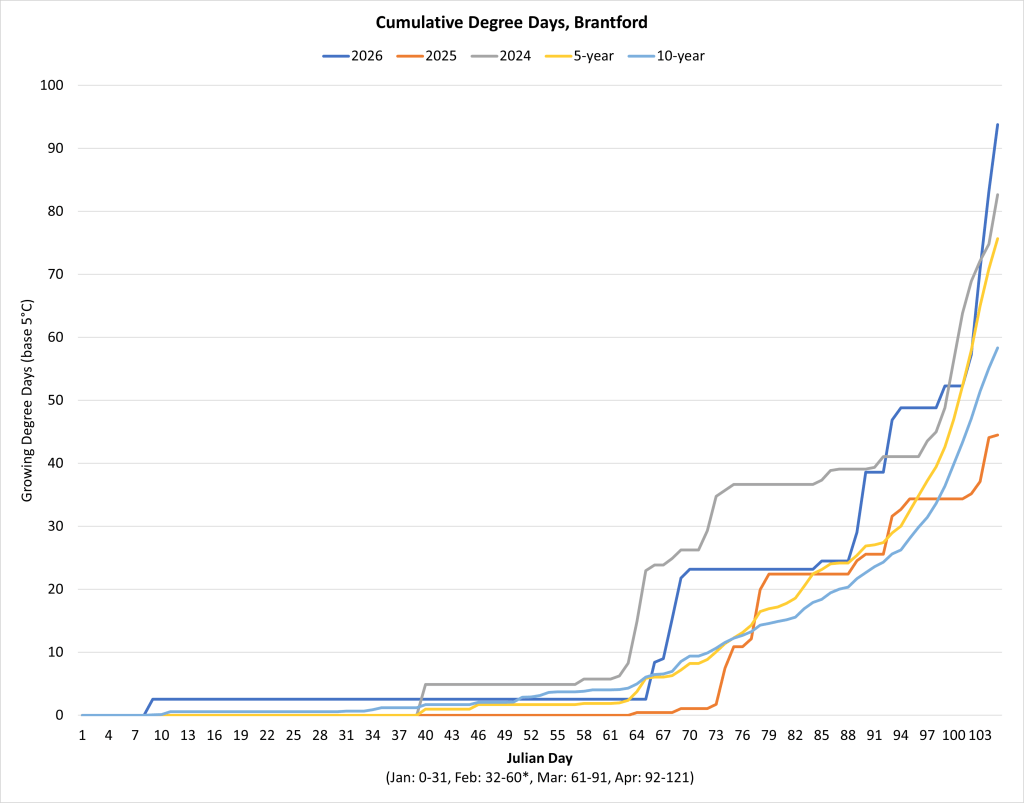
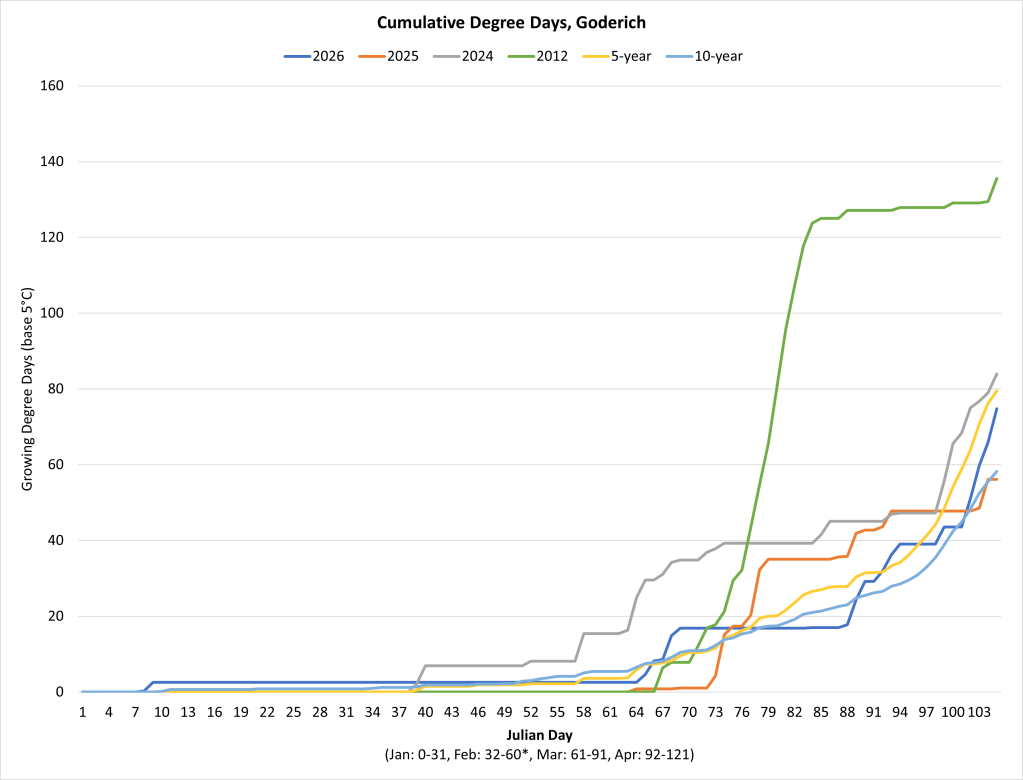
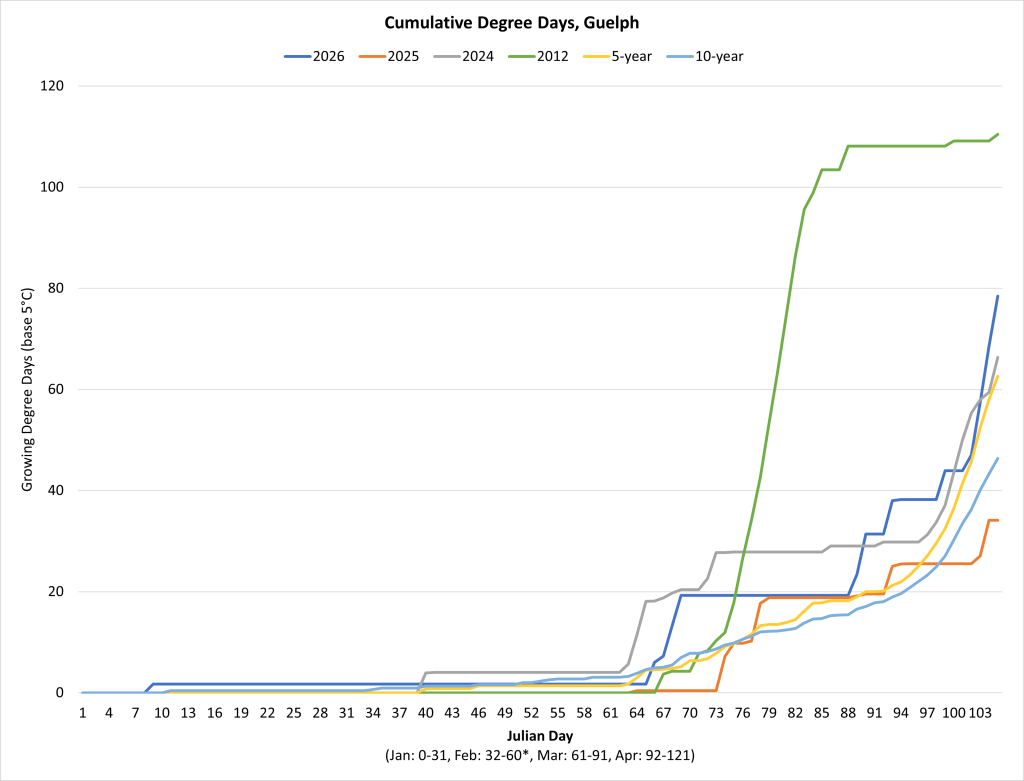
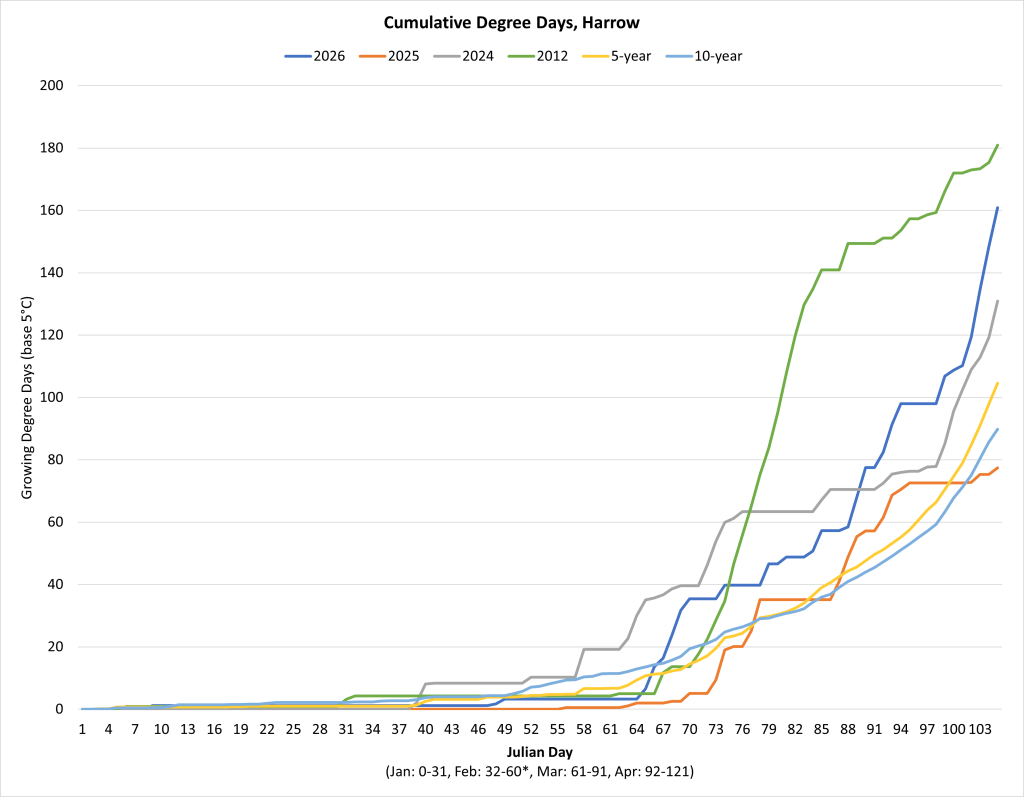
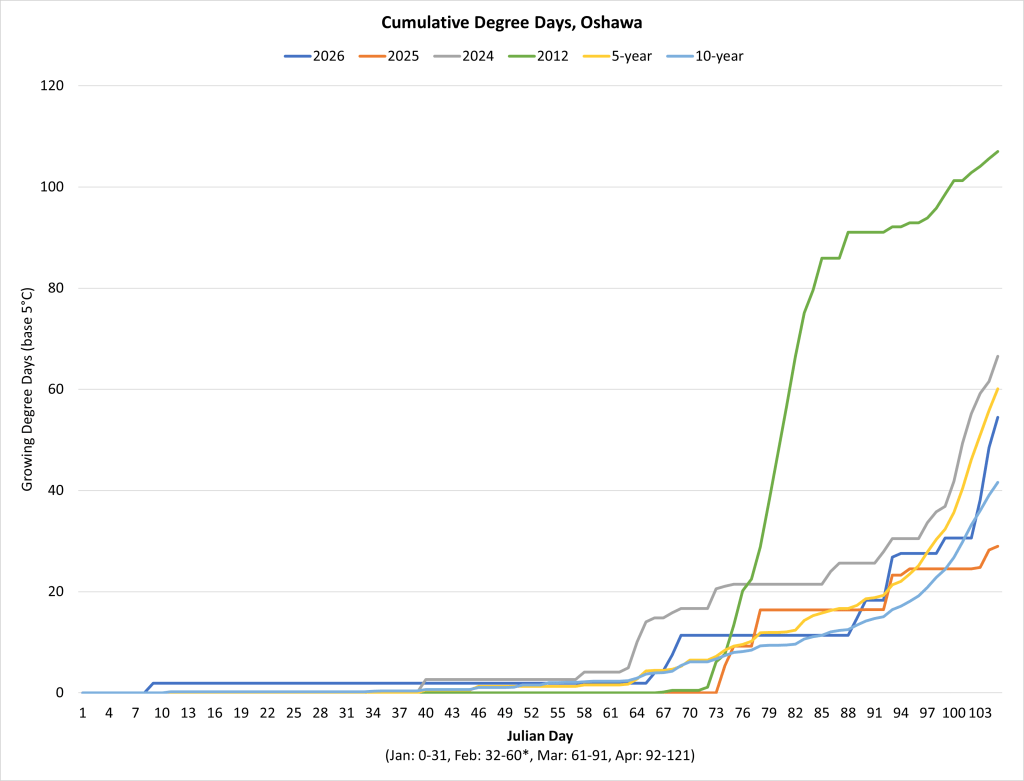
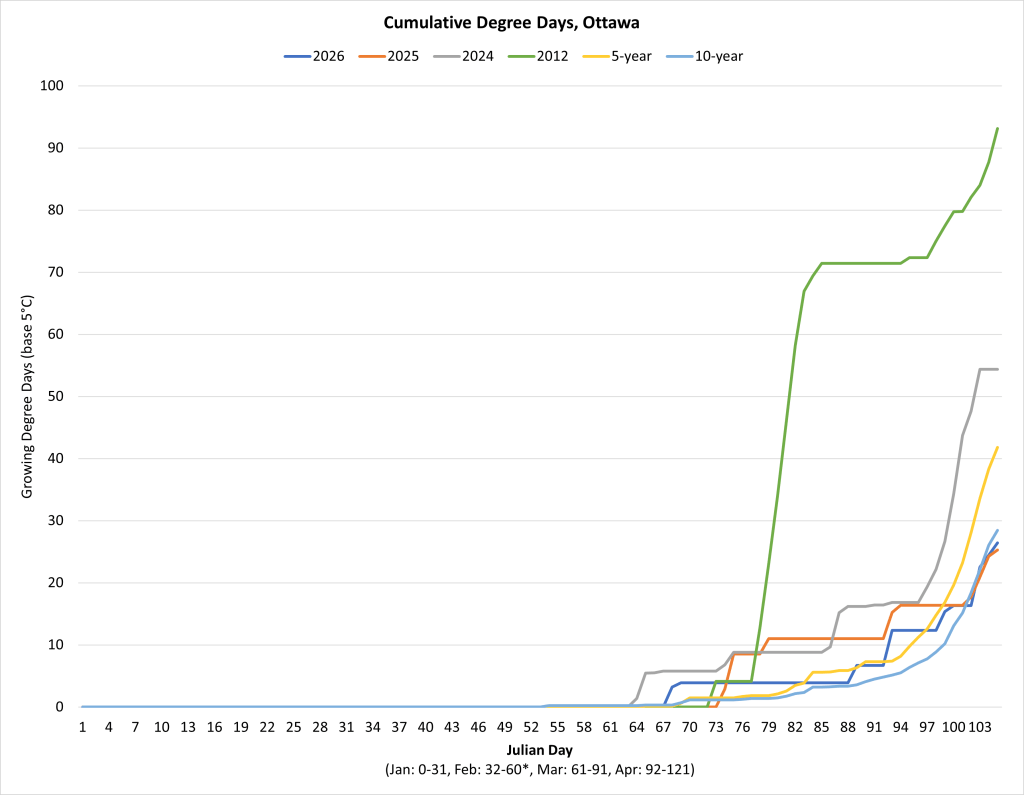
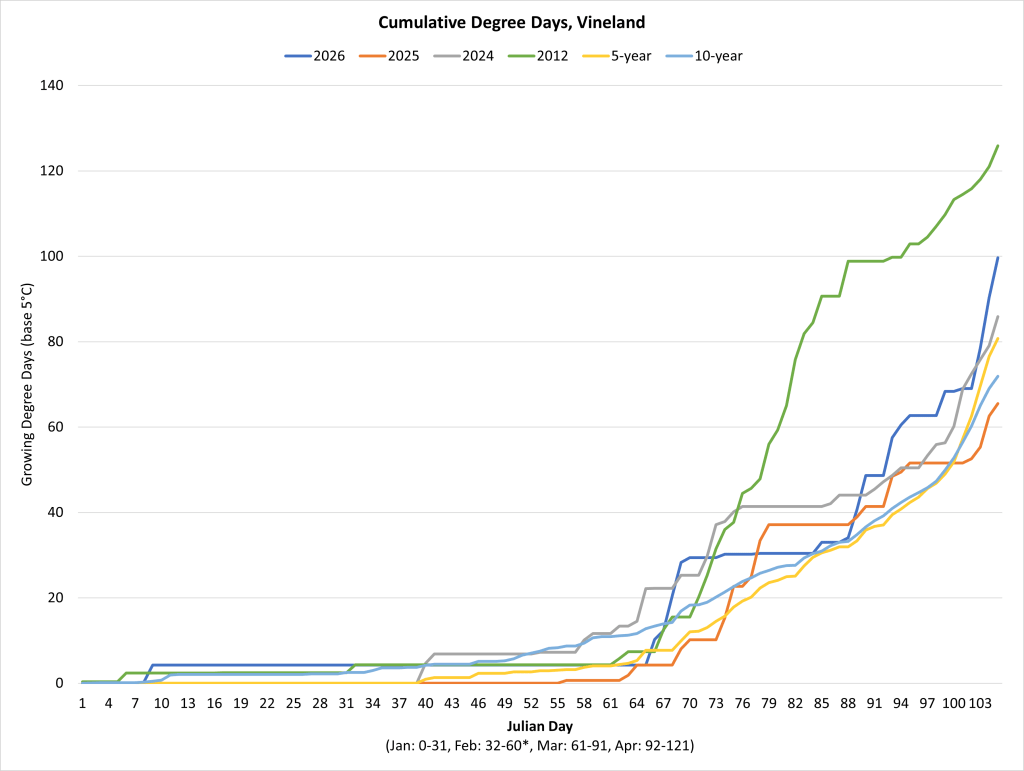
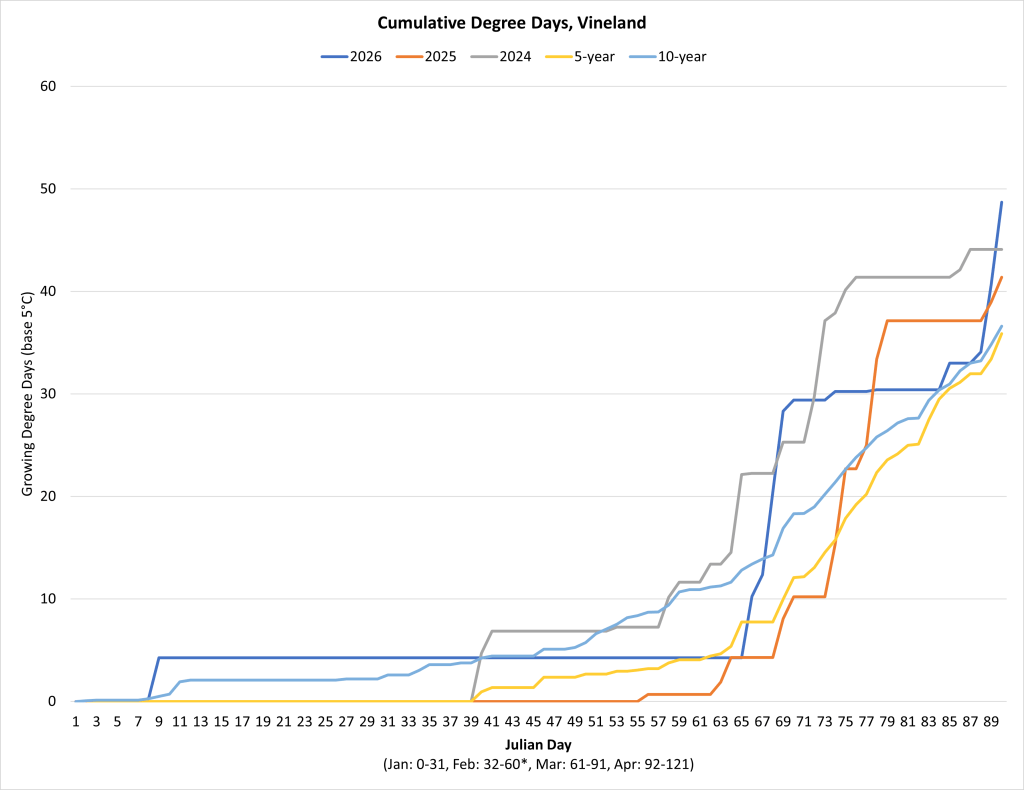
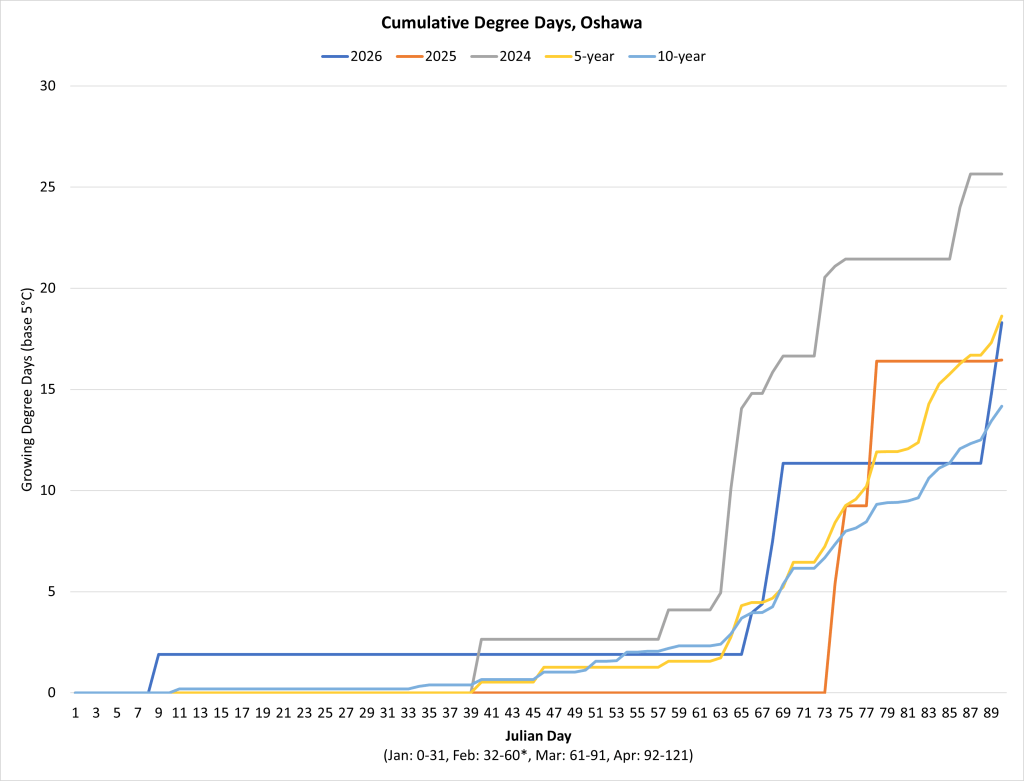
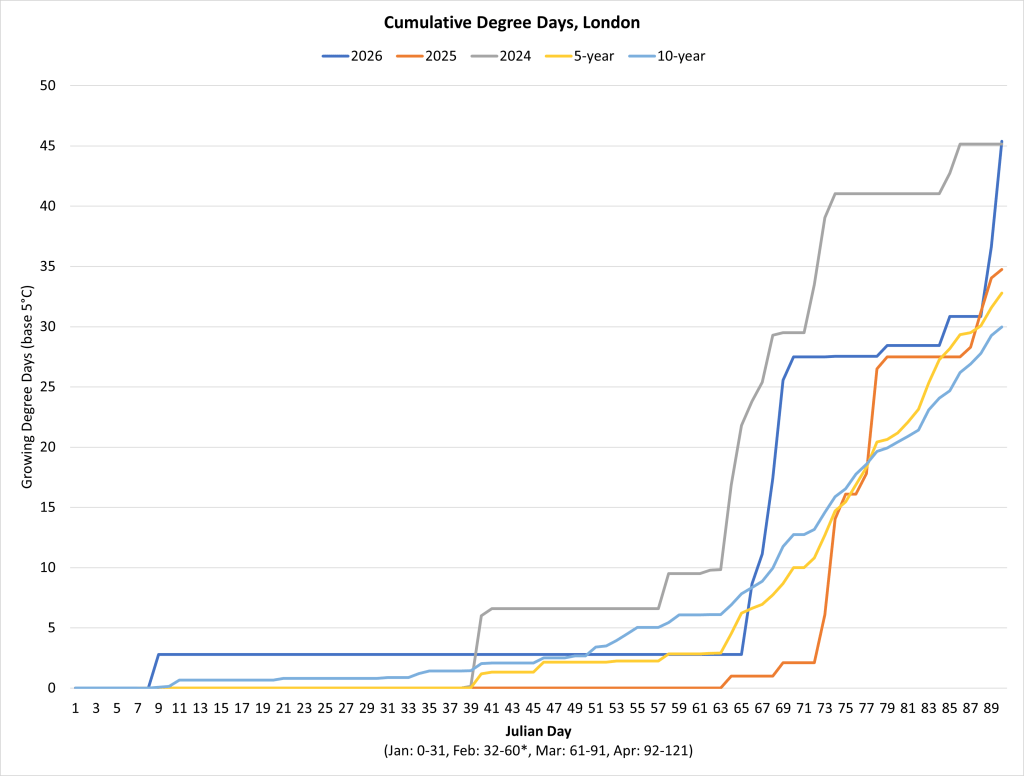
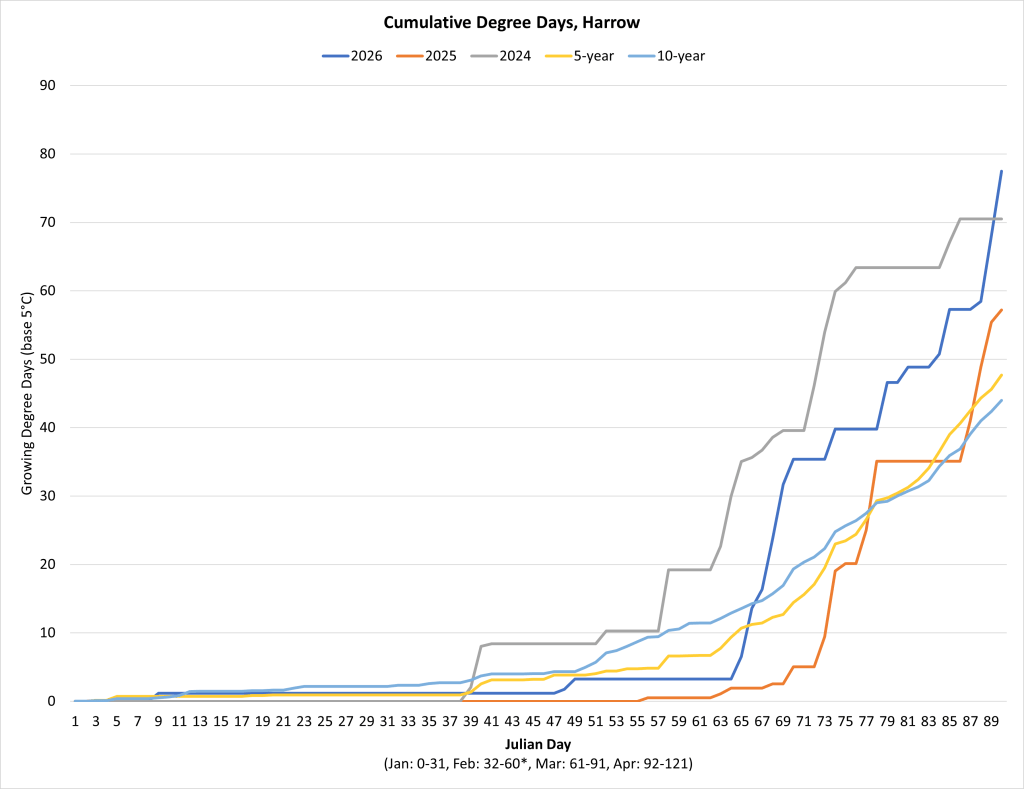
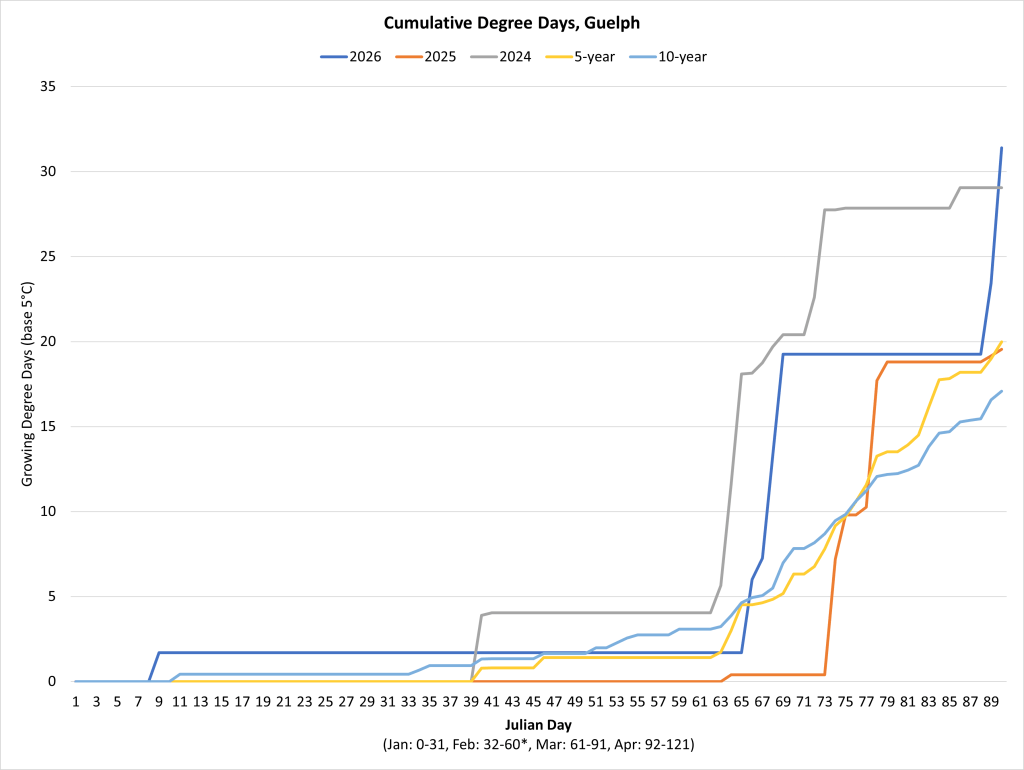
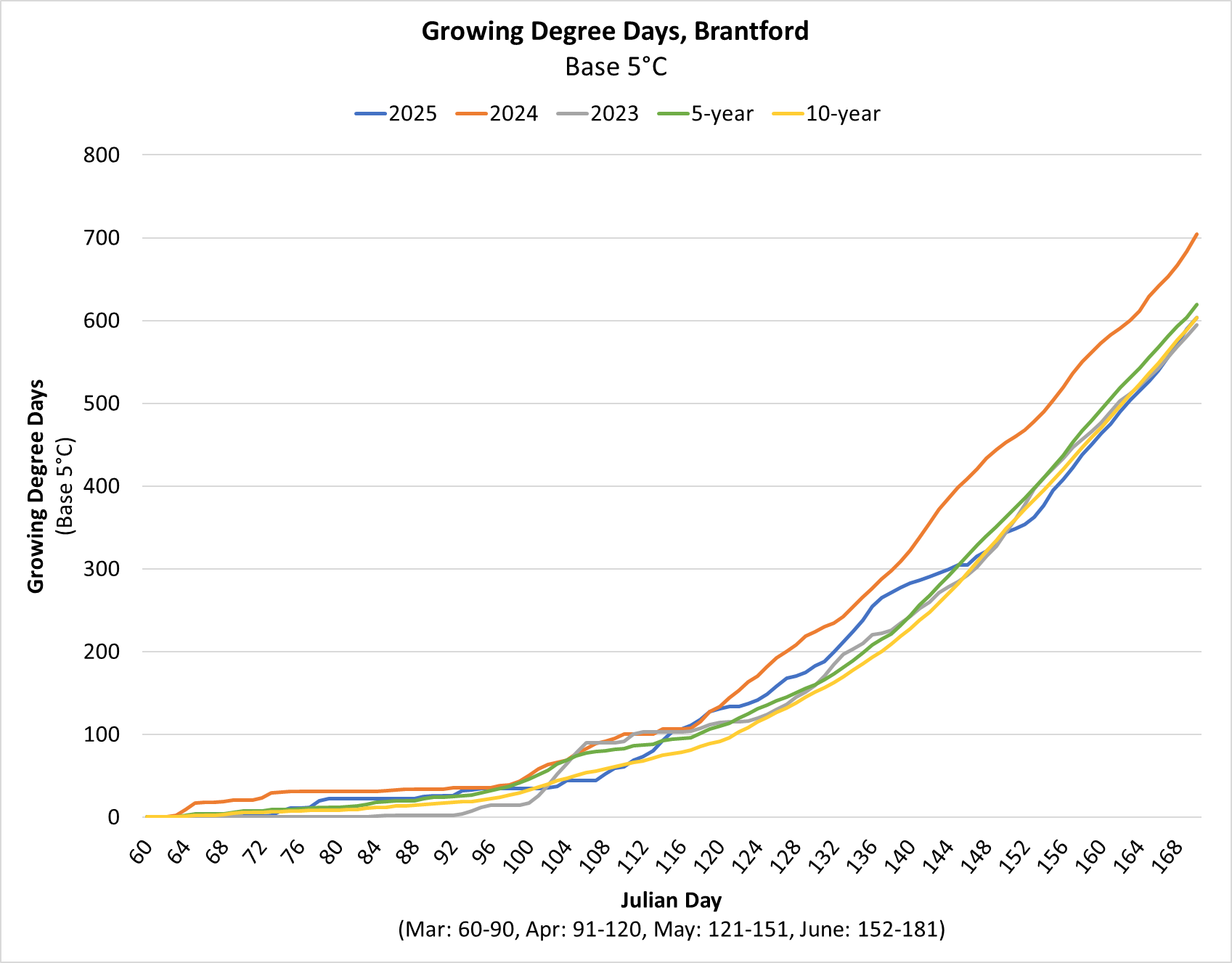
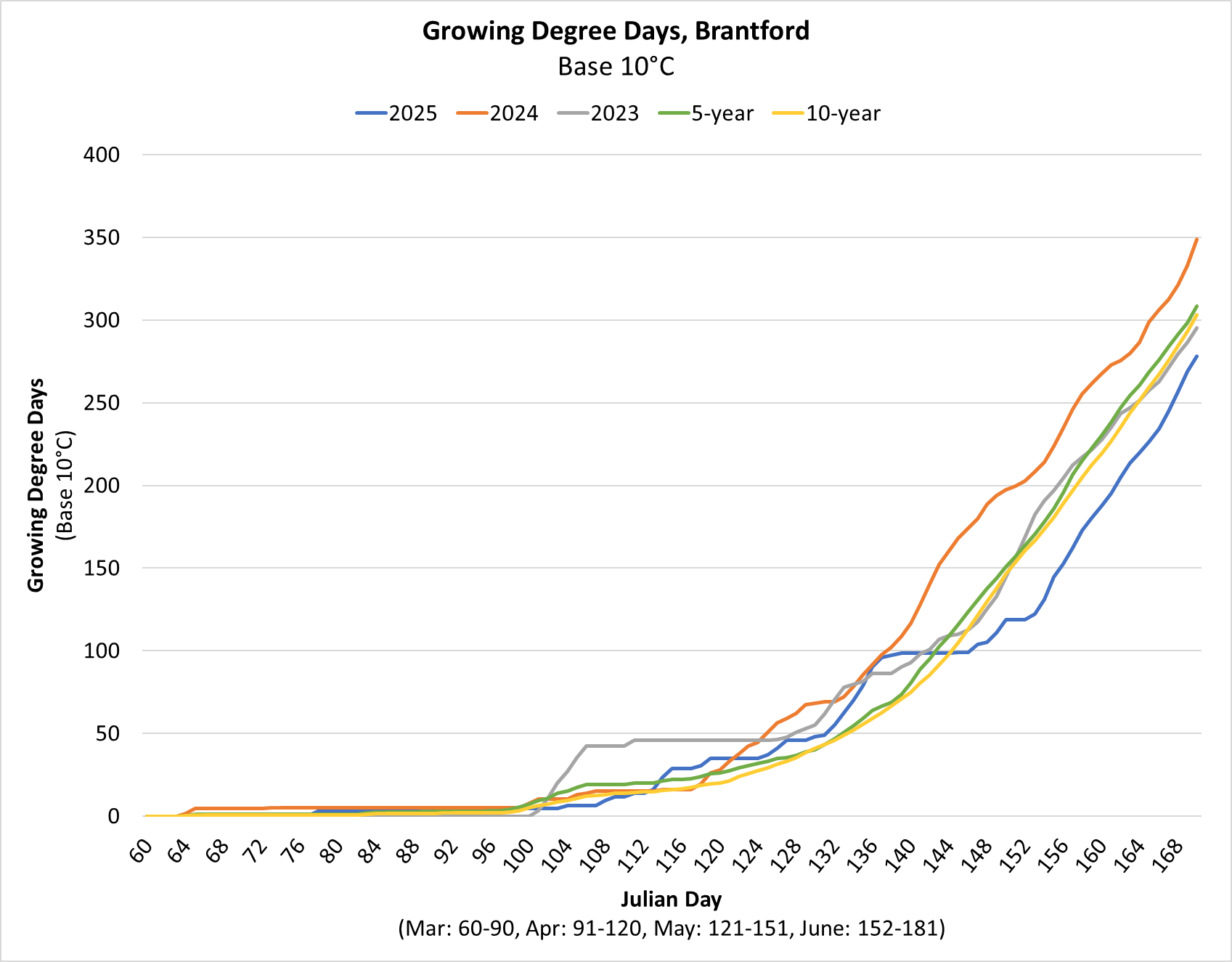
Across the province we are seeing the GDDs with base 5°C, starting January 1, accumulate ahead of long-term averages. Most areas are ahead of the 10-year average and close to or slightly more advanced than the 5-year average. This year is following a similar pattern to 2024, with warm daytime and nighttime temperature advancing the season quickly.
Key GDD Takeaways:
Recent seasons (2024 – 2026) show stepwise rather than smooth GDD accumulation.
Most locations show plateaus followed by jumps in GDDs, meaning – cool periods stall heat accumulation with short warm spells that add GDDs quickly.
2026 is ahead of the 10-year average and slightly ahead of 5-year average, not as advanced as 2012, but certain areas are catching up to or exceeding 2024 (location dependant).
Lake-adjacent sites start slower but accelerate rapidly once warmth sets in.
The gap between the 5-year and 10-year average of GDD is narrowing, suggesting that springs heat accumulation is longer than the norm and is drifting earlier.
Bud development and pest stages may change based on shifting weather patterns. Make phenology-based decisions, not calendar-based decisions.
Development is likely to advance in bursts, which could lead to complications in phenology predictions and spray timing.
Frost risk persists because development is advancing faster than frost-free dates.
The Wet Report
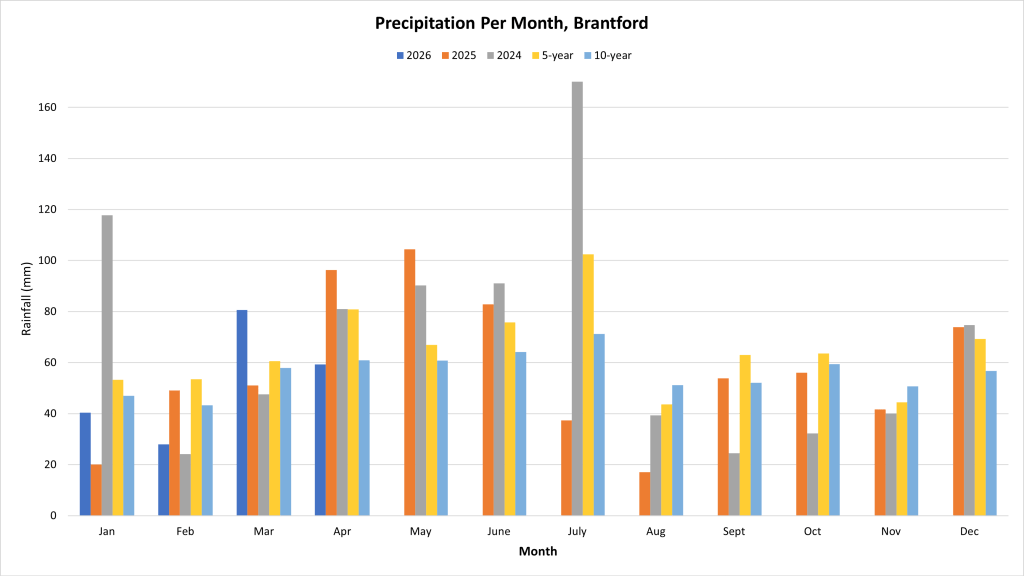
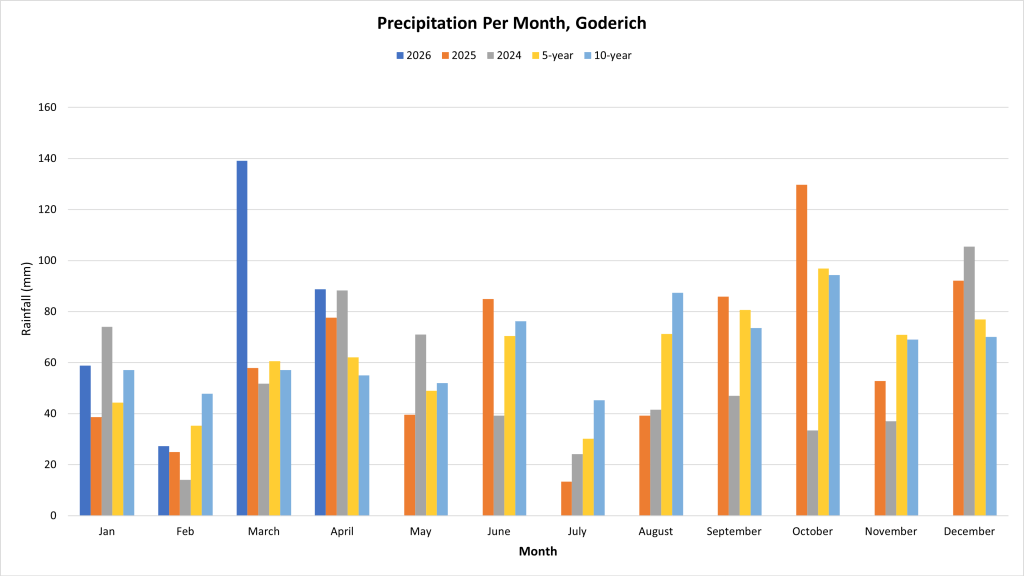
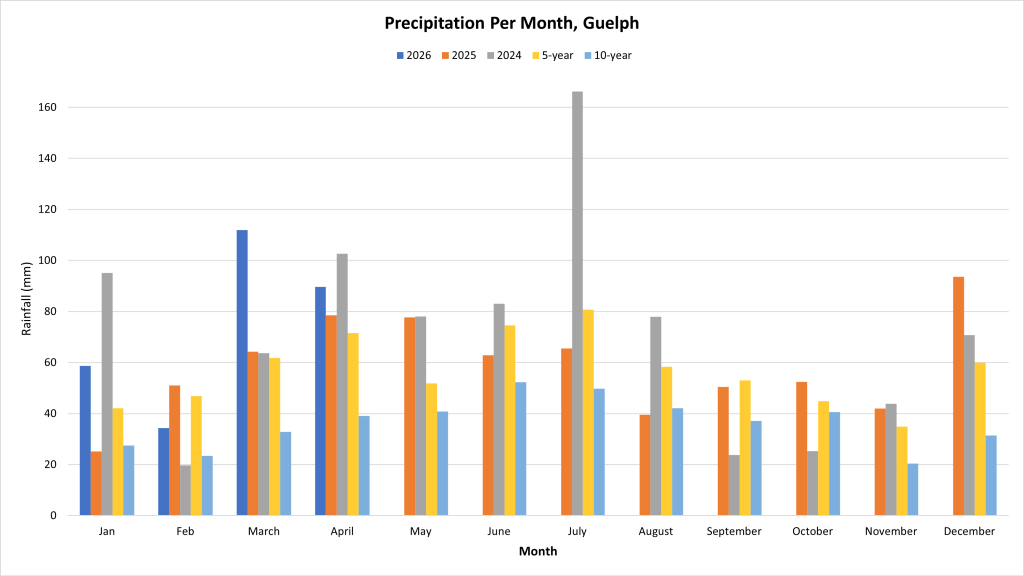
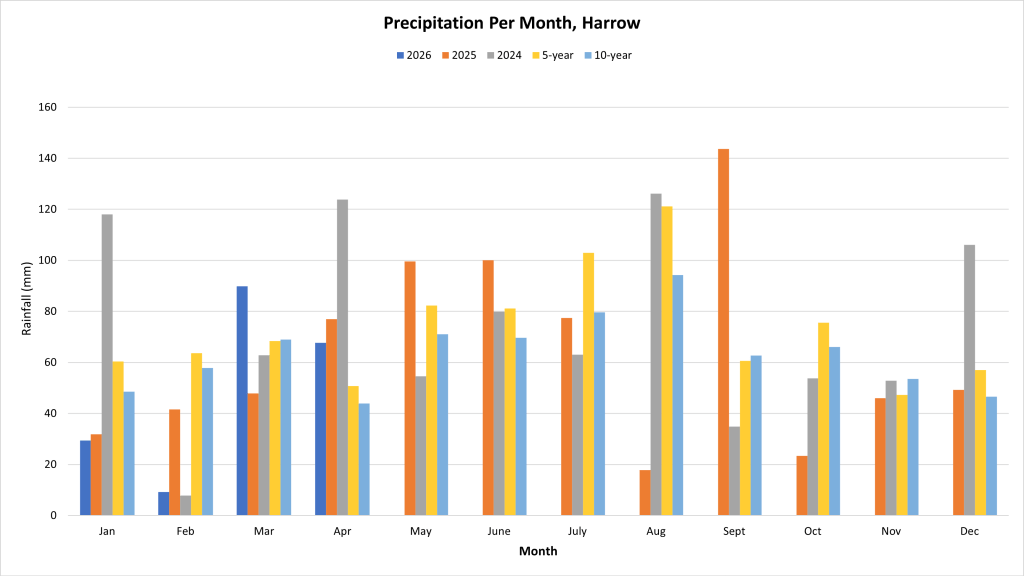
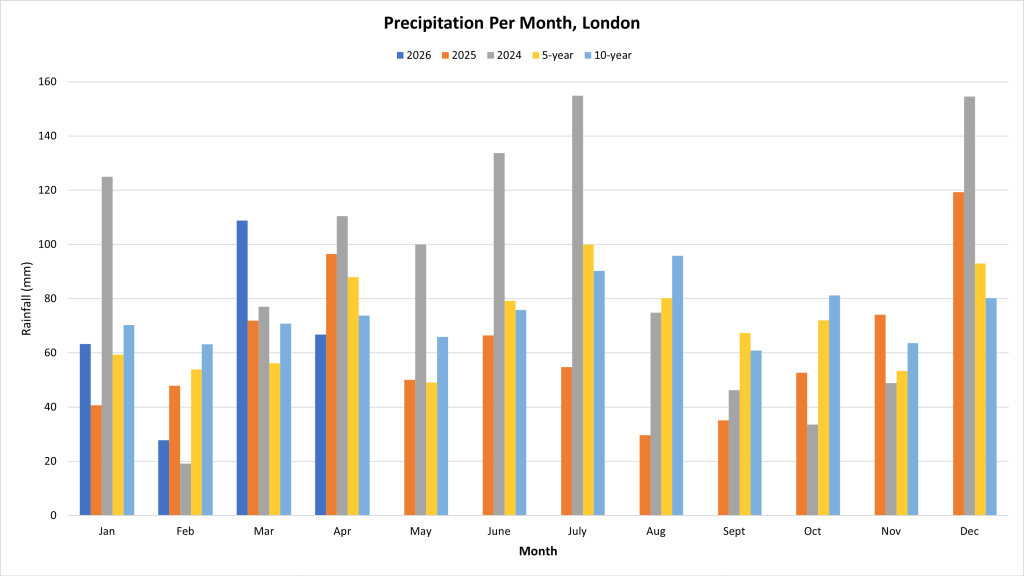
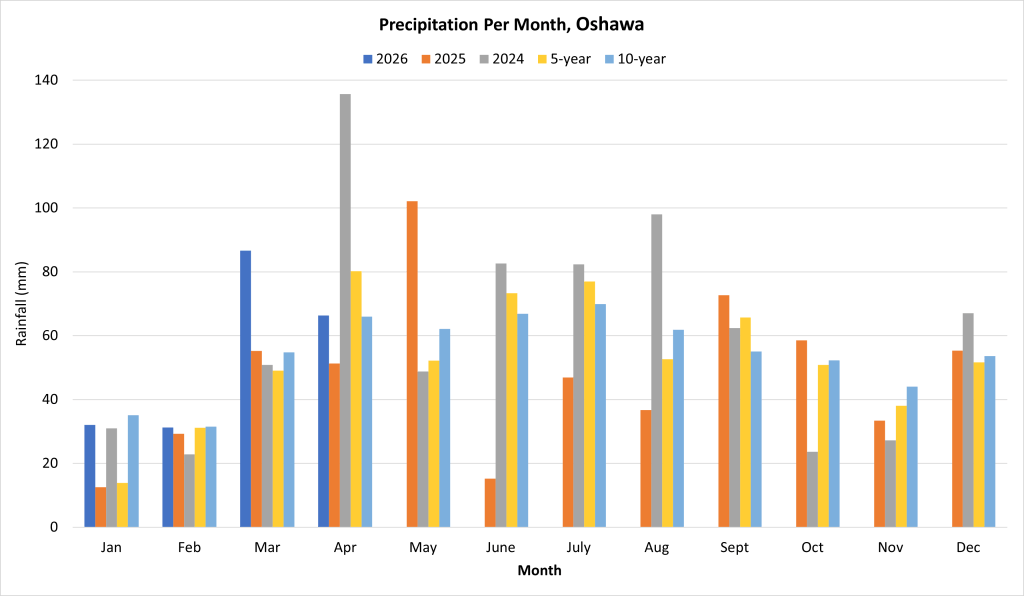
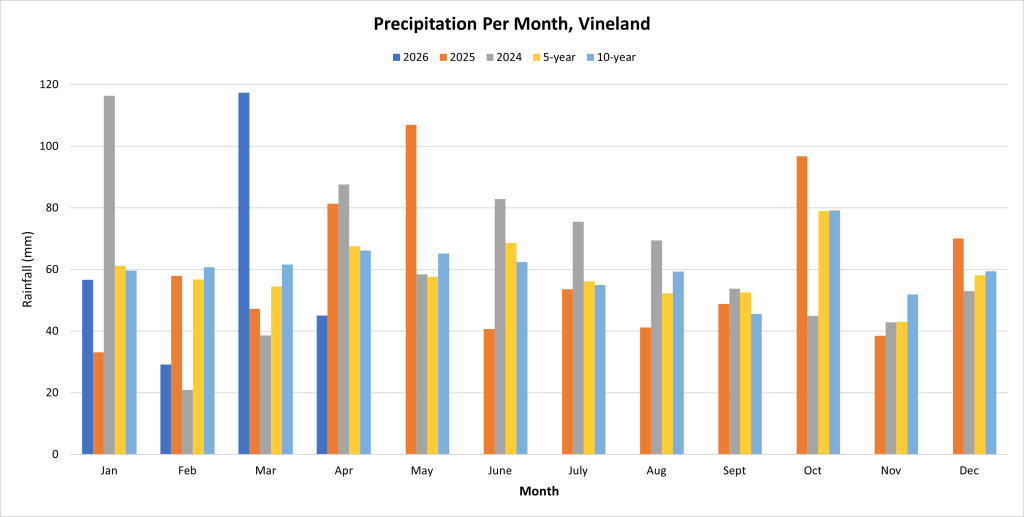
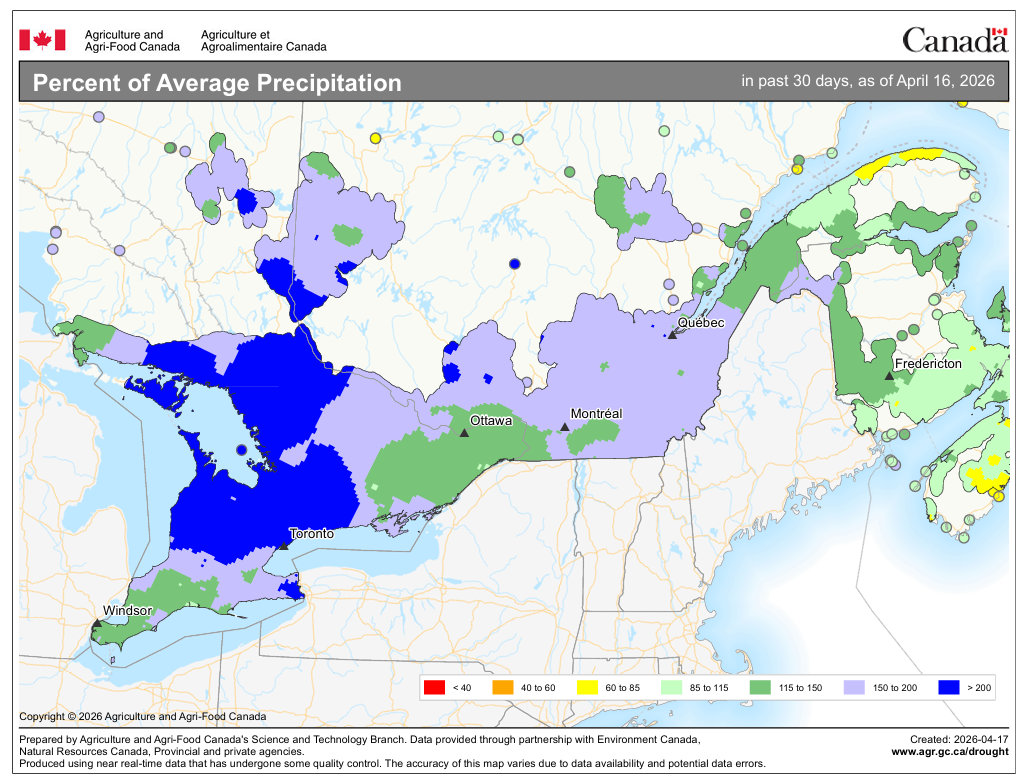
Ontario is experiencing spatial variability regarding precipitation since the beginning of the year. Some regions have experienced reasonable (and unreasonable) rainfall while some regions may be actively dry (Figures 1 & 2). Most apple growing regions have accumulated a significant amount of rain over the past week and the data shows that many locations have already accumulated more than the average for the month of April when we are halfway through the month.
Key Rain Takeaways:
Single months in some years are delivering 2× the 10‑year average, while other months fall well below normal.
2024 was consistently wet in mid‑summer; 2025 trends drier early, wetter later
2026 shows no consistent wet or dry signal (regional specific figures below).
Summer rainfall increasingly arrives in fewer, larger events with peaks in individual months (especially July, August, September).
The 5‑year average is often higher than the 10‑year average
Timing now may have more of an impact than amount due to inconsistent rainfall events. The timing and quantity have serious implications regarding — drainage, soil structure, and nutrient management response.
Due to last year’s drought, some regions may experience a need for soil recharge – keep an eye on moisture levels as there could be early season stress.
If you’re still sitting between dormant and half-inch green, there is still time to consider dormant copper for fire blight suppression and early-season scab reduction. Did you know that an early-season application of dormant copper can be just as effective as a mancozeb? But the window is closing fast!
Use caution:
Beyond half-inch green
Around freezing temperatures
In slow-drying conditions
Under these conditions, the phytotoxicity risk increases with copper being more readily drawn into the green tissue and can trigger bud damage or fruit russetting.
This is one of those sprays where timing matters more than intention – if you’re past the ideal growth stage, it’s better to pivot than push it.
With the warm weather and fast movement in green tissue, many growers’ priorities have shifted to protecting against primary apple scab. The rain events this week have likely resulted in the first apple scab infection(s) of the year for earlier regions of the province.
Primary infections are driven by overwintering inoculum. Orchards with carryover pressure from 2025 are at higher risk of early, aggressive infection events and exponential problems later season. If you saw scab last year, do not skip early season sprays and keep the schedule tight (5-7 day intervals) during high infection risk times. With the warm temperatures, infection events can occur in less than 10 hours of leaf wetness.
Apply protectant fungicides (e.g., mancozeb, captan, folpet) now if not already covered. Most of the available mature spores are discharged within 2 hours after the start of a wetting event. If using protectant fungicides alone, remember these are contact fungicides and do not provide effective post-infection or anti-sporulant activity.
If heavy rains greater than 2″ occur, residues will have likely been washed off. Reapply at any break in the rain if things continue over a period of days. Be prepared to cover again once things dry up.
If there are any concerns about residue wash-off, you may want to consider going in after the rains have stopped with a post-infection, or kickback product. Keep in mind, the timing for kickback activity starts at the beginning of the infection period, not after the rain stops or at time of application. For example, at 16C an infection event begins at 6 hours of leaf wetness. If a product has 48 hours of kickback activity, it begins at that 6 hour mark, even if the rain continues after that point.
There are several registered scab products that have post-infection, or kickback activity. Refer to Characteristics of Apple Scab Fungicidesfor more information.
Kickback Tips
For resistance management, do not rely on kickback activity.
Continue to prioritize protectant products ahead of infection events and rotate modes of action to reduce selection pressure.
Some products perform better in cooler weather than others, including Syllit (do not use beyond tight cluster), Scala, Inspire Super, Luna Tranquility, Migiwa, and Buran.
This doesn’t mean these products don’t work in warm weather, but that they are just as effective in cool stretches.
If things are further along in development (tight cluster and on), consider products that belong to Groups 3, 7 or 11 to provide more broad-spectrum disease control, such as for powdery mildew or rust.
Reminder, powdery mildew thrives in warm, humid (but not wet) conditions – see the next section below!
Where possible, tank-mix systemic fungicides with a protectant such as a Group M (mancozeb, captan, folpet) or a biological product.
Fluazinam (Allegro, Vantana, Downforce) does not offer post-infection activity; this is a contact product.
What About Mildew?
While it might seem a little pointless mentioning powdery mildew in the midst of rain (hint: rain deters powdery mildew development), things will eventually dry up. High powdery mildew pressure in recent years followed by the mild winter could be an unwelcome mix resulting in an early spring arrival of this disease.
Be sure to consider a mildew protectant such as a low rate (3-5 kg/ha) of sulfur in your early season scab program, especially on susceptible cultivars or orchards with a history of powdery mildew. Continue this until tight cluster when more systemic fungicides with mildew activity like the Group 3, 7 and 11s start to be used. Watch your use of sulphur around oil sprays – read the product label for more information.
As mentioned, rain washes off powdery mildew spores. Instead, mildew is spread by wind and thrives in dry weather and high relative humidity. So, protectant sprays may still be required when things dry up and there is little risk from apple scab.
In addition to familiarizing yourself with the maps, now is also the time to consider pre-bloom immune boosting strategies, especially in blocks with a history of fire blight. Products like Lifegard or Regalia can be applied pre-bloom to activate host plant defenses and better prepare the tree for any upcoming infection risk.
These are not rescue products and do not replace blossom blight management. They work best before pressure begins, not during it.
Has Scale Tipped?
As buds move into green tip and beyond, the window for true dormant control of scale is quickly closing. The smothering action of oil reduces in efficacy for scale and may not provide consistent control as the immature nymph emerges from dormancy and begins maturing.
If the dormant window has passed, it’s better to shift strategy to control of the crawler stage, when scale are most vulnerable and exposed. That means planning ahead for in-season applications using degree-day models, typically around early to mid-June (1st generation) and August (2nd generation). Pre-bloom management using products currently registered for scale has not been tested in Ontario and efficacy in not known.
This timing mindset is opposite of how growers often think about oil for mite management – which is why timing is sometimes applied too late for scale. While scale depends on an early dormant window for maximum impact, oil applications for mites are best applied delayed dormant into tight cluster to target the developing eggs.
Save the Date! Apple IPM Workshop
Looking for a chance to refresh your knowledge of apple IPM? New to growing or scouting apples?
Join me for an Apple IPM Workshop!
VIRTUAL – Monday, May 4th from 9:00AM – 12:00PM
IN-PERSON (Simcoe) – Tuesday, May 5th from 9:30AM – 3:30PM
We will discuss common orchard pests, scouting techniques for various insects and disease, tools of the trade, safety protocols and tips for success. Time will also be available to answer any pest-specific questions regarding pre-recorded presentations available on the Apple IPM Resources page.
Production and pest update brought to you by the OMAFA Apple Team:
Erika DeBrouwer, Tree Fruit Specialist and Kristy Grigg-McGuffin, IPM Specialist
And just like that – the 2026 apple season is officially underway! We will start back to sharing pest and production updates from across the province, including timely management insights, resources, and upcoming events. Follow along throughout the season.
Grower Grind
Growers have been in their orchard for a bit, taking advantage of the (previously) consistent weather to prune. Keep an eye out on the weather before making any future cuts as limbs can take up to 2 weeks to fully heal after pruning.
Growth Stages
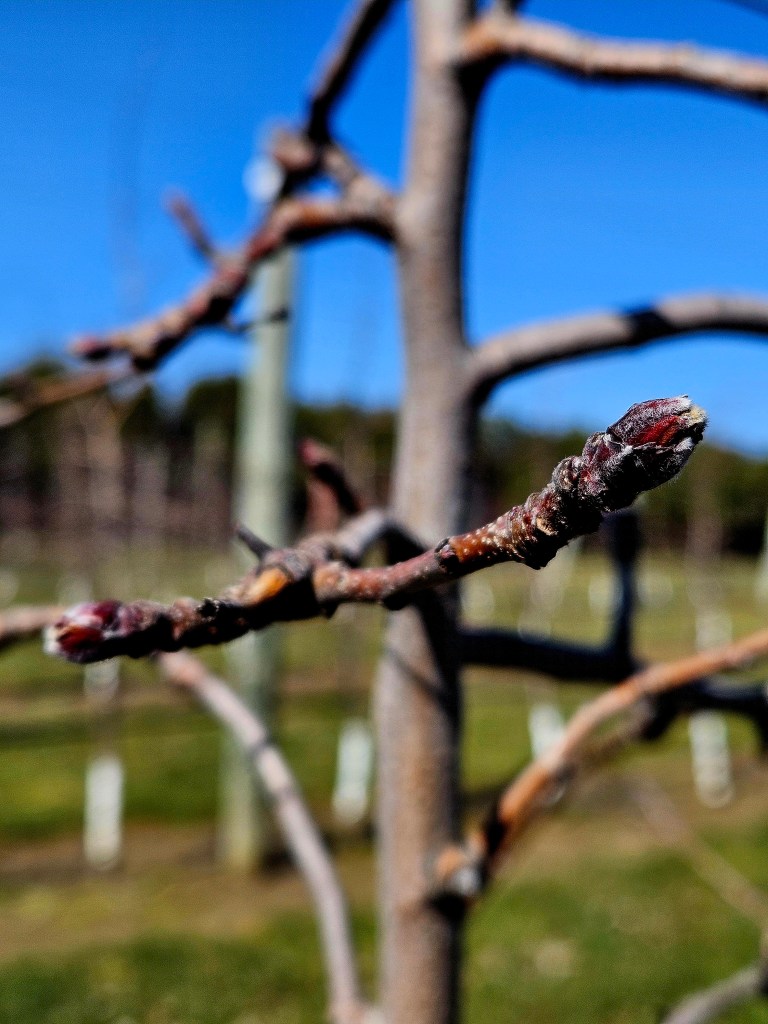
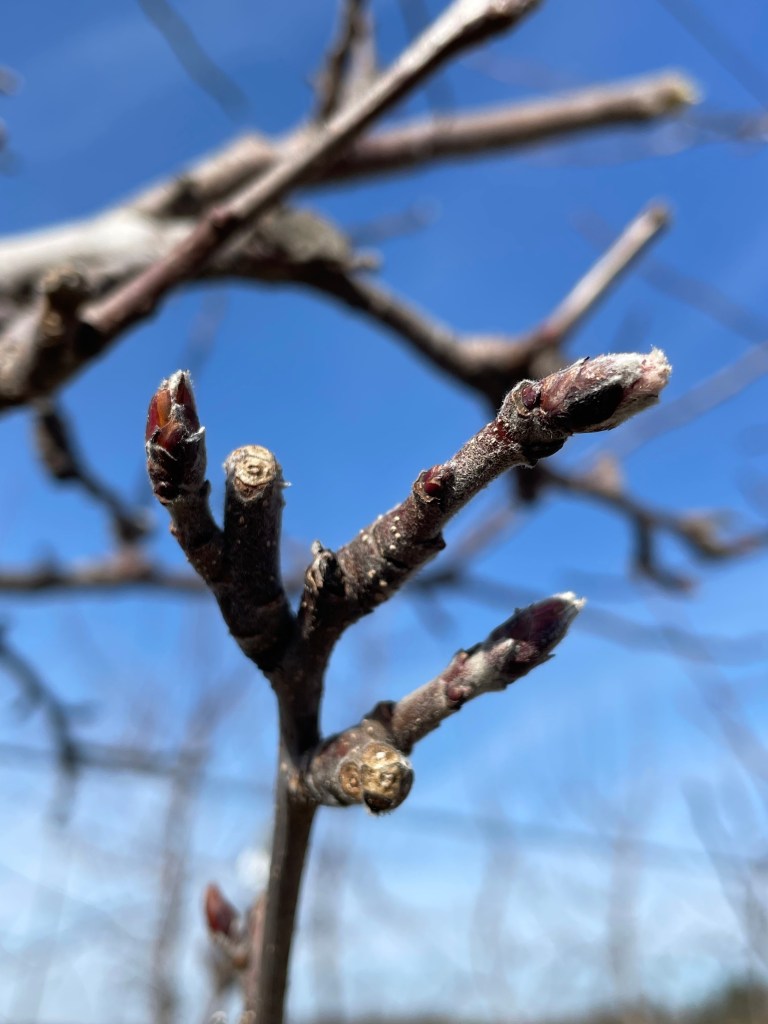
Early growing regions are reporting silver tip, with the first hints of green tip emerging on early cultivars like Golden Russet.
Silver tip on HoneycrispSilver Tip on Brookfield Gala
Phenology Clock Advancing (GDDs)
Looking at 7 locations across Ontario the accumulation of Growing Degree Days (GDD) are shown in the graphs below. All GDD started January 1 of each year with a baseline of 5ﹾC.
To view next graph location > click and drag
It is still early to determine what we may see this spring – but in warmer regions of the U.S. they are noticing earlier development by 14 days. As we all know, the weather can change drastically and quickly, therefore these graphs are for your awareness and allow you to compare your current season to past seasons and/or regions in preparation for what may come.
Takeaways:
Brantford, Guelph, Harrow, London, Vineland seem to follow the 2024 spring season (as a reminder of the 2024 season, we were ahead by 10 to 14 days in the spring which continued up to harvest. Some regions were affected by frost).
Oshawa, Goderich are showing a slower accumulation, but is staring to peak and rise to and be comparable to the 2024 spring.
Harrow (77.5) is the most advanced for GDD currently, followed by Vineland (48.7) and London (45.4)
WE NEED YOU! We are collecting bud break data from Ambrosia, Honeycrisp, Gala and McIntosh to be used for future production- and pest-related prediction models. Please fill out this survey to help!
With development kicking off, it’s time to turn your attention to early season pest management. Let’s go through the checklist of things to consider:
Apple-y Ever After Starts With Sanitation
The first line of defense for pest management in an orchard is prevention. There is no silver bullet to eradicate something like disease once it becomes well established. Instead, management is about reducing inoculum and preventing spread to healthy trees or fruit.
Cut It
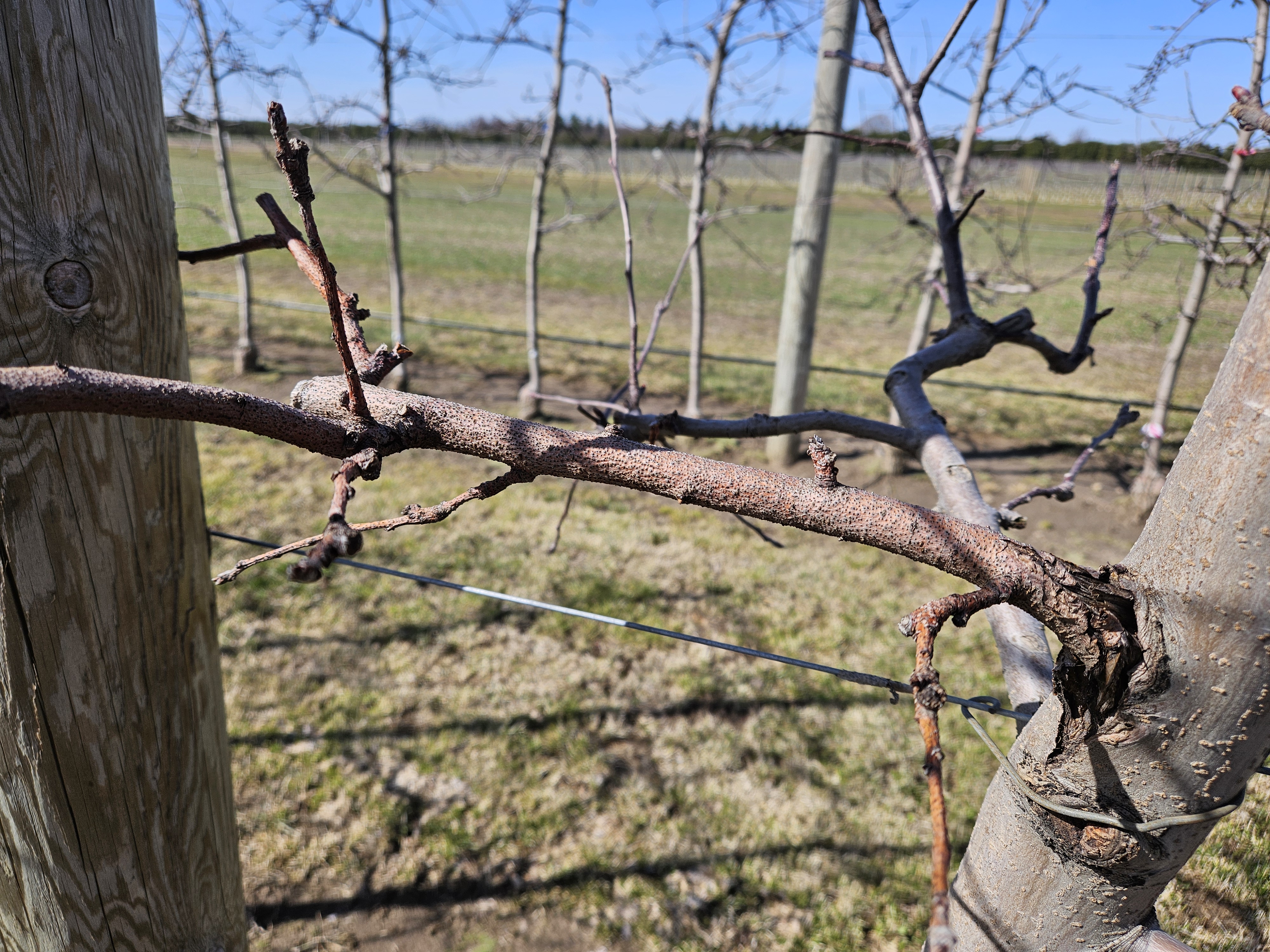
Prune out dead or diseased limbs, trees or signs of cankers as well as rotten or mummified fruit. These can harbour overwintering pests, such as fire blight, black rot or bitter rot.
Remove It
Get rid of wood or cull piles, stumps or old bins that may have been in or near the orchard over the winter. These often provide overwintering sites for insects, such as codling moth and plum curculio.
Mow It
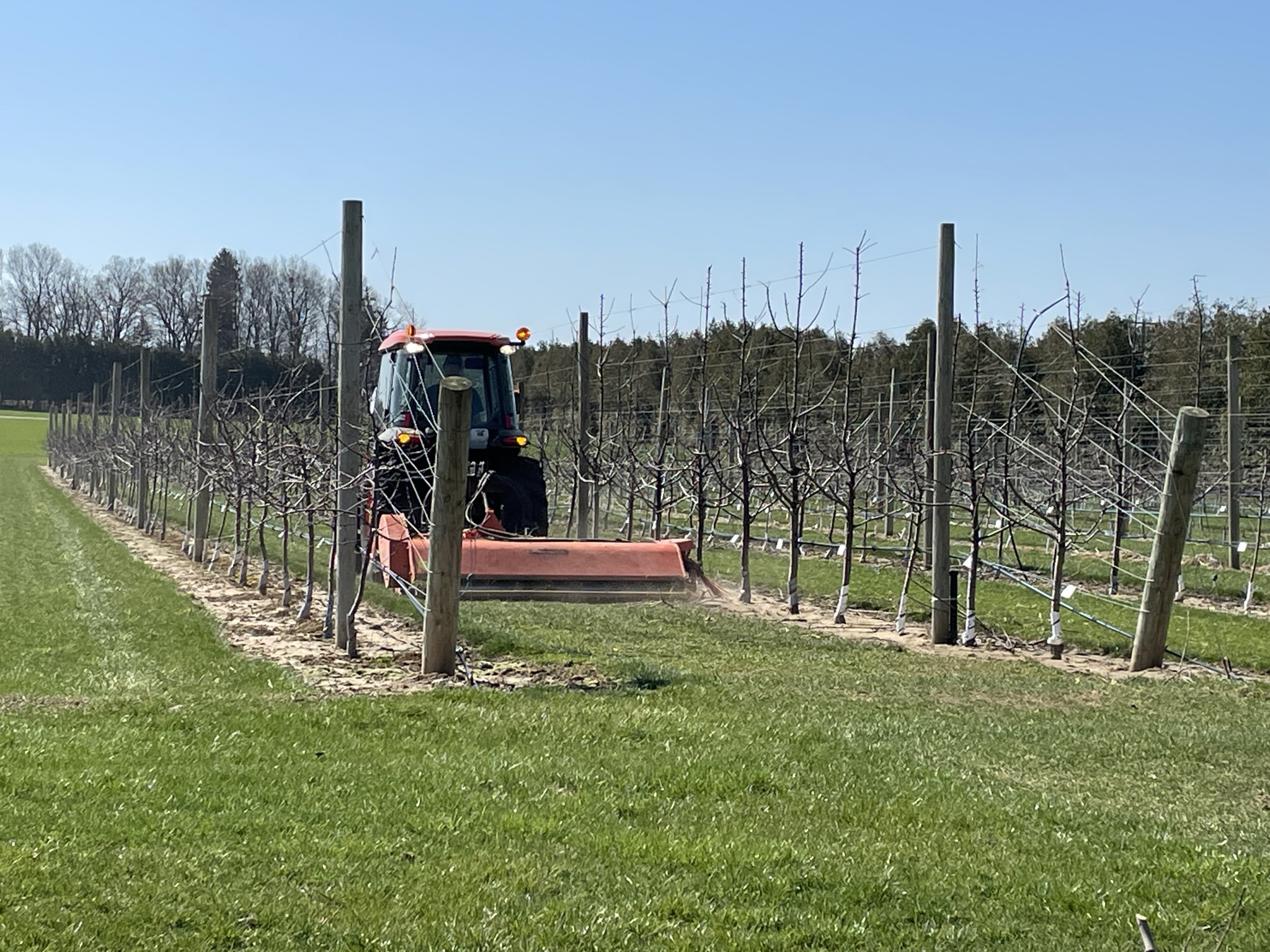
If the ground is dry enough to get the tractor through, flail mow the orchard floor to mulch up leaves, branches and fruit to encourage decomposition.
Note: Spring-applied urea should go on after snow melt, while the tree is still dormant to facilitate leaf decomposition. If buds have already broken in your orchard, urea applications for inoculum reduction are likely not worthwhile. Flail mow instead.
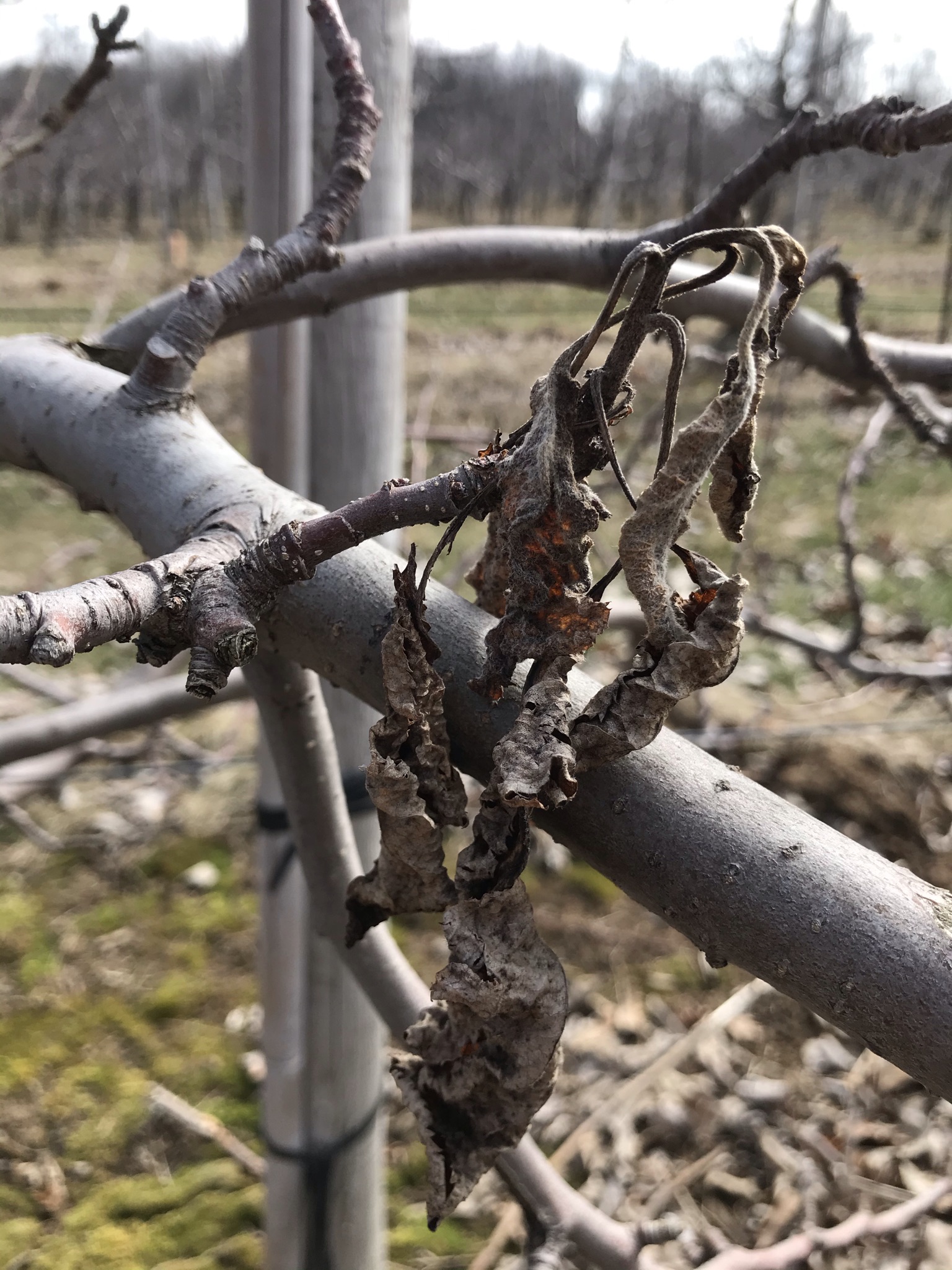
Dead limbs and cankers can harbour overwintering pathogens, such as fire blight, black rot or bitter rot.
Removing fruit mummies will help reduce overwintering pest pressure.
Rotting fruit, leaves and branches on the orchard floor can be host for many orchard insects and diseases.
Flail mowing in the orchard.
Keep Calm And Copper On
Dormant copper can protect against any bacteria oozing from overwintering fire blight cankers that may have been missed during pruning. Copper is not systemic; its activity is contact only and provides a barrier over the tree to prevent fire blight bacteria from colonizing an area. This means it will only kill bacteria on the surface of the tree as it emerges from cankers with warmer weather. A delayed dormant copper spray will also provide some protection against apple scab.
Residual activity typically last about 7-10 days under ideal spring conditions. However, once rainfall exceeds 2” from the last copper application, it should be assumed all residue has been washed off. Depending on the spring, you may need multiple applications.
Dormant copper such as Copper Spray, Copper 53W, Cueva, Parasol and Kocide can be safely applied up to ¼” green (possibly ½” green) without risk of phytotoxicity. However, the use of a softer copper registered for season-long control such as Cueva could be extended in those early spray timings to ½” green or tight cluster in blocks with low scab inoculum (ie., free of scab last year) to offset the need for other early protectant fungicide sprays.
For some copper formulations, using a dormant oil will act as a sticker/spreader as well as provide efficacy on scale, European red mite and suppression of powdery mildew. This is not the case for all registered coppers. Always refer to precautions listed on the product label prior to use.
Overwintering fire blight infected shoot of apple tree.
Overwintering fire blight infected shoot of apple tree.
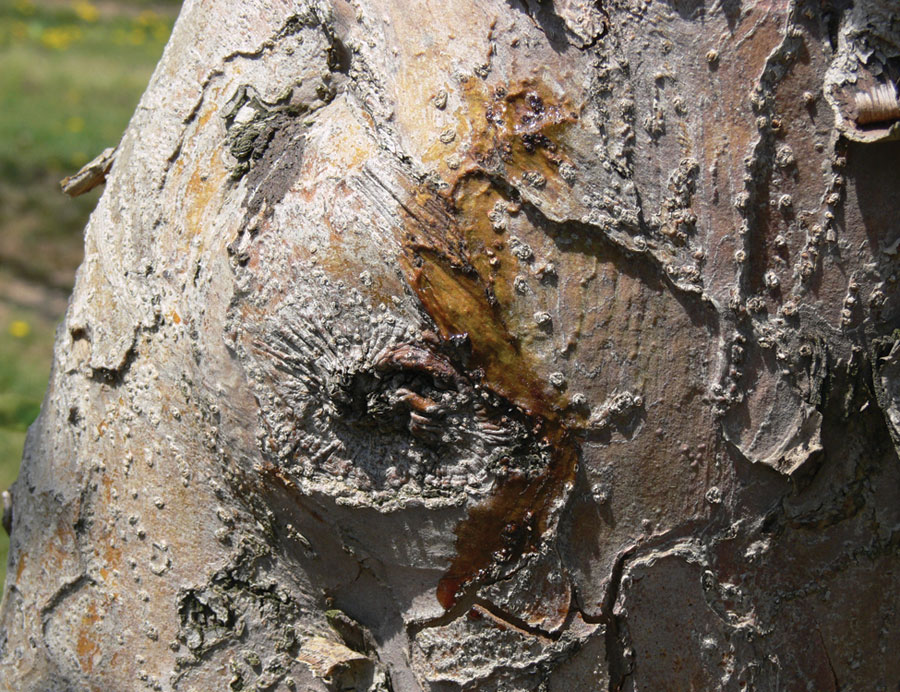
Visible margin of fire blight infection below which tissue appears healthy. Bacteria will ooze from the edge of the canker.
Ooze on overwintering fire blight canker on apple tree.
A Little Oil Goes A Long Way
Depending on the target pest, the term “dormant” oil can be rather misleading as sprays can be applied from the true dormant state prior to bud break up until pink. Unfortunately, optimal dormant timing for scale is not necessarily the same for mites.
If damage from last year indicated scale is a bigger issue in the orchard, oils need to be applied before or shortly after bud break. This efficacy against scale is significantly reduced with later oil applications for European red mite as they develop a waxy protective layer that impedes the oil from effectively penetrating and preventing respiration. Dormant oil applications for scale are one of the most effective control strategies when applied correctly!
However, if European red mite populations have been the problem, sprays can be delayed. Ideal timing is half-inch green to tight cluster but can be delayed to pink; however, blossoms can be quite sensitive to oil under adverse conditions so consider using a lower rate at this timing. Delayed dormant oil applications can also provide suppression of early aphid emergence and powdery mildew sporulation in overwintering buds.
Dealing with the fluctuating spring temperature can often make timing for dormant oil challenging. Be sure to avoid the following situations to reduce the risk of injury:
Do not apply oil if frost is forecast 48 hour before or after planned application.
Allow at least 10-14 days between oil and the use of captan or sulphur products. Oil can enhance penetrant activity of these products, resulting in phytotoxicity.
Do not apply oil during periods of slow drying conditions that may lead to burning of sensitive tissues.
Red Delicious, Empire, Mutsu and Ambrosia can be particularly sensitive to bark damage if applied in conditions listed above.
Overwintering scale, or “black caps” on trunk of Honeycrisp.
Overwintering European red mite eggs.
Save the Date! Apple IPM Workshop
Looking for a chance to refresh your knowledge of apple IPM? New to growing or scouting apples?
Join me for an Apple IPM Workshop!
VIRTUAL – Monday, May 4th from 9:00AM – 12:00PM
IN-PERSON (Simcoe) – Tuesday, May 5th from 9:30AM – 3:30PM
We will discuss common orchard pests, scouting techniques for various insects and disease, tools of the trade, safety protocols and tips for success. Time will also be available to answer any pest-specific questions regarding pre-recorded presentations available on the Apple IPM Resources page.
Registration is now open for many of the OMAFA IPM workshops. Workshop options of in-person, hybrid or virtual only will vary depending on the session and is noted below.
To register, please follow the registration link or call the Agriculture Information Contact Centre at 1-877-424-1300.
This is an introductory workshop that covers the basic information that scouts need to know. Topics that will be covered: the importance of integrated pest management, disease causal agents, symptoms and damage of insects and mites, scouting for weeds in horticulture crops, pesticide safety, soil diagnostics, symptoms of nutrient deficiencies, tissue sampling, invasive species and farm visit biosecurity. Other scouting workshops will build on this information and will be tailored to the specific crops.
Workshop Leader – Denise Beaton
Location – In person (Auditorium, Ontario Crops Research Centre – Simcoe, 1283 Blueline Rd., Simcoe ON)
Over this 3 hour virtual workshop, participants will learn about the basics of apple IPM, common pests to look out for over the season as well as orchard scouting tips and tricks. This is a condensed version of the in-person workshop, ideal for those looking for a refresher.
Workshop Leader – Kristy Grigg-McGuffin
Location – Virtual (link will be provided after registration)
Reference materials will be provided to attendees
Pre-recorded presentations posted on Apple IPM Resources. Come with pest-specific questions for Q&A.
This in-person workshop will cover the basics of apple IPM, identification and biology of common pests, as well as proper orchard scouting techniques. Portions of this workshop will be held outdoors, weather permitting.
Workshop Leader – Kristy Grigg-McGuffin
Location – In person (Auditorium, Ontario Crops Research Centre – Simcoe, 1283 Blueline Rd., Simcoe ON)
In-person spaces are limited so registration is restricted to potato scouts only. All other attendees are asked to register for the concurrent hybrid Zoom meeting.
Production and pest update brought to you by the OMAFA Apple Team:
Erika DeBrouwer, Tree Fruit Specialist and Kristy Grigg-McGuffin, IPM Specialist
The time of year we have all been working towards. Apple harvest is underway in most regions for early timed cultivars! Yay! Most regions have gotten a sprinkle of rain (thankfully!) over the past week. Cool nights have also been in the forecast as of late, where most growers are hoping for these trends to continue. Wishing you all the best over the harvest season!
Growth Stages
Fruit continues to size with colour developing the closer we get to harvest timing.
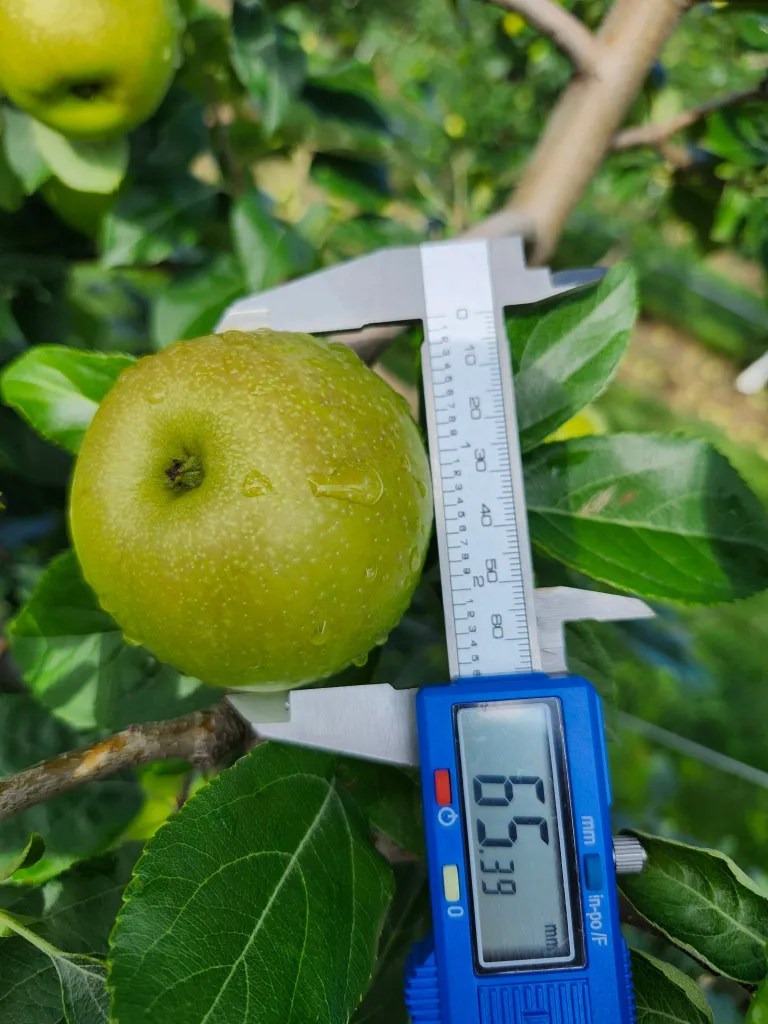
At the Simcoe Research Station, fruitlets and terminals are sitting at the following:
Honeycrisp
Ambrosia
Gala
Fruitlet Size
82.2 mm
67.0 mm
66.3 mm
Terminal Growth
29.5 cm
26.9 cm
36.2 cm
Simcoe Research Station measurements taken on August 22, 2025
Harvest Homework
There are a few ways to tell how mature your fruit is, which can take some trial and error in the field. These tools can be used to aid in planning your harvest logistics and should be used in a complimentary fashion with each other.
Starch
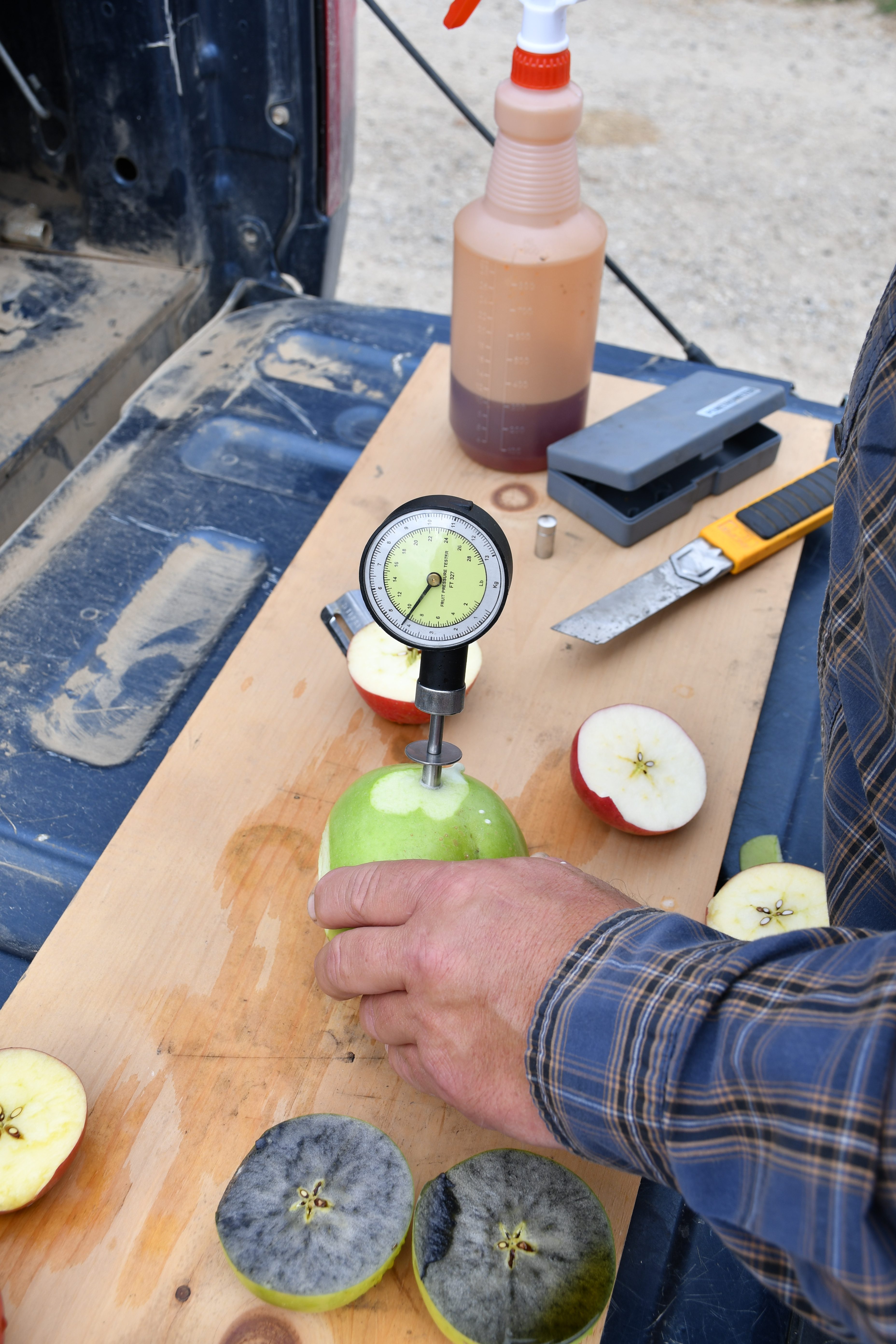
Starch testing is one of the most common maturity indictors due to ease and cost. Starch is an effective tool to use in the field as it provides a great visual and numerical ripeness representation of sugar conversion. Ultimately, the less stain that is shown, the more mature the apple is.
There are two recipes that can be used to perform the starch iodine test which are outlined below.
Test
Benefits
Challenges
Potassium iodide
– Good representative of sugar accumulation – Can be performed in the field or in a lab setting
– The recipe needs to be prepared by a pharmacist, chemist or veterinarian. – Iodine solution needs to be made fresh. – Solution is poisonous. – Can be difficult to perform in orchard.
2% iodine solution
– Good representative of sugar accumulation – More convenient regarding supplies than potassium iodide test – Can be performed in the field or in a lab setting
– Is more costly than recipe above. – Iodine must be diluted. – Can be difficult to perform in orchard.
Firmness
Firmness can be determine with handheld or tabletop penetrometers. This is also a common test that is easier to perform in the field than other tests. A handheld penetrometer gives you more flexibility and ability to test in the orchard.
Grower testing maturity (firmness and starch levels)
Sugar
Sugar is another common indicator to determine ripeness, which is best utilized in tandem with acidity testing. Refractometers are used to determine the level of °brix within the fruit juice itself, with optical refractometers being the most typical. Remember to clean and dry off the instrument between each sample.
Sugar content is usually higher with reduced moisture, high temperatures and high sunlight.
Trees with high crop loads tend to have lower sugar levels.
Acidity
Acidity is commonly tested for in cider and wine-making, where levels decrease as fruit becomes more mature. Acidity testing can be performed with pre-made kits where the level of malic acid is shown. This test can be performed in the field but should be trialed over time.
Colour
Colour can be difficult to determine in the field when aiming for a precise level, especially with lighting changing throughout the day in the orchard. Luckily, for Ambrosia, a colour chart was developed by British Columbia to aid in determining harvest maturity based on the background colour of the fruit.
Ethylene
Internal ethylene can be measured using a delta absorbance (DA) meter. This is a less common test, as there are substantial difference in values across regions – but – it can be used throughout harvest if you are willing to spend time to develop a standard within the cultivar you are looking at.
Ripe on Cue
Cultivars vary in respect to ideal maturity for harvest. Below is a table developed by Dr. Jennifer DeEll that outlines the unique starch index values, firmness and internal ethylene concentrations at harvest for apples going into long-term storage.
Cultivar
Starch Index(1-8)*
Firmness(lb)
Internal Ethylene(ppm)
Ambrosia
2.5 – 4
> 17
< 1
Cortland
2.5 – 3.5
> 15
> 0.2 in < 20%**
Crispin
3.5 – 4.5
> 17
> 0.2 in < 20%
Delicious (Red)
2.5 – 3.5
> 17
> 0.2 in < 20%
Empire
2.5 – 3.5
> 17
> 0.2 in < 20%
Gala
2.5 – 3
> 18
< 1
Golden Delicious
3 – 4
> 16
> 0.2 in < 20%
Honeycrisp
~ 5
> 15
Not useful
Idared
3 – 4
> 15
Not useful
McIntosh
2.5 – 3.5
> 15
> 0.2 in < 20%
Northern Spy
2.5 – 3.5
> 18
> 0.2 in < 20%
* Cornell Starch Iodine Index Chart (1-8) ** No more than 0.2 ppm in less than 20% of apples
A Core-dinated Record
Be sure to keep track of the detail for future reference. Looking back to help determine the do’s and don’ts will pay off in the long-term. Remember to include:
calendar date of harvest
yield and other quality parameters (size, firmness, colour, weight)
length of time stored/when apples were removed from storage (if you have access to this)
pay out for crop
it would be good to write down GDD and night-time temperatures for reference for the week(s) prior to harvest
Remember that these strategies should be used in collaboration with one another to give you a better idea of when to harvest.
For more information check out Dr. Jennifer DeEll’s articles on harvest maturity found below:
Harvest is the busiest time of the year, but the exact timing of when fruit comes off the tree has long-lasting impacts on both crop quality and orchard health. Picking too early or too late doesn’t just affect fresh quality – it can also set the stage for pest carryover, storage diseases, and physiological breakdown disorders.
Late-Hanging Fruit
From a pest management perspective, leaving apples on the tree past optimal maturity:
Extends the window for insect pests like apple maggot, codling moth, and stink bug
Increases overwintering survival and pressure for next season
Leaves fruit more prone to sooty blotch, fly speck, black rot and bitter rot that can spread quickly preharvest, as well as during or after storage
Encourages secondary colonizers (and major harvest nuisances) like yellow-jacket wasps to exploit overripe or damaged fruit
Any fruit that becomes overripe, cracked, or bruised is also more vulnerable to storage rots such as blue mold (Penicillum expansum) and gray mold (Botrytis cinerea). The risk is highest when fruit are harvested during wet weather, when spores are more easily spread. Overmature fruit with softer skin are also more susceptible.
Key harvest practices to reduce storage disease risk include:
Harvest dry fruit whenever possible – avoid picking in the rain
Cool fruit quickly – moving bins into cold storage right after picking reduces infection development
Sanitize bins before use – to limit any pest carryover
Handle fruit gently – to reduce bruising and micro-cracks that act as entry points for infection
Harvest at the right maturity stage – not too ripe and not too immature
Having a Breakdown
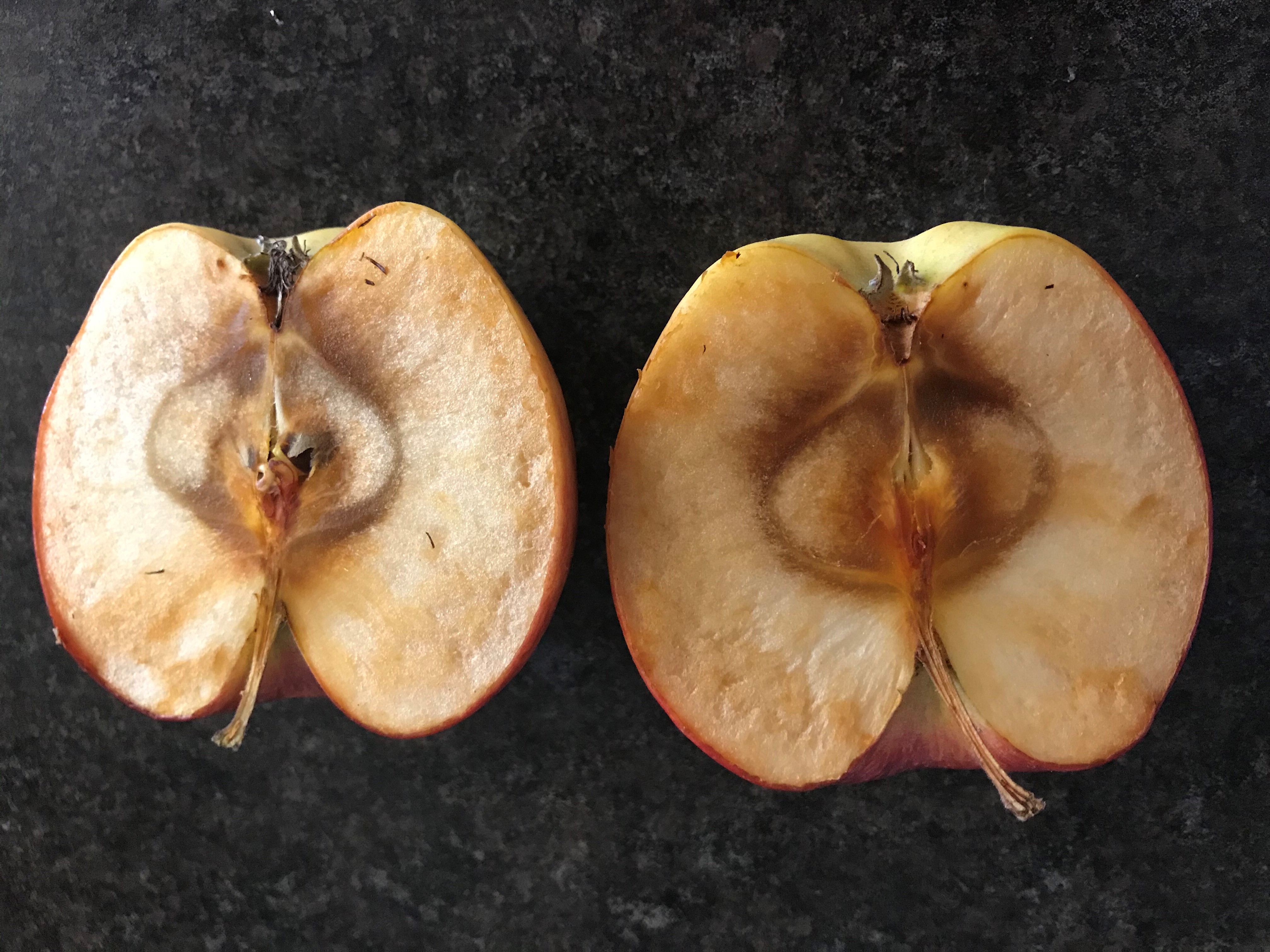
Harvest timing also has a direct impact on postharvest disorders. If fruit are picked overmature – especially during warm fall weather – the risk of internal breakdown rises. This disorder shows up later in storage as browning and softening of the flesh from the core outward. Factors that increase risk include large fruit size, delayed harvest, and holding fruit too warm after picking
Internal breakdown in Ambrosia
Lenticel breakdown is another issue that becomes more likely when harvest is delayed. This shows up as small, dark, sunken spots around the pores on the fruit skin. It is strongly influenced by cultivar (Honeycrisp and Ambrosia are quite prone), but risk also increases with fluctuating moisture before harvest, wet picking conditions, and overmaturity.
Lenticel breakdown in Gala
Both disorders are aggravated by rough handling, so gentle harvest and careful bin management are just as important as timing.
What the Crop?! Apple Update: August 8, 2025
Production and pest update brought to you by the OMAFA Apple Team:
Erika DeBrouwer, Tree Fruit Specialist and Kristy Grigg-McGuffin, IPM Specialist
August has arrived, bringing with it the final stretch of summer and a noticeable shift in the orchard. For Ontario apple growers, this month marks a critical transition – from monitoring and maintenance to preparing for harvest. The fruit is sizing up, colour is beginning to show, and the results of this season’s hard work are finally becoming visible. Continue to fine-tune insect and disease management strategies, and keep a close eye on weather that can either help or hinder the final push to harvest.
Growth Stages
Terminal bud set continues. With the on-going heat, some cultivars like Ambroisa are showing signs of reverting. Not only is water critical at this time for floral induction, but also fruit sizing. Be sure to provide your trees with enough water and nutrients for this season and the next.
At the Simcoe Research Station, fruitlets and terminals are sitting at the following:
Honeycrisp
Ambrosia
Gala
Fruitlet Size
71.3 mm
62.1 mm
62.1 mm
Terminal Growth
30.5 cm
24.9 cm
35.4 cm
Simcoe Research Station measurements taken on August 6, 2025
Paint It Red (With Science)
With harvest closely upon us, the push for fruit colour also intensifies.
The best option for ideal colouration is to have an open canopy to allow light penetration throughout the tree.
Although having an open canopy aids significantly in colouration, sometimes a boost is needed. Options that may be of interest include:
Leaf Removal: whether that be manual (pruning) or mechanical (defoliator)
Nutrients: phosphorus, magnesium, and boron have shown to aid in colour development, along with nutrients like calcium, zinc and manganese indirectly affecting colour.
Plant Growth Regulators: in the form of colour enhancers and fruit maturation inhibitors
Reflective Ground Cover: this includes various materials that are laid beneath the tree and in the alley to reflect the sun
Remember that: timing is critical for all colouring technologies AND cool nights are still needed for the success of any colour aid.
iClouds Not Synching
Continued dryness throughout the province (Figure 1) over the past few weeks and/or months depending on the location, has growers irrigating regularly.
Knowing how much water is needed for your trees, based on your soil, temperature, relative humidity, wind speed, and solar radiation, is important before making any decisions. If rainfall isn’t meeting the demands needed by your trees irrigate if possible.
If water resources need to be dispersed due to limitation of water levels consider the steps below:
Prioritize newly planted and young trees due to their minimal root system in comparison to mature tree root systems.
Monitor for signs of drought stress. Pale, wilted or scorched leaves, along with early leaf senescence or drop. Trigger water if these symptoms are seen.
Other considerations, such as weed management to encourage water be directed to your crop, and purchasing of rain gauges and/or soil moisture monitors to aid in water management.
Alternatives to Irrigation Systems
For growers that do not have an irrigation system, here are some alternatives:
Purchase water from a water hauling company
Water can be held in tanks until needed. This can be costly over time and requires additional infrastructure (holding tanks and delivery access).
Purchase municipal water from hydrants
This can also be costly, and may not be an option for all locations.
Access water from a neighbour
A written agreement may help to ensure the sharing arrangement is clear for both parties and help avoid disputes.
Ensure that the total withdrawal complies with the Permit To Take Water (PTTW) issued by the Ministry of Environment Conservation and Parks (MECP).
A PTTW is required for takings of 50,000L or more on any one day from any water supply, either groundwater (wells) or surface water (pond, stream, wet area, ditch etc.). 50,000L is equivalent to approximately half an acre irrigated with one inch of water.
As harvest approaches, pest management decisions shift from protecting developing fruit to ensuring fruit quality and minimizing residues. Even though the bulk of your pest worries may have lessened, late season pressure from both insects and pathogens can still downgrade fruit and complicate storage.
Keep the following in mind over the next few weeks leading up to harvest:
The PHI Files
This is a critical time to double-check the preharvest interval (PHI) of any product you’re considering, or the minimum number of days between the last application and planned harvest. Spraying too close to harvest can lead to unacceptable residue levels which could result in:
Detectable residue or compliance violations
Rejected loads, especially for export or processing markets
Loss of certifications (e.g., CanadaGAP)
Regulatory penalties
Check the PHI of every product used between now and harvest. PHIs can vary between active ingredient, formulations, and market (domestic vs export). Note, PHI compliance is still required even if the fruit is going into long-term storage. You can’t wait out a PHI in the cooler – the harvest date is the legal reference point.
All PHI are listed on the product label and can be found under ‘View Details’ for each product on the Ontario Crop Protection Hub. If using List View, be sure to select a pest for the PHI to appear.
As harvest approaches, ask:
Is the block within the PHI window already?
Will weather or pest pressure force you to spray after that window?
Will spraying a produce with a long PHI force you to delay harvest?
Plan sprays backwards from your expected harvest date. Build in a few extra days if the weather may accelerate ripening.
Different cultivars = different harvest dates = different PHI cutoffs
Early cultivars like Paulared or Ginger Gold need shorter PHI products, whereas late cultivars like Fuji or Cortland allow more time – but also more potential for late-season issues like pinpoint scab, codling moth or fruit rot.
Keep block-specific spray and harvest plans to avoid any accidental residue issues.
No Worm Left Behind
Certain insect pests remain active well into the harvest window. The critical ones to manage are those that will cause direct damage to the fruit. At this point in the season, foliar insect pests can impact winter hardiness and tree vigour but are not priority for management.
Codling moth – Second or third generation larvae may still be tunneling into fruit. Use degree-day models to time your final sprays, especially for later cultivars.
Apple maggot – Adults can be active right up until the first frost. Keep monitoring and consider controls is you’re still getting catch.
Obliquebanded leafroller – The overwintering generation of OBLR larva will continue activity into September. A late flush can damage fruit surfaces. However, management of OBLR at this timing is tricky. Be prepared for springtime emergence instead.
Fall webworm – These can be sporadic around edges near hedgerows and often look worse than they are. Prune out and burn the limbs if you see them. Pay particular attention to young trees as this can affect their development.
Stink bug – In the fall, adults of species like brown marmorated stink bug move into orchards to feed and prepare for overwintering. Late season damage close to harvest can lead to internal browning and corking, often only visible post-harvest.
San Jose scale – Second generation crawler emergence is on-going in all areas of the province (see table below). This activity can continue well into September. Applying two consecutive sprays 14-days apart will extend the length of coverage to avoid this late-season damage.
Rot & Roll
Rain, humidity and heavy dews in late summer can trigger infection from a few key diseases, especially if fungicide coverage is lacking. Preventative fungicide applications are still warranted, especially in high-risk blocks (can anyone say Ambrosia?!), when rain is forecast and if harvest is still more than 2 weeks away.
Fly speck & sooty blotch – Risk increases with prolonged wetness and high canopy humidity. This infection can sit latent (aka no symptoms) until scab fungicide residues become minimal late season.
Black rot – Warm, humid weather can lead to fruit infections, especially on trees with or near cankered wood or following trauma damage (hail, bird, insect, etc). Enlarged lenticels are also prone to secondary infection by black rot and may appear in storage.
Bitter rot – This one loves to sneak in late summer following a heat wave and thunderstorm. Often symptoms don’t develop until fruit comes out of storage.
Pinpoint scab – Even orchards that looked clean all season can show tiny black dots at harvest caused by pinpoint scab infection. Risk increases when fungicide coverage lapse near harvest. If possible, try to get a preharvest spray on that have good efficacy on scab.
Powdery mildew – This might come as a surprise but late season infection can occur on shoot where terminal bud set reverts and new growth is present. This won’t infect fruit but will increase overwintering pressure for next year.
Hygiene Matters
Even at harvest, orchard sanitation plays a role in pest management:
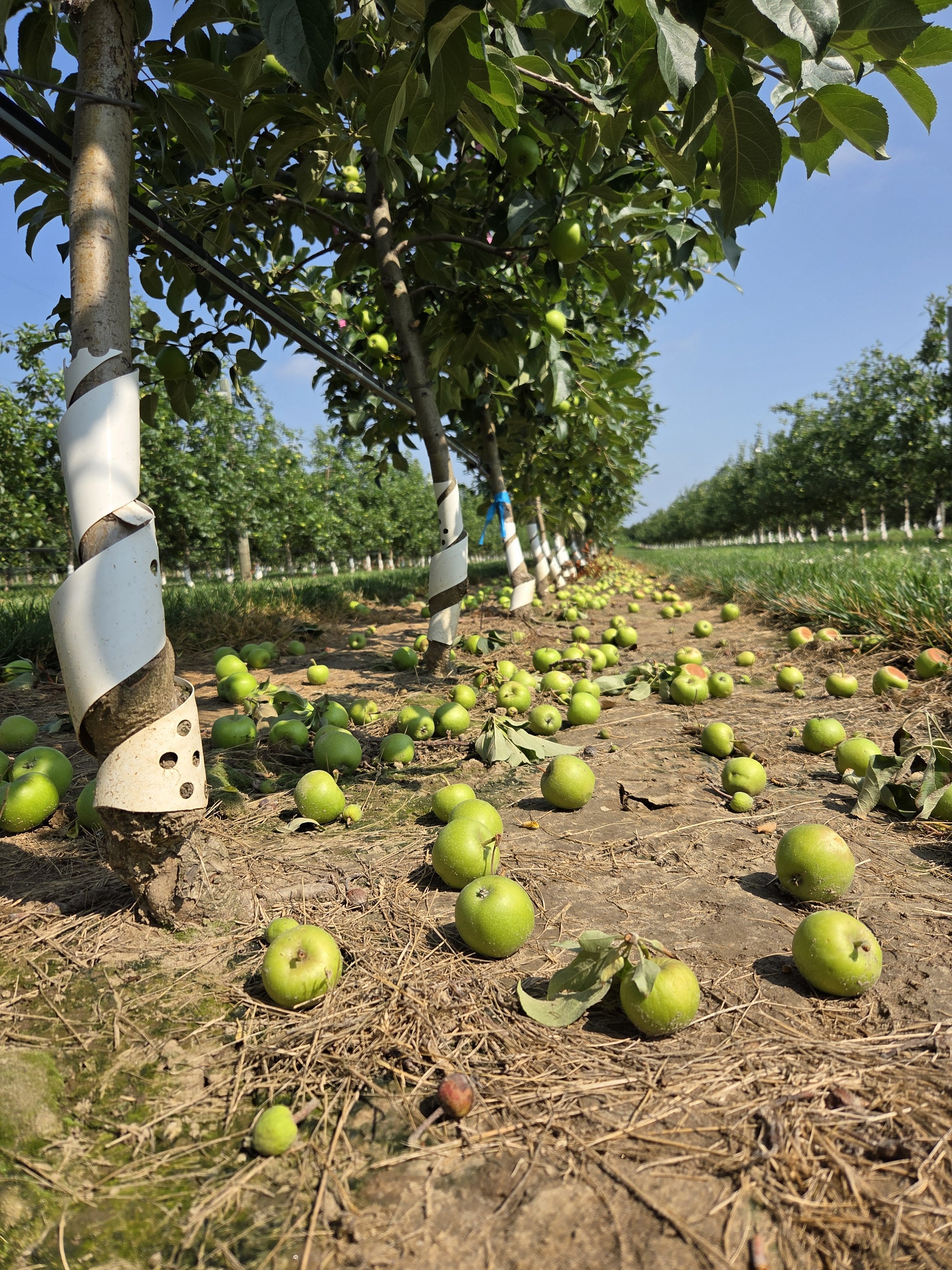
Remove or mulch dropped fruit to prevent overwintering sites for pests such as rot or larva.
Clean bins before bringing them into the orchard to avoid introducing pathogens or insects from other blocks or previous years.
Minimize bruising and wounding during harvest to reduce postharvest rots.
Degree (Days) of Separation
Based on the degree day model, crawler emergence for second generation San Jose scale is on-going across the province.
San Jose scale degree day accumulations based on March 1st biofix and base temperature 10C
Region
Current Degree Day Celsius (DDC)
Predicted Crawler Emergence 2nd Gen (806 DDC)
Harrow
1056 DDC
on-going
London
887 DDC
on-going
Delhi
1029 DDC
on-going
Grimsby
966 DDC
on-going
Clarksburg
784 DDC
Aug 8
Durham
843 DDC
on-going
* as of August 6, 2025
For more information on registered products or those with efficacy against scale, see San Jose scale on Ontario Crop Protection Hub.
For good resistance management, always rotate to a different chemical group than what was used for the earlier generation.
Have You Been Tested?
A reminder that there is FREE molecular herbicide resistance testing available to Ontario growers. This service allows Ontario farmers to submit leaf tissue samples and receive quick, accurate confirmation of herbicide resistance, often within 10 business days.
If you have noticed weed issues this season and suspect resistance may be a problem, check out the post below for more information on how to submit a sample. Take advantage of this service while it is still available!
Production and pest update brought to you by the OMAFA Apple Team:
Erika DeBrouwer, Tree Fruit Specialist and Kristy Grigg-McGuffin, IPM Specialist
Grower Grind
Across the province growers continue to hand thin, irrigate, manage pests and prepare for harvest! Early cultivars in the southwest regions are quickly approaching harvest timing. Further, the sun continues to shine meaning protection for you and your fruit is pertinent!
Growth Stages
Terminal bud set continues. Be sure to provide your trees with enough nutrients and water necessary to aid in floral induction.
At the Simcoe Research Station, fruitlets and terminals are sitting at the following:
Honeycrisp
Ambrosia
Gala
Fruitlet Size
66.0 mm
54.6 mm
53.0 mm
Terminal Growth
28.6 cm
27.2 cm
33.7 cm
Simcoe Research Station measurements taken on July 25, 2025
Rain, Rain, (Don’t) Go Away
Noting the low precipitation that continues across the province (Figure 1), be sure to provide water to your trees, not only to enable fruit size, but also to encourage resilience to heat stress.
As we get closer to harvest be sure to consider the potential for sunburn on apples. Sunburn can occur at various temperatures and is affected by many environmental factors.
Sunburn can be more damaging if there is a week of cool, windy, overcast weather followed by a hot (over 30°C) calm day with full sunshine.
Water stressed trees are even more prone to sunburn damage.
Types of Sunburn
Type of Sunburn
What Is It?
How Does It Happen?
What Happens to the Fruit?
Sunburn necrosis (Fig 1A&B)
When the fruit surface temperature exceeds 50°C for as little as 10 minutes, causing cell death.
Caused by excessive heat and is exacerbated by low humidity.
Cell death occurs, causing brown or black lesions.
Sunburn browning (Fig 1C&D)
Combination of UV-B radiation and high fruit surface temperature causing degradation of cell membranes. Sunburn browning can contribute to storage/delayed sunburn.
Typically occurs between fruit surface temperatures of 45 – 49°C, although this can change based on the variety (i.e. Honeycrisp is more sensitive than Red Delicious or Braeburn). Higher risk occurs between the hours of 11am and 5pm when maximum daily air temperature and mean maximum hourly temperature are high.
Yellow, bronze or brown spot develops on the sun-exposed side of the peel but may not appear for a few days.
Photo-oxidative sunburn (Fig 1E&F)
Shock exposure to visible light due to light intensity, which can occur at low temperatures (17°C).
Risk factors include hand thinning, tree training, selective picking, summer pruning, branch movement and postharvest transit. Photo-oxidative sunburn has been seen in the province where areas that have had ‘overcast’ conditions due to the smoke, with a sudden break and intense sunlight could have led to fruit sunburn.
Bleaching and eventual darkening of the peel.
Storage sunburn
Symptoms develop after harvest within the first few months of cold storage.
Exposure to excess heat and light stress during the growing season.
Fruit appears normal at harvest but develop brown discolouration during storage.
Strategies to Mitigate Sunburn
Adequate Moisture
Frequent, shallow watering during heat waves helps maintain soil moisture near the root zone in high-density systems. Use drip irrigation for precision and efficiency. Consider pulse irrigation to avoid water stress midday. This allows trees to continue natural physiological growth patterns.
Under Tree Mulching: organic mulches (e.g., straw, wood chips, spray on mulches – paper fibre) can help retain soil moisture and reduce surface temperature.
Field Activity Adjustments
Delay non-urgent tasks like pruning or heavy equipment use to cooler periods. Avoid stress-inducing sprays during peak heat.
Summer pruning: delay if possible and only perform on cool days with 3 or 4 days of cool weather following.
Harvest management: fruit should be moved quickly out of the sun, preferably into storage as soon as possible.
Monitoring & Record-Keeping
Use soil moisture sensors and weather stations to make timely decisions. Track GDDs and stress days to refine your response year to year.
Nutrient Support
Ensure adequate potassium and calcium to help with plant stress tolerance and fruit integrity. Foliar feeds may be used when uptake through roots is impaired.
Evaporative Cooling
Use overhead sprinklers or misters during peak heat hours to reduce canopy and fruit surface temperatures. Especially useful to prevent sunburn on fruit.
Protective Netting
Overhead netting that reflects/absorbs sunlight can reduce the impact of sun on exposed fruit. Colour of the net can influence growth, colour and quality of fruit (positivity or negatively), but can also prevent wind and/or hail damage.
Sunburn Protection Products
Apply fruit protectant, kaolin clay or calcium carbonate sprays to reflect sunlight and lower fruit surface temperatures. These often require reapplication, but can be utilized for spot treatments.
*Most sunburn protectants (kaolin clay, calcium carbonate) have limited compatibility for tank-mixing with other products; consult product labels regarding best practices for product use.
End of the Line
As trees begin to set terminal buds, you can breathe a small sigh of relief – at least when it comes to some insect and disease pressure. Terminal bud set signals the end of shoot growth, and with that comes a shift in how we approach orchard pest management.
Many insects such as aphids and apple leafcurling midge target young, tender growth and move elsewhere or become less of a threat once shoots harden off. Be sure not to let root suckers get away from you though – these pests will just move down to this new growth.
Diseases respond to this shift as well. Movement of fire blight within a shoot slows down significantly after terminal bud set, since the bacteria rely on active growth to spread. Powdery mildew is also closely tied to new shoot growth, needing actively growing tissue to infect and loses momentum once elongation stops. Watch for late season reversal and new shoot growth that sometimes occurs as mildew risk will pick back up again. A reminder though, fruit cannot be affected by powdery mildew at this stage. Fruit infection occurs over bloom.
Fly Time
Apple maggot have been caught throughout the province. Emergence is closely linked to soil moisture with flushes in flight often following periods of significant rainfall loosening soil. Those areas receiving good amounts of rain with the events rolling through may see a flush of apple maggot emergence in the coming days to weeks. On the other hand, those areas that have seen little to no rain over the last weeks may see a delayed emergence of this pest. Apple maggot has the ability to remain in the soil until conditions are right.
With catch on yellow sticky boards, it is important to differentiate between male and female adult flies. Males generally begin emerging before the females, but by peak emergence (August), the sex ratio is about 1 to 1.
Apple maggot flies. Note the rounded abdomen of the male (left) and pointed abdomen of the female (right). (Photo: Dr. Rob Smith, retired, AAFC Kentville)
Timing for management depends on the type of trap:
Sexually immature males and females are attracted to the yellow sticky boards, which mimic nectar sources. Insecticides are not needed until 7-10 days after first fly, particularly a female, is captured.
Sexually mature females ready to lay their eggs are attracted to red spheres, which mimic ripe apples and indicate an insecticide should be applied immediately as damage is imminent.
For more information on registered products or those with efficacy against apple maggot, see Apple Maggot on Ontario Crop Protection Hub.
Imidan has worked well for years as a border spray option for many growers. However, with the new label changes, all hand thinning activities must be finished before Imidan can be used. The main reason why Imidan can be used effecively as a border spray is its activity as a contact adulticide, killing adults as they fly into the orchard from surrounding areas. Not all alternative products registered for apple maggot have this same activity and therefore are not recommended in a border spray program.
In the table below, adapted from Dr John Wise at Michigan State University (2021), summarizes the characteristics of apple maggot products. Organophosphates (Imidan) and neonicotinoids (Assail, Calypso) are the only insecticide groups that have strong long-lasting activity on the adults as well as a curative effect on the eggs and larvae due to their ability to penetrate into the flesh of the fruit.
Summary of Insecticides Used to Control Apple Maggot
Based on the degree day model, crawler emergence for second generation San Jose scale has started in the earliest areas of the province.
San Jose scale degree day accumulations based on March 1st biofix and base temperature 10C
Region
Current Degree Day Celsius (DDC)
Predicted Crawler Emergence 2nd Gen (806 DDC)
Harrow
903 DDC
on-going
London
743 DDC
July 29
Delhi
836 DDC
on-going
Grimsby
799 DDC
July 25
Clarksburg
640 DDC
14+ days
Durham
696 DDC
14+ days
* as of July 24, 2025
Damage from the 1st generation crawler activity can be found. Those that have a history of damage from this pest may want to consider managing the 2nd generation to prevent fruit damage close to harvest, especially since activity can continue well into September.
For more information on registered products or those with efficacy against scale, see San Jose scale on Ontario Crop Protection Hub.
For good resistance management, always rotate to a different chemical group than what was used for the earlier generation.
As mentioned earlier, crawler activity is typically 4-6 weeks. In previous years, I have seen new scale damage on Ambrosia at the end of September. Applying two consecutive sprays 14-days apart will extend the length of coverage to avoid this late-season damage. However, be aware of the preharvest interval particularly on any early varieties.
If you are planning to make one application only, you may want to consider holding off a week or two from start of predicted emergence timings to target peak crawler activity. There is the possibility of fruit damage occurring during the gap in spray timing, particularly in a year like this where generations may be overlapping.
Small But Mite-y
The hot, humid weather has resulted in an increased activity of European red mite (ERM), two-spotted spider mite (TSSM) and apple rust mite (ARM) in some orchards. Those growers that are seeing populations reach threshold quickly are opting for miticides with relatively quick knock-down.
Keep in mind – larger, established trees can withstand higher thresholds for mites throughout the season as the tree canopy becomes more dense. Be cautious of large populations on younger or less vigorous trees.
European red mite on underside of leaf.
When choosing a product, consider the abundant life stages that are present in your orchard. For instance, if you are seeing mainly eggs, Envidor may be an option as it is slower acting. However, if the population is mainly nymphs or adults, you may opt for a product that offers a faster knock-down. Products like Nealta or Kopa should be applied as populations are building.
For more information on registered products or those with efficacy against mites, see Mites on Ontario Crop Protection Hub.
Despite the lush, dense foliage this time of year, do not let mite populations cause extensive damage. Late-season mite pressure and leaf bronzing can result in poor fruit finish and reduce winter hardiness.
What the Crop?! Apple Update: July 11, 2025
Production and pest update brought to you by the OMAFA Apple Team:
Erika DeBrouwer, Tree Fruit Specialist and Kristy Grigg-McGuffin, IPM Specialist
Grower Grind
Across the province growers are hand thinning, applying foliar nutrients, irrigating (in certain areas), preparing for harvest and keeping on top of summer time pests.
Growth Stages
Terminal bud set has begun, noting a slowing of terminal growth and an ‘end’ to this season growth. Some rainfall in certain areas has sparked new growth and certain areas seem to have a stop and go terminal ‘set’.
Terminal bud set is also an indicator of floral induction, meaning buds set for next season will be deciding whether to turn into floral buds. Be sure to provide your trees with enough nutrients and water necessary to aid in this process.
At the Simcoe Research Station, fruitlets and terminals are sitting at the following:
Honeycrisp
Ambrosia
Gala
Fruitlet Size
54.1 mm
44.6 mm
43.7 mm
Terminal Growth
25.6 cm
23.7 cm
26.6 cm
Simcoe Research Station measurements taken on July 11, 2025
Leaf It to the Lab
Terminal bud set has begun – noting an ideal timing for nutrient leaf sample collections in apple orchards. If you have not done so, but plan to, be sure to take advantage of this timing.
Rainfall has been sporadic to say the least, some growers experienced significant rainfall over a short period of time, where neighbours had minimal to no significant rainfall (Figure 1). For information on irrigation check out the resources below:
Figure 1. Accumulated rainfall across central Canada from April 1, 2025 to July 10, 2025
Beetlemania Begins
Japanese beetle activity has started in many regions. The characteristic leaf skeletonization is quite distinct. Look for damage and congregations of this pest at the top of the canopy as damage often moves down the tree. Honeycrisp is often the most preferred variety.
Most insecticides applied for oriental fruit moth or codling moth should have good efficacy on Japanese beetle; however, the tendency of these beetles to move in from surrounding areas may make multiple applications necessary.
For more information on registered products or those with efficacy against Japanese beetle, see the Japanese beetle section on Ontario Crop Protection Hub.
If applying a control product, target timing for early morning while beetles are still relatively inactive on the tree. Once feeding begins, the sex pheromones emitted by females combined with what numerous studies believe to be feeding-induced plant volatiles attract more beetles to congregate in the feeding area. Achieving knockdown before this occurs could help reduce the number of individuals coming into the orchard from surrounding areas.
Good weed control in and around the orchard will also help reduce Japanese beetle pressure. Populations tend to be more abundant in orchards where there is poor control of wild raspberry, blackberry, Virginia creeper and wild grape.
To Prune or Not to Prune – That Is The Question
There have been many questions lately on how to manage fire blight. Now that fire blight is present, when should you prune it out? Unfortunately, there is no easy answer, since the severity of the infection and the weather conditions suitable for infection impact the decision.
Be mindful of where your management recommendations are coming from. In the northeast, we experience much more humid and wet conditions than that in the western part of North America. While more arid climates may be able to leave strikes to dry, doing so in our region may result is significant spread to adjacent trees or blocks.
Pruning the trees at this time of year can have two different outcomes:
Reduce the inoculum and prevent the spread of disease.
Increase shoot growth, making the tree even more susceptible to fire blight.
Blight the Bullet
Older, Vigorous Trees
When dealing with older (especially >10 year old) vigorous trees that have MANY fire blight strikes, avoid pruning out shoot and blossom strikes early in the growing season. Extensive early pruning stimulates trees to produce succulent shoots, making them more susceptible to infections.
When dealing with high vigour trees that have only a FEW fire blight infections, pruning out the fire blight may help to provide complete control of this disease.
Older, Low Vigour Trees
In slow growing, low vigour trees or trees that have been sprayed recently with Apogee/Kudos, the bacteria generally doesn’t move into major limbs or trunks during the growing season. As a result, lesions can be pruned out when the tree is dormant. This may help to save time and money.
Young Trees
In comparison, young (<5 years) vigorous trees are very susceptible to fire blight and the bacteria may move rapidly into the trunk and down to the rootstock, killing the tree. As a result, pruning is recommended on young trees AS SOON AS INFECTION APPEARS to prevent the spread of the disease to adjacent trees.
When Does It Stop?
Keep in mind that once the terminal buds have set on apple trees, fire blight stops spreading within infected trees. Summer pruning to increase fruiting wood in high-density orchards encourages new shoot growth and extends the susceptibility period for shoot blight. However, leaving the disease in the orchard may serve as a source of inoculum, and cause increased infections in the result of hail, severe storm, or high wind damage.
Key Pruning Points
If you decide to prune out fire blight strikes, remember:
Cut at least 30 cm (12 in) or more beyond the visible infected tissue, preferably into 2nd or 3rd year wood.
Look at the cambium after your cut – if it appears brown, you need to cut further (but disinfect your pruner first!)
Prune out strikes when there are 2-3 consecutive days of low humidity and temperatures below 25°C to allow pruning wound time to heal without conditions conducive to disease spread.
Disinfect tools between cuts by dipping them in a 65-70% alcohol solution or a solution of 1 part bleach to 5 parts water.
If time and labour allow, remove pruning cuts from orchard as soon as possible and burn – but be sure not to touch healthy trees along the way!
If wet weather is not predicted, pruning clippings could alternatively be tossed into the row middles and allowed to dry before flail mowing.
Continue monitoring and managing insects in infected blocks that may spread the fire blight bacteria, such as aphids, leafhoppers and beetles.
Manage excessive succulent growth, where possible.
Prohexadione-calcium (Apogee/Kudos) can provide protective benefits when applied now (ie., thickening of cell walls to prevent infection) but this action will take 10 days from application.
Consider products that:
Surface sterilize such as Cueva or Oxidate
Boost immunity such as Lifegard, Regalia or Double Nickel
Dessicate infection such as Buran or Cyclone Plus
In sections where trees are severely affected or trees are continuously infected year after year, it may be more cost-effective to simply remove the whole tree.
Drop It Like It’s Rot
With hand thinning starting, a reminder that those apples on the ground might seem harmless, but are prime real estate for pathogens like black rot and bitter rot. This means increased risk of fruit infection for the remaining crop later in the season.
The weather lately has been optimal for bitter rot infection – hot, humid and thunderstorms. Fruit on the floor have been known to cause infection of remaining fruit on the tree by splashing spores during rain events. A simple orchard floor clean-up can go a long way in reducing disease pressure and protecting fruit quality. Toss or sweep thinned fruitlets to the row middle and mulch.
Hand-thinned fruit left on the orchard floor have been known to cause infection of remaining fruit, especially bitter rot.
Agrobotics Demo Day – Simcoe
See AgRobotics in action at the July 22nd Demo Day! REGISTER HERE
Join the AgRobotics Working Group and Innovation Farms Ontario for in-field demonstrations of robotic technology at the Ontario Crops Research Station – Simcoe (1283 Blueline Rd. Simcoe ON) on July 22, 2025 from 9:30 AM – 3 PM.
Lunch is provided to those who pre-register, so register today.
Production and pest update brought to you by the OMAFA Apple Team:
Erika DeBrouwer, Tree Fruit Specialist and Kristy Grigg-McGuffin, IPM Specialist
Growth Stages
At the Simcoe Research Station, king fruitlets and terminals are sitting at the following:
Honeycrisp
Ambrosia
Gala
King Fruitlet Size
40.2 mm
30.1 mm
33.1 mm
Terminal Growth
26.5 cm
26 cm
26.5 cm
Simcoe Research Station measurements taken on June 25, 2025
Throw Some Shade (The Good Kind)!
Considerations for a ‘Hot’ Orchard
With the recent heat wave, we aren’t the only ones feeling uncomfortable—it can also be physiologically stressful for trees. Visually assessing heat stress on trees is often found too late, resulting in leaf scorching, fruit sunburn, premature fruit drop and a reduction in growth. With this in mind, be sure to keep your orchard chill with protective methods listed below.
Irrigation Management
Frequent, shallow watering during heat waves helps maintain soil moisture near the root zone in high-density systems. Use drip irrigation for precision and efficiency. Consider pulse irrigation to avoid water stress midday.
Evaporative Cooling
Use overhead sprinklers or misters during peak heat hours to reduce canopy and fruit surface temperatures. Especially useful to prevent sunburn on fruit.
Sunburn Protection
Apply kaolin clay or calcium carbonate sprays to reflect sunlight and lower fruit surface temps. Maintain a balanced canopy to provide natural shade (avoid over-pruning in summer). For more thorough definitions of the various types of sun damage in apple – refer to this link. https://onfruit.ca/2024/06/21/what-the-crop-apple-update-june-21-2024/
Strategy
Definition & Use
Pros
Cons
Evaporative cooling
Overhead irrigation that reduces air temperature due to water vapourization
– Water stains on fruit – Root flooding
– Expensive to install, maintain and operate – Access to water source during peaks
Protective netting
Overhead netting that reflects/absorbs sunlight
– Can reduce effects of wind / hail damage – Colour of net can influence growth, colour and quality
– Expensive – Learning curve for deployment and removal – Colour of net can influence growth, colour and quality
Sprayable protectants*
Application of materials on fruit to create a physical barrier
– Spot treatment
– Not as effective as other options – Reapplication often required
*Most sunburn protectants (kaolin clay, calcium carbonate) have limited compatibility for tank-mixing with other products; consult product labels regarding best practices for product use.
Under Tree Mulching
Organic mulches (e.g., straw, wood chips, spray on mulches – paper fibre) help retain soil moisture and reduce surface temperature. Can also reduce competition from weeds for water and increase young tree growth.
Nutrient Support
Ensure adequate potassium and calcium to help with plant stress tolerance and fruit integrity. Foliar feeds may be used when uptake through roots is impaired.
Field Activity Adjustments
Delay non-urgent tasks like pruning or heavy equipment use to cooler periods. Avoid stress-inducing sprays during peak heat.
Monitoring & Record-Keeping
Use soil moisture sensors and weather stations to make timely decisions. Track GDDs and stress days to refine your response year to year.
Water You Waiting For?
Irrigation during dry periods is crucial in high-density apple orchards, where limited root zones and closely spaced trees increase vulnerability to heat stress. Consistent moisture helps maintain cell turgor, supports active photosynthesis, and prevents fruit shrivel and sunburn.
Timely irrigation not only preserves fruit quality and size but also enhances the trees’ resilience, ensuring they can withstand prolonged heat without compromising productivity.
For best management practices for irrigation management, practical calculations and drip irrigation information, check out the following links:
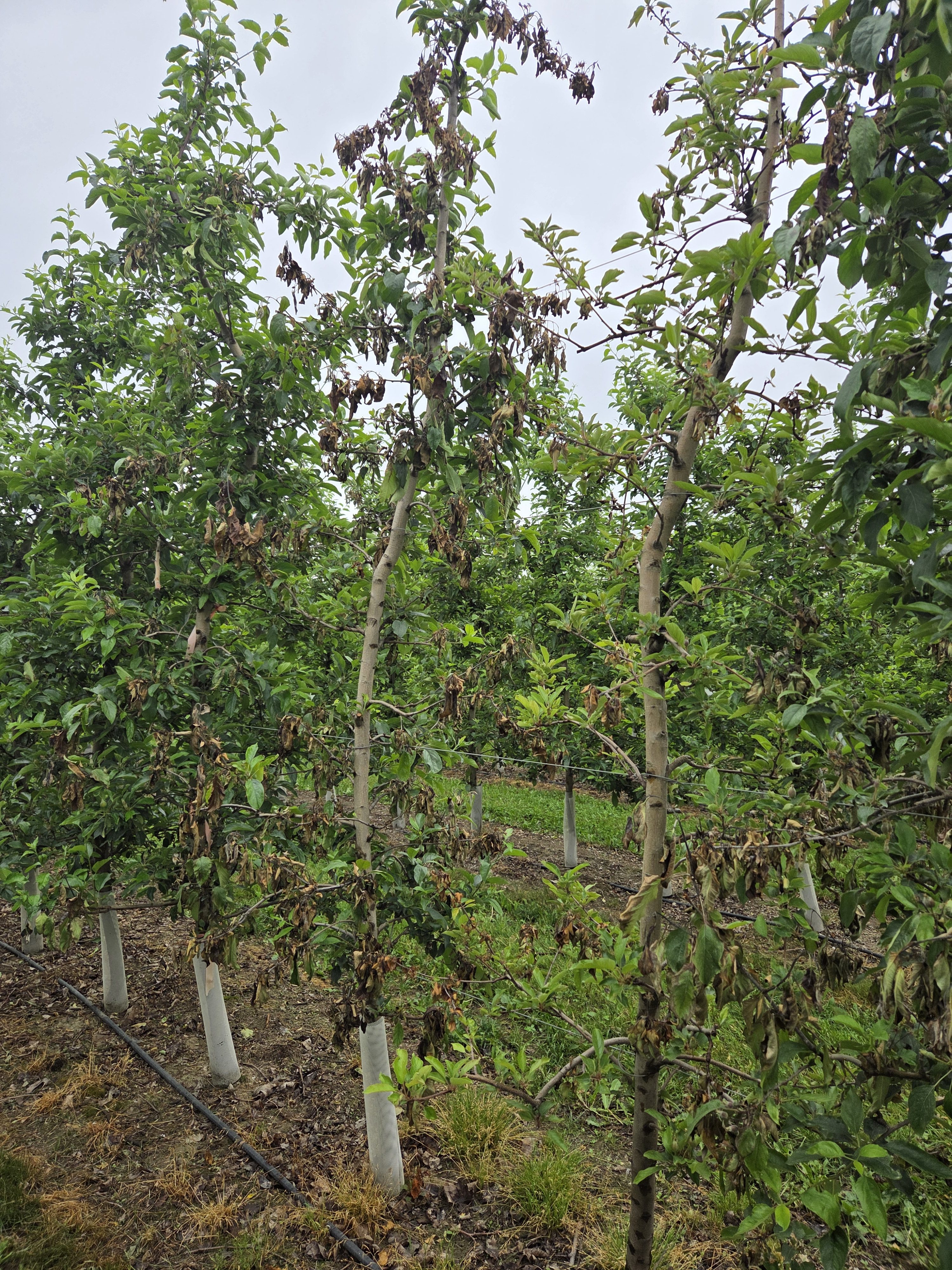
Fire blight can be found spreading through this Gala block in the warm, humid conditions.
Key reminders:
Consider products that:
Surface sterilize such as Cueva or Oxidate
Boost immunity such as Lifegard, Regalia or Double Nickel
Dessicate infection such as Buran or Cyclone Plus
Prioritize management and pruning out strikes:
Focus on young and/or vigorous blocks (with few strikes) when weather is suitable.
Delay pruning vigorous blocks with many strikes per tree, low vigour trees or blocks where prohexadione-calcium (Apogee/Kudos) has been used consistently – save this for after terminal bud set or during dormancy.
If concerned about spread but labour is limited, cut tree a foot or two above graft union and leave attached to trellis wire to dry out.
Do not prune in high temperatures and humidity – active fire blight shoots will be oozing and highly susceptible to spread.
Ideal conditions are several cooler (low 20s) days with humidity <60% (if possible in Ontario!).
Unsettled weather may bring hail, strong winds or heavy rains that could trigger trauma blight.
Apply Streptomycin (PHI 50 days), 0.5-0.8% Cueva or Oxidate as soon as possible after a trauma event (ideally 4-12 hours).
Prohexadione-calcium (Apogee/Kudos) can provide protective benefits when applied now (ie., thickening of cell walls to prevent infection) but this action will take 10 days from application.
Manage sucking insect pests such as aphids, leafhoppers, and plant bugs which can transmit the bacteria through the wounds they create while feeding.
Summer Disease
Now is the time to start considering summer disease management. While symptom development doesn’t really start to appear for fruit rots, fly speck and sooty blotch until later in the summer or into the fall, infection actually happens now.
We have had ideal bitter rot infection conditions over the last week with the hot, humid weather followed by rain. With hand thinning beginning, be sure to toss thinned fruitlets to the row middle and mulch. These fruit have been known to cause infection of remaining fruit on the tree by splashing spores during rain events.
Infection timing for fly speck and sooty blotch should also be considered. In wet years, infection typically begins 2-3 weeks after petal fall but can be delayed in areas that have not seen much rain since bloom.
Residual protection will vary depending on the product used. For example, Pristine/Merivon can provide reasonable residual control of summer disease up to 3 weeks at the labelled rate in ideal conditions; however, captan should not be pushed further than 14-days between sprays particularly since it is not as strong on fly speck and sooty blotch as other control products. In all cases, reduce interval to 7 days during times of hot, wet weather but be mindful of the preharvest interval (PHI). These values can be found under View Details for each product in the Ontario Crop Protection Hub.
Important cultural management recommendations include:
Prune and thin clustered fruit to facilitate drying and improve fungicide coverage.
Remove potential sources of inoculum such as dead branches, fruit mummies (where possible), infected fruit on the orchard floor and alternate hosts including brambles (blackberry, raspberry) from surrounding hedgerows or woodlots.
Toss pruning cuts and thinned fruit in the row middle and mulch.
Reduce tree stress by irrigating and/or applying a sun protectant, especially ahead of a heat wave.
Jump Scare
Potato leafhopper are quite active though little hopper burn and leaf cupping have been reported. This damage is caused by a toxin in the leafhopper’s saliva that blocks vascular system flow, preventing normal movement of water and nutrients to the affected area.
In most high vigour blocks, leafhopper damage is manageable, particularly once terminals harden off. However, nursery trees and non-bearing blocks require control at first sign of injury since vigour and shoot growth can be significantly impacted. With the first cut of hay happening in many regions, there may be a flush of potato leafhopper moving into orchards in the coming weeks.
For more information on registered products or those with efficacy against leafhopper, see the Potato Leafhopper section on Ontario Crop Protection Hub.
Small But Mite-y
The hot, humid weather has resulted in an increased activity of European red mite (ERM) in some orchards. Those growers that are seeing populations reach threshold quickly are opting for miticides with relatively quick knock-down. Despite the lush, dense foliage this time of year, do not let mite populations cause extensive damage. Late-season mite pressure and leaf bronzing can result in poor fruit finish and reduce winter hardiness.
The table Activity of Miticides Registered on Apple and/or Pear in Ontario lists registered miticides for summer management. When choosing a product, consider the abundant life stages that are present in your orchard. For instance, if you are seeing mainly eggs, Envidor may be an option as it is slower acting. However, if the population is mainly nymphs or adults, you may opt for a product that offers a faster knock-down. Products like Nealta or Kopa should be applied as populations are building.
Presence of European red mites on underside of apple leaf
Degree (Days) of Separation
Scale
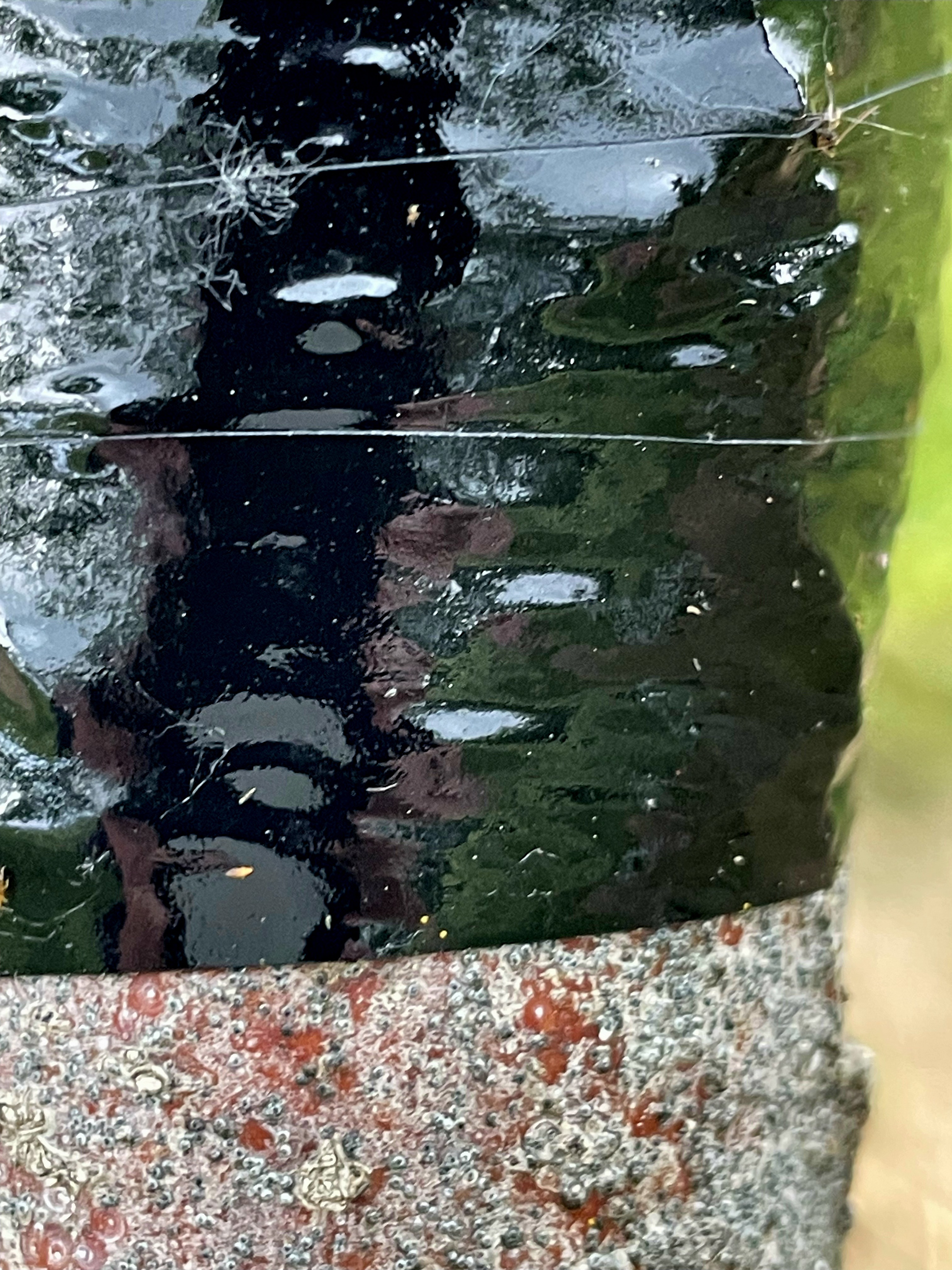
San Jose scale crawler activity for the 1st generation has begun. The heat has helped move development along quickly. To spot these small yellow-orange nymphs, you’ll need to get close to the trunk with a hand lens or use black tape (sticky side out) as you can see in the picture below.
This generation will be active, however, for 4-6 weeks as crawlers move to new shoots and developing fruitlets. Watch closely for signs of scale on fruitlets, which appear as small, reddish-purple rings or halos. Once attached and starting to feed, these immature scales will form waxy coverings that protect them from insecticides so early timing for management is important.
Black electrical tape used to monitor for San Jose scale crawler emergence (small yellow spots shown in image).
The table below highlights the predicted timings for various locations using the 14 day forecast for the respective regions. The second generation crawler emergence is predicted to begin at 806 DDC.
For more information on registered products or those with efficacy against scale, see the San Jose scale on Ontario Crop Protection Hub.
San Jose scale degree day accumulations based on March 1st biofix and base temperature 10C
Region
Current Degree Day Celsius (DDC)
Predicted Crawler Emergence 1st Gen (278 DDC)
Predicted Crawler Emergence 2nd Gen (806 DDC)
Harrow
507 DDC
Crawlers active
14+ days
London
395 DDC
Crawlers active
14+ days
Delhi
422 DDC
Crawlers active
14+ days
Grimsby
399 DDC
Crawlers active
14+ days
Clarksburg
306 DDC
Crawlers active
14+ days
Durham
341 DDC
Crawlers active
14+ days
* as of June 25, 2025
Apple leafcurling midge
Early regions are entering into the second generation adult flight. Emergence predictions for the 2nd generation adults are summarized below. See May 23rd What The Crop?! for management options.
Predicted emergence date of second generation adult apple leafcurling midge, by region (biofix March 1st, base 9C)
Region
5% Gen 2 (430 DDC)
50% Gen 2 (556 DDC)
95% Gen 2 (701 DDC)
Harrow
Passed
Passed
July 4
London
Passed
July 3
>14 days
Delhi
Passed
June 30
>14 days
Grimsby
Passed
July 1
>14 days
Clarksburg
July 2
>14 days
>14 days
Durham
June 29
July 9
>14 days
*as of June 25, 2025
Agrobotics Demo Day – Simcoe
See AgRobotics in action at the July 22nd Demo Day! REGISTER HERE
Join the AgRobotics Working Group and Innovation Farms Ontario for in-field demonstrations of robotic technology at the Ontario Crops Research Station – Simcoe (1283 Blueline Rd. Simcoe ON) on July 22, 2025 from 9:30 AM – 3 PM.
Lunch is provided to those who pre-register, so register today.
Production and pest update brought to you by the OMAFA Apple Team:
Erika DeBrouwer, Tree Fruit Specialist and Kristy Grigg-McGuffin, IPM Specialist
Grower Grind
Fruitlets continue to drop, with most growers having to hand thin to clean up particular cultivars. Most areas across the province were looking dry with many regions irrigating, but with the sporadic storm certain areas were able to shut off their irrigation for the time being.
Growth Stages
Growers are noting fruit drop across the province, with some going in to hand thin – specifically hard to thin cultivars like Gala.
Essex& Chatham-Kent – Fruit set (20+ mm)
Lambton, Middlesex, Elgin – Fruit set (20+ mm)
Norfolk – Fruit set (20+ mm))
Brant, Wellington – Fruit set (20+ mm)
Niagara – Fruit set (20+ mm)
Grey – Fruit set (20+ mm)
Durham – Fruit set (20+ mm)
Northumberland and Quinte – Fruit set (20+ mm)
Ottawa Valley – Fruit set (20+ mm)
At the Simcoe Research Station, king fruitlets and terminals are sitting at the following:
Honeycrisp
Ambrosia
Gala
King Fruitlet Size
34.8mm
28.6mm
29.7mm
Terminal Growth
15.7cm
15.8cm
18.1cm
Simcoe Research Station measurements taken on June 20, 2025
The Heat Is On (Or Is It?)
Growing Degree Day Springs Into Action
Thankfully we have recently seen brighter days compared to the previous month. GDDs have been slow to accrue due to the low temperatures across the province at the end of May and into June.
Delving into the GDDs with a baseline temperature of 5°C and using Brantford as an example (Figure 1), we note the following:
April followed typical GDD accumulation
May was above average for accumulation, until the end of the month (around Julian day 145)
June was lower than the 5- and 10-year GDD accumulation
Currently, Brantford is 16 GDD lower than the 5 year average, but is on par with the 10-year average (Table 1)
Figure 1. Visual growing degree day accumulation over time at Brantford, Ontario base 5°C
Julian Day
2025
2024
2023
5-year
10-year
90
26
33
2
24
16
120
131
134
114
110
91
151
349
460
360
374
360
170
603
704
595
619
604
Table 1. Growing degree day accumulation over time at Brantford, Ontario base 5°C
Looking at the GDDs with a baseline temperature of 10°C (Brantford as an example, Figure 2) we note the following:
April followed typical GDD accumulation
May was above average for accumulation, until the end of the month (around Julian day 140)
June continues to be lower than the 5- and 10-year averages
Currently, Brantford is 30 GDD lower than the 5-year average, and 25 GDD lower than the 10-year average (Table 2)
Figure 2. Visual growing degree day accumulation over time at Brantford, Ontario base 10°C
Julian Day
2025
2024
2023
5-year
10-year
90
4
5
0
3
2
120
35
28
46
26
20
151
119
200
156
157
154
170
278
349
295
309
303
Table 2. Growing degree day accumulation over time at Brantford, Ontario base 10°C
Be sure to check out a more in-depth and wider provincial review in the Spring Issue of ONcore (to be released shortly)!
Breezy Does It
Strong winds continue to persist over the growing season, which can cause damage of leaders, limbs, fruit drop, and even breakage of the graft union.
The best way to address wind issues is by understanding your landscape and how it can affect your orchard
Hills, valleys, dense vegetation, and fencing all factor into wind patterns and aerodynamics. Be sure to factor these in before planning or making changes to your orchard.
To mitigate wind issues consider the following:
Windbreaks on windward side of orchard trees
Orientation of rows, along the path of prevailing winds
Support trees directly after planting
Maximize strength of trellis systems and anchors
Prune trees to fruit to hang away from limbs
Prune limbs that may cause rubbing
For more information check out the following resources
The unsettled weather we are experiencing may continue to bring hail, strong winds or heavy rains that could trigger trauma blight, especially with the amount of bacterial-laden ooze out there.
Be sure to apply Streptomycin (PHI 50 days), 0.5-0.8% Cueva, or Oxidate as soon as possible after the trauma event (ideally 4-12 hours after), especially if foliage damage is extensive or fire blight is known to be active in the orchard (ie., cankers, etc). Anything applied later runs the risk that the bacteria will have already established and begun to grow, reducing the efficacy of the product.
Streptomycin will provide kickback activity for any infection already in the tree – to an extent, of course – whereas, Cueva and Oxidate are surface sterilants only (ie., will just kill the bacteria on the tissue surface before infection occurs).
Following a trauma event, continue with an immune boosting program, using products such as Regalia or Lifegard to help the tree better fight off infection. Other products such as Buran or Cyclone Plus can help as dessicants to slow the spread of shoot infection.
For a full list of registered products, see Fire Blight on the Ontario Crop Protection Hub.
Barking Up the Wrong Tree
Dogwood borer trap catch has started to peak in early regions this week in orchards with a history of problems with this pest. Adult emergence will continue through to early September but management often targets peak flight or shortly after, as explained below. Throughout their activity, females will lay eggs on the surface of burr knot formations, pruning cuts, cankers, and wounded bark, after which the larvae use these as entry points to bore into the tissue to begin feeding.
Currently, pyrethroids, Altacor, Delegate and Rimon are registered for trunk application for control of borers:
Pyrethroids at this timing can have significant impacts on the natural enemy complex.
Rimon 10 EC is an insect growth regulator (IGR) that must be absorbed by eggs or ingested by larvae to be fully effective. The optimal timing for this product is around 25-75% egg laying, or approximately peak flight.
Delegate and Altacor must be ingested by the larva in order to work; therefore it must be applied at the beginning of egg hatch, or a few weeks following peak flight.
With all products, a repeat application 14 days later is recommended.
For more information on registered products for dogwood borer, see the Dogwood Borer on Ontario Crop Protection Hub.
An alternative management option for dogwood borer next year is the mating disruption product, Isomate DWB. Dispensers (250-375 dispensers/ha) should be applied before adult borer emergence, or approximately the end of May. Researchers from Rutgers and Cornell University feel that Isomate DWB can adequately control light to medium dogwood borer infestations and give equal control to trunk drenches after multiple years of use.
Degree (Days) of Separation
Scale
For more information on registered products or those with efficacy against scale, see the San Jose scale on Ontario Crop Protection Hub.
San Jose scale degree day accumulations based on March 1st biofix and base temperature 10C
Region
Current Degree Day Celsius (DDC)
Predicted Crawler Emergence (278 DDC)
Harrow
410 DDC
Passed
London
301 DDC
Passed
Delhi
341 DDC
Passed
Grimsby
310 DDC
Passed
Clarksburg
226 DDC
June 23
Durham
257 DDC
June 22
* as of June 19, 2025
Crawlers have been observed on monitoring tape in Norfolk County this week, which aligns with the forecasted emergence.
Two yellow San Jose scale crawlers at the bottom edge of black sticky tape were observed this week in Simcoe ON.
Apple leafcurling midge
Early regions are entering into the second generation adult flight. Emergence predictions for the 2nd generation adults are summarized below. See May 23rd What The Crop?! for management options.
Predicted emergence date of second generation adult apple leafcurling midge, by region (biofix March 1st, base 9C)