Phytophthora Crown Rot and Red Stele of Strawberries
By Michael Celetti, OMAFRA Plant Pathologist – Horticultural Crops, Guelph
The wet conditions experienced last fall and earlier this spring in many regions of Ontario were ideal for infection and development of Phytophthora crown rot and red stele in strawberry crops. Symptoms of these diseases are showing up in many strawberry fields this time of year.
Phytophthora crown rot is caused by the water molds Phytophthora cactorum. Strawberry plants infected with Phytophthora crown rot frequently occur in patches of wilted and stunted plants. Leaves of infected plants may appear bluish green initially; however as the disease progresses, leaves on infected plants may develop brown necrotic tissue along the leaf margins and between the veins. The plants wilt very quickly during fruit development or during warm or hot weather conditions when plants are demanding water regardless if the soil contains adequate moisture. Symptoms are often first noticed in low areas of a field or rows where water had accumulated for an extended period after a heavy rain. Eventually the disease moves along the rows from the patch of initially infected plants. Cutting open the crowns longitudinally with a knife reveals a red or reddish dark brown spongy rot inside infected crowns (Figure 1). The reddish brown discoloration may appear at the base, middle or top of the crown. Often roots attached to the infected crown appear black at the point of attachment. The root systems are also frequently discolored and may have fewer secondary roots.
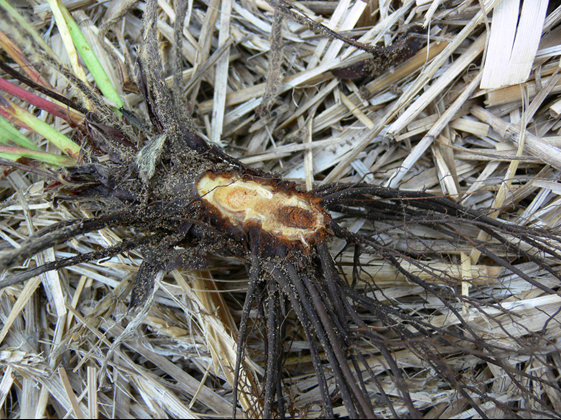
Figure 1. A reddish dark brown, spongy rot inside a strawberry crown with Phytophthora crown rot. Roots attached to the infected crown appear black at the point of attachment.
Red stele is caused by the water mold Phytophthora fragariae. It is relatively easy to diagnose red stele by digging up the roots of infected strawberry plants and slicing them longitudinally (Figure 2). The vascular tissue (sometimes called the stele) of infected roots will appear blood red surrounded by white cortex tissue hence the name “red stele”. The secondary roots are often pruned significantly giving the root system a “rat tail” appearance.
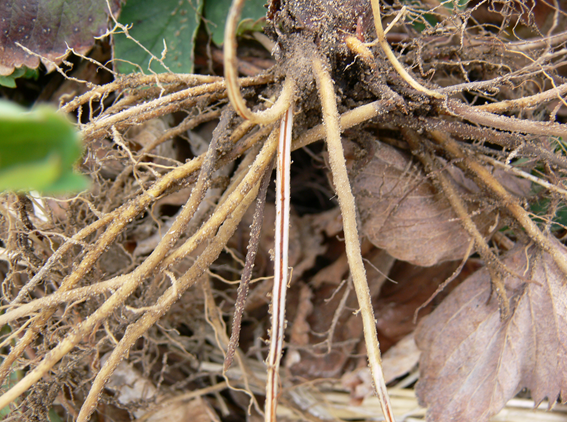
Figure 2. The vascular tissue (sometimes called the stele) of Red stele infected roots will appear blood red surrounded by white cortex tissue when cut longitudinally.
Both Phytophthora crown rot and red stele pathogens survives as persistent, resistant, resting spores for long periods in soil or infected plant tissue. During wet conditions, the resting spores germinate to produce a spore sack called a sporangium. Under prolonged periods of moist conditions, roots and crowns can become infected if they come in contact with the sporangium. However, when soils become very wet or saturated for a sustained period of time (30 minutes to 6 hours), the sporangium produce and release many specialized spores called zoospores that have tails which allows them to swim toward and infect the crowns and roots of strawberry plants. Strawberry plants growing in poorly drained fields where standing water occurs after a heavy rain; or heavy, wet soils are at more risk of becoming infected by Phytophthora spp. The pathogens can contaminate ponds when run off from contaminated fields flows into the ponds. Irrigation from contaminated ponds can spread the pathogen to other fields.
Managing Phytophthora crown rot and red stele in strawberries is difficult and requires an integrated approach. Select fields that are well drained with light soils if possible. If well-drained or light soils are not available, plant in raised beds. Avoid planting in fields that had a history of crown rot or red stele. Fumigation prior to planting will also help reduce soil populations. Always plant disease free transplants to avoid introducing the pathogens into your fields. There are no fungicides registered for Phytophthora crown rot control in strawberries. However, Aliette WDG (fosetyl-Al) and Ridomil Gold SL (metalaxyl-M) are two very effective fungicides registered in Ontario for red stele control in strawberries but not for the control of Phytophthora crown rot. However, both Ridomil Gold and Aliette will help reduce Phytophthora crown rot when treating strawberries to manage red stele. As with any pesticide, always read and follow the product label prior to use. Pay attention to timings. Ridomil Gold 480SL is registered for two applications as a soil drench in the fall for red stele control and should not be applied in the spring to bearing strawberries. Aliette WDG must be applied as a foliar spray to actively growing plants and can be applied up to four times in a growing season but has a 30 day pre-harvest interval. For best results, Aliette WDG should be applied well before infection takes place, either in early spring or early fall.