Apple Pest Update: April 14, 2023

As much as I try to prepare, the growing season always seems to catch me off guard. This year has certainly not been any different with the warm days and nights moving development along quickly. While most regions of the province are seeing signs of green, some of the earliest areas have moved from green tip to nearly tight cluster in only a matter of a few days.

With the season on our doorstep, are you prepared for early pest management? Let’s go through the checklist of things to consider:

Orchard sanitation – your first line of defense

The first line of defense for pest management in an orchard is prevention. There is no silver bullet to eradicate something like disease once it becomes well established. Instead, management is about reducing inoculum and preventing spread to healthy trees or fruit.

  • Prune out dead or diseased limbs, trees or signs of cankers as well as rotten or mummified fruit. These can harbour overwintering pests, such as fire blight, black rot or bitter rot.
  • Get rid of wood or cull piles and stumps that may have been in or near the orchard over the winter. These often provide overwintering sites for insects, such as codling moth and plum curculio.
  • If the ground is dry enough to get the tractor through, flail mow the orchard floor to mulch up leaves, branches and fruit.
  • If you haven’t already done so last fall or earlier this spring, apply 45 kg of agricultural urea per 1,000 L of water/ha to the orchard floor for scab or apple blotch (Marssonina) inoculum reduction.

Dormant copper for fire blight and scab management

Dormant copper such as Copper Spray, Copper 53W, Cueva, Parasol and Kocide can safely be applied up to ¼” green (possibly ½” green) without risk of phytotoxicity. However, the use of a softer copper registered for season-long control such as Cueva could be extended in those early spray timings to ½” green or tight cluster in blocks with low scab inoculum (ie., free of scab last year) to provide some scab protection.

Residual activity typically last about 7-10 days under ideal spring conditions. However, once rainfall exceeds 2” from last copper application, it should be assumed all residue has been washed off. For some copper formulations, using a dormant oil will act as a sticker/spreader as well as provide efficacy on scale, European red mite and suppression of powdery mildew. This is not the case for all registered coppers. Always refer to precautions listed on the product label prior to use.

Dormant oil – the earlier, the better for scale control!

Depending on the target pest, the term “dormant” oil can be rather misleading as sprays can be applied from the true dormant state prior to bud break up until pink. Unfortunately, optimal dormant timing for scale is not necessarily the same for mites.

If monitoring indicates scale is a bigger issue in the orchard, oils need to be applied before or shortly after bud break. This efficacy against scale is significantly reduced with later oil applications for European red mite as they develop a waxy protective layer that impedes the oil from effectively penetrating and preventing respiration.

However, if European red mite populations are the problem, sprays can be delayed. Ideal timing is half-inch green to tight cluster but can be delayed to pink; however, blossoms can be quite sensitive to oil under adverse conditions so consider using a lower rate at this timing.

First cover spray options for primary scab infection

For those regions further along in development, consider the following for the first cover sprays for primary scab infection:

  • Leaves are susceptible to infection as soon as green tissue is present, especially if you had scab in your orchard last year.
  • Green tip to tight cluster is a period of extensive new growth. Keep covered with a good protectant fungicide program (such as captan, folpet and/or mancozeb) and re-apply every 5-7 days during periods conducive to disease development or following heavy (greater than 1”) rain.

    • Protectant fungicides do not provide effective post-infection or anti-sporulant activity.
    • That means if sprays are applied in less-than-ideal conditions, ie., windy, alternate rows, or washed off in rain, the risk of scab infection is increased.

  • Ascospores mature slowly early season and infection takes longer in cooler temperatures, peaking over bloom period so plan to save your systemic scab products (such as Group 3, 7 and 11s) for when infection risk is greatest.
  • During cool, wet springs, protectant fungicides may not be enough. Consider using products such as Syllit, Scala, Inspire Super, Luna Tranquility or Buran which perform better in cooler conditions.

    • These products could help fill potential gaps in early season management and allow mancozeb use to be saved for pink to petal fall timing.

Early season powdery mildew management

High powdery mildew pressure in recent years followed by the mild winter could be an unwelcome mix resulting in an early spring arrival of this disease. Be sure to consider a mildew protectant such as a low rate (3-5 kg/ha) of sulfur in your early season scab program, especially on susceptible cultivars or orchards with a history of powdery mildew. Continue this until tight cluster when more systemic fungicides with mildew activity like the Group 3, 7 and 11s start to be used.

Rain deters powdery mildew development by washing off spores. Instead, mildew thrives in dry weather and high relative humidity. So, protectant sprays may still be required during dry periods when there is little risk from apple scab.

Anthracnose Fruit Rot Management Research Update

Erica Pate, Fruit Crop Specialist, & Katie Goldenhar, Pathologist- Horticulture

Fungicide options for strawberry anthracnose control have become more limited for Ontario strawberry growers in recent years. In 2015 OMAFRA detected resistance to pyraclostrobin (FRAC group 11), the active ingredient in Cabrio and one of the active ingredients in Pristine (pyraclostrobin + boscalid) and Merivon (pyraclostrobin + fluxapyroxad). Additionally, a recent re-evaluation of the broad-spectrum fungicide captan resulted in the restricted entry interval (REI) for captan products increasing to 6 days. This longer REI means growers can no longer use captan during harvest for broad-spectrum disease control and resistance management. This is particularly challenging for day-neutral growers, who need to apply regular fungicide applications throughout the long day-neutral season for anthracnose control.

A better understanding of the presence of fungicide resistance in Ontario is important, and new and lower risk fungicides are needed for control and to help slow the development of resistance. Research in 2021 was targeted at addressing the challenges with anthracnose management and included fungicide resistance survey and fungicide efficacy screening.

Group 11 resistance testing

A plate dilution test was used in 2015 when resistance to pyraclostrobin, a FRAC group 11, was first confirmed in Ontario. This test is time-consuming and expensive, so only 5 farms were included in the original survey. Fortunately, there is now an alternative method for detecting anthracnose resistance. Anthracnose resistance to group 11 fungicides is associated with a known genetic mutation that confers complete resistance. This mutation is known as the G143A mutation, and has been identified in anthracnose in other regions, including the northeastern US. Detecting resistance using this genetic mutation is a faster and cheaper method and identifies resistance to all group 11 fungicides, not just pyraclostrobin. This method was used in the 2021 survey. Additionally, older isolates of Colletotrichum sp. collected from strawberries were screened for the G143A mutation.

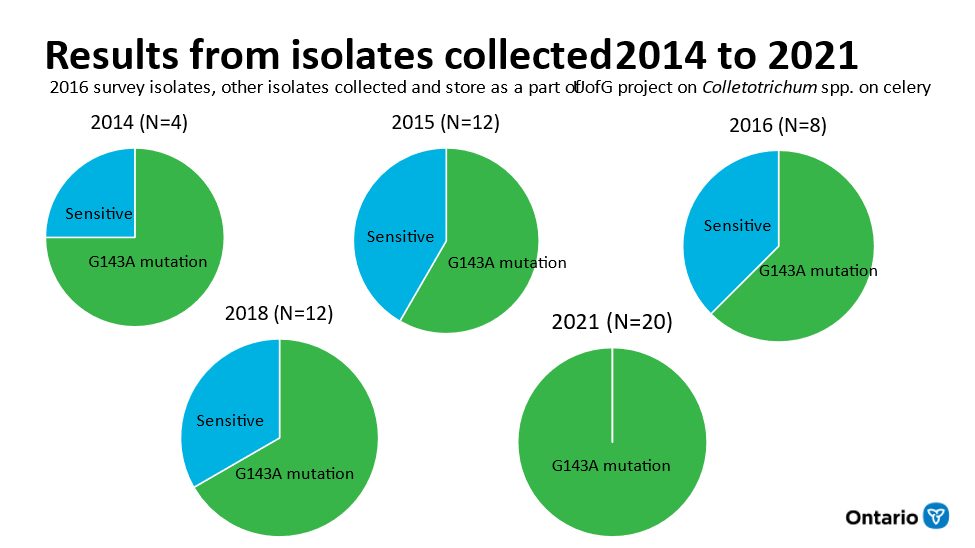
In 2021, the Ontario berry team collected two samples from ten farms across the province. The G143A mutation was confirmed in every sample we collected. These results confirm that group 11 fungicides (as well as premixes containing a group 11) may not provide adequate control of strawberry anthracnose fruit rot, and that strawberry growers should not rely on group 11 fungicides for anthracnose control. FRAC group 11 products registered for anthracnose in strawberries includes Cabrio (11), Evito (11), Pristine (11+7), Merivon (11+7), Quadris Top (11+3) and Luna Sensation (11+7).

Figure 1. Mutation screening results from 2014, 2015, 2016, 2018 and 2021. Blue indicated that the isolates did not have the mutation and green indicated isolated that have the G143A mutation, conferring resistance to all group 11’s.

Some of these group 11 products provide control for other diseases. If using a group 11 product, make sure to include another effective product against anthracnose or include a group M fungicide when possible for broad spectrum disease control. Growers interested in having their farm surveyed for anthracnose resistance are encouraged to reach out to erica.pate@ontario.ca 

Fungicide efficacy testing

There are only two fungicides registered for anthracnose control that do not include a group 11: Switch (group 9+12) and Diplomat (group 19).  New and lower risk fungicides are needed for control and to help slow the development of resistance. A fungicide efficacy study was established in 2021 at the Ontario Crops Research Centre- Simcoe to screen promising fungicides and biofungicides, to understand the control options available to growers and develop management recommendations.

Day-neutral strawberries cv. ‘Albion’ were planted in May in a randomized complete block design with 4 replications. Plants were inoculated with Colletotrichum nymphaeae spores on July 21 (after the first 2 fungicide applications). Fungicide treatments were applied on a 7 to 10-day schedule, starting at first flowering until September 7. The trial was harvested twice a week until September 7th.

Treatments:

  1. Control (no fungicide)
  2. Serifel (Bacillus amyloliquefaciens MBI 600) – FRAC BM02
  3. Problad (BLAD polypeptide) – FRAC BM01
  4. Diplomat (polyoxin D zinc salt) – FRAC 19
  5. Switch (fludioxonil + cyprodinil) – FRAC 9 + 12
  6. Cevya (mefentrifluconazole) – FRAC 3
  7. Mettle (tetraconazole) – FRAC 3
  8. Inspire (difenoconazole) – FRAC 3
  9. Fullback (flutriafol) – FRAC 3
  10. Sercadis (fluxapyroxad) – FRAC 7

This trial included non-group 11 active ingredients in two products registered for anthracnose control: difenoconazole (the other part of Quadris Top) and fluxapyroxad (the other part of Merivon). Diplomat and Switch are also registered for anthracnose control. The other products were promising potential products for anthracnose control.

Treatment 7/27 7/30 8/03 8/06 8/10 8/13 8/17 8/20 8/24 8/27 8/31 9/03 9/07
Untreated control 0 ns1 0 ns 21.6 ns 7.9 ns 39.7 a2 32.7 ab 94.1 ns 81.6 a 59.3 a 54.4 ab 97.1 a 98.9 a 100 a
SERIFEL 4.7 3.8 27.4 9.9 33.7 ab 34.1 ab 95.8 84.6 a 60.6 a 59 ab 95.6 a 94.9 a 100 a
PROBLAD BIOFUNGICIDE 1.4 1.7 20.8 7.1 21.9 ab 34.1 ab 94.2 79.8 a 55.9 a 53.2 ab 96.9 a 93.7 a 100 a
DIPLOMAT 5 SC 0 3.9 14.6 5.3 21.3 ab 22.7 ab 92.8 73.7 a 45.9 ab 32.3 b 88.3 a 83.7 a 99.4 a
SWITCH 62.5 WG 0 1.3 0 0 4.4 b 17.7 b 74 29.6 b 18.6 b 8.9 c 32.8 b 38.7 b 56.8 b
CEVYA 0.9 1.9 22.3 2.3 32.1 ab 30.8 ab 93.6 85.3 a 61.3 a 50.8 a 96 a 96.1 a 100 a
METTLE 125 ME 7.9 4.9 11.8 9.9 23 ab 29.3 ab 89.4 77.3 a 45.1 ab 42 ab 93.5 a 97.8 a 100 a
INSPIRE 5.8 9.4 17.5 9.2 30.3 ab 27.2 ab 90.7 76.9 a 62.6 a 45.7 ab 94.9 a 94.3 a 100 a
FULLBACK 125 19 21 29 10.8 49.3 a 44.5 a 93.8 86.6 a 66.2 a 64.6 a 98.7 a 98.6 a 100 a
SERCADIS 0 2.7 17 9.1 20.8 ab 26.4 ab 94.2 78 a 46.7 ab 43.5 ab 99.2 a 100 a 100 a
Table 1.  Incidence (% infected) of fruit with anthracnose (Colletotrichum nymphaeae) on strawberry cv. Albion at each harvest date.
1 ns= no significant differences at a confidence level of 5%, Tukey’s HSD.
2Numbers in a column followed by the same letter are not significantly different at P = 0.05, Tukey’s HSD test.
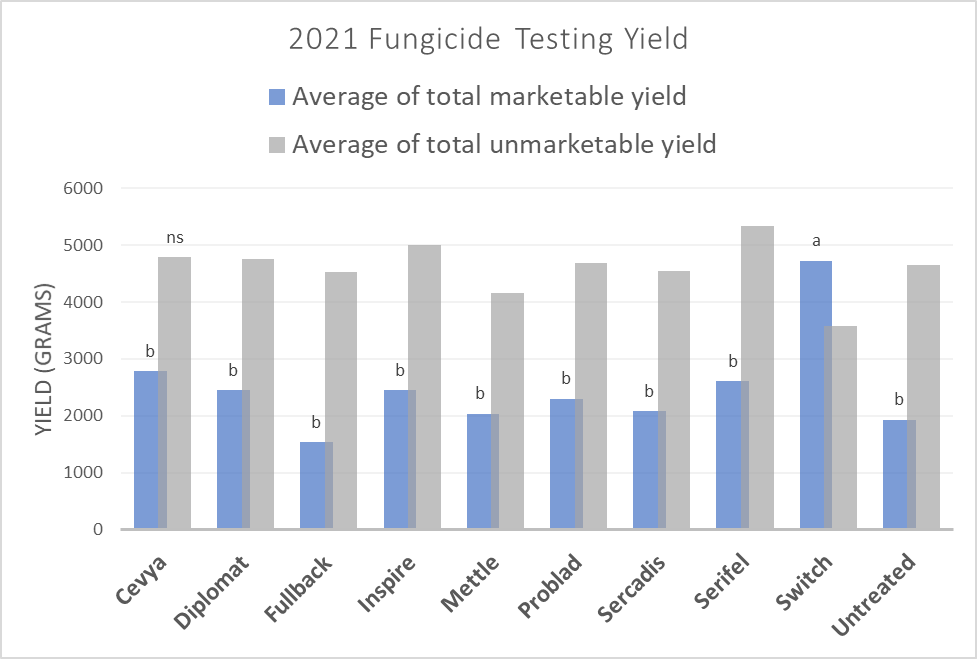
Figure 2. Marketable and unmarketable yield of strawberries from July 27- September 7. Columns with the same letter are not significantly different at P = 0.05, Tukey’s HSD test. ns = not significant

Anthracnose pressure was low at the beginning of the season, and there were no significant differences between the fungicide treatments and the untreated control until August 10. However, disease pressure began to increase on August 10th and for the rest of the season Switch was consistently more effective than the other fungicide treatments and untreated control. When disease pressure was high Switch was the only effective product at reducing disease.

This project was funded by the Berry Growers of Ontario and the Canadian Agriculture Partnership. Thank you to the participating growers and OMAFRA summer students Ali Collingwood and Mathew Wake.


Product Update for Berry Growers

New pesticides and uses have been registered for berry growers since last season. Here is a quick look at a few of the new products berry growers can use in 2022:

Fungicides

Product (active ingredient) Group Crop Pests Details
Miravis Neo
(pydiflumetofen+ Azoxystrobin +propiconazole)  
PCP#33391  
7+3+ 11 Blueberry   Anthracnose, Mummy Berry Rate: 0.75 L/ha
REI: 12 hours
PHI: 30 days
Zampro
(Ametoctradin + Dimethomorph)   PCP#30321  
45+40 Blackberry Downy Mildew (suppression only) Rate: 0.8-1.0 L/ha
REI:12 hours
PHI: 14 days
Evito
(fluoxastrobin)
  PCP# 30408
11 Strawberry Anthracnose Rate: 146-280 mL/ha
REI: 12 hours
PHI: 0 days

Insecticides

Product
(active ingredient)
Group Crop Pests Details
Closer
(sulfloxaflor)  
PCP# 30826
4C Bushberry Aphids, Leafhoppers (suppression only) Rate: Aphids: 100-200 mL/ha Leafhoppers: 200-400 mL/ha REI: 12 hours
PHI: 1 day
Entrust
(spinosad)  
PCP# 30382  
5 Blueberry Blueberry maggot (suppression only) Rate: 219-440 mL/ha
REI: 1 day
PHI: when dry
Danitol (fenpropathrin)   PCP# 33817 3 Caneberry Japanese beetle, Leafhoppers, Spotted wing drosophila Rate: 779-1169 mL/ha
REI: handset irrigation: 17 days
Tying, hand harvesting: 15 days Scouting, hand weeding: 7 days
All other activities: 24 hours
PHI: 15 days

Herbicides

Product (active ingredient) Group Crop Pests Details
Dual II Magnum
(S-Metolachlor)  
PCP# 25729
15 Caneberry Pre-emergent to labelled weeds Rate: 1.15-1.75 L/ha
REI: 12 hours
PHI: 28 days

Product cancellations:

Following re-evaluations cancellations and changes have been made to the following products:

Product Crop (pest)  
Ferbam
Product: Ferbam 76 WDG (20136)
Blueberry (Botrytis) Raspberry and Blackberry (Anthracnose, spur blight) Registration is cancelled on all uses and has been phased-out. Growers can no longer use this product(effective December 14, 2021).  
Thiram
Product: Granuflo T (30548)
Strawberry (botrytis) Registration is cancelled on all uses and has been phased-out. Growers can no longer use this product (effective December 14, 2021).  
Alias, Actara, Admire- soil applications Admire, Alias: Raspberry, strawberry, blueberry, Saskatoon berry (larvae of the European chafer & larvae of Japanese beetle)   Actara: Blueberry, Saskatoon berry (brown marmorated stink bug), Strawberry (black vine weevil adults) All soil applications of these products have been cancelled. Berry growers can no longer apply these as a soil application. The last date of use for growers is April 11, 2022.

For crop protection information this season the Ontario Crop Protection Hub will replace the OMAFRA crop protection publications, including Publication 360 Fruit Crop Protection Guides beginning Spring 2022. Join us for a Lunch ‘N Learn workshop for berry growers to learn how to use this tool and enhance your experience.

When: March 15, 2022 12:00- 1:00 PM

Register in advance:

https://zoom.us/meeting/register/tJAsf-mqqjovEtXT55Owz9391dE8R7yKwztW

After registering, you will receive a confirmation email containing information about joining the meeting


Rootshield HC® Biological Fungicide label expanded via Minor Use Program to help manage botrytis leaf blight on CG 13-07B, Bushberries

By Josh Mosiondz, Minor Use Coordinator, OMAFRA

The Pest Management Regulatory Agency (PMRA) recently announced the approval of a minor use label expansion registration for Rootshield HC® Biological Fungicide for control of Botrytis (Botrytis cinerea) in Canada. Rootshield HC® Biological Fungicide was already labeled for management of diseases on a wide range of crops in Canada. This minor use proposal was submitted by Ministère de l’Agriculture, des Pêcheries as a result of minor use priorities established by growers and extension personnel.

The following is provided as an abbreviated, general outline only. Users should be making disease management decisions within a robust integrated disease management program and should consult the complete label before using Rootshield HC® Biological Fungicide

Crop(s) Target Rate (kg product/ha) Application Information
CG 13-07B, Bushberry Botrytis (Botrytis cinerea) 10  Apply 10 grams per liter of water to foliage every 7-14 days depending upon disease pressure. Crop size, spray equipment and local practice will determine the volume of water needed. Apply prior to disease establishment, when conditions favour disease development. Apply enough volume to thoroughly cover foliage without runoff.

Do not apply or allow drift of Rootshield® HC Biological Fungicide to other crops or non-target areas. Do not contaminate off-target areas or aquatic habitats when spraying or when cleaning and rinsing spray equipment or containers.

Follow all other precautions, restrictions, and directions for use on the Rootshield HC® Biological Fungicide label carefully.

For a copy of the new minor use label contact Erica Pate, Berry Crops Specialist OMAFRA, Simcoe (519) 410-0624, your regional supply outlet, or visit the PMRA label site http://www.hc-sc.gc.ca/cps-spc/pest/registrant-titulaire/tools-outils/label-etiq-eng.php

Note:  This article is not intended to be an endorsement or recommendation for this particular product, but rather a notice of registration activity.


Ontario Apple Growers Virtual Orchard Tour

The Ontario Apple Growers are pleased to share with you the next videos for their 2021 Virtual Orchard Tour. Links to all videos in the series, including those from the Summer Orchard Tour are below.

Fall Orchard Tour

NEW RELEASE! Soil Health

NEW RELEASE! Cultivar Testing in Ontario

NEW RELEASE! Rootstock Evaluations


Summer Orchard Tour

New Orchard Advancements

Life Without Group M

The Joys of Thinning – Grower Perspectives

The Joys of Thinning – Research Update

The Ontario Apple Growers would like to thank the sponsors listed in each video for their continued support as well as all those involved in assisting with this year’s “tour”.


New Episode of What’s Growing ON?

Season 3 Episode 2: Precision Spraying

In this episode, Kristy sits down with OMAFRA’s Application Technology Specialist, Jason Deveau to talk sprayer technology. In the first part of the conversation, Jason covers tips, tricks and pieces of advice for sprayer winterization and spring preparedness. Switching gears for the second half, Jason moves into precision agriculture and the future of spray technology. Questions for Jason? Contact him at jason.deveau@ontario.ca.    

For more information on spray application and technology in Ontario, check out the following resources:


Accessible format available upon request.

Music: Aspire by Scott Holmes

Have a question or a topic you’d like us to cover? Email us at ONhortcrops@gmail.com 

Click here for a list of previous What’s Growing ON? episodes.


Marssonina (Diplocarpon) Blotch Confirmed in Ontario Apples

Recent surveys of some Ontario apple orchards this fall have confirmed the presence of Marssonina (Diplocarpon) blotch in Gala and Empire blocks. This disease could become a concern for Ontario apple growers as it seems it may be able to build up in orchards, especially with reduced late season fungicide applications.

If you suspect Marssonina (Diplocarpon) blotch in your orchard and would be interested in participating in a provincial survey, please email or call/text:

Kristy Grigg-McGuffin kristy.grigg-mcguffin@ontario.ca, 519-420-9422
Katie Goldenhar katie.goldenhar@ontario.ca, 519-835-5792

What Is It?

Marssonina (Diplocarpon) blotch of apples is caused by the fungus Marssonina coronaria and was first identified in Ontario in the early 1900s. Despite this, Marssonina (Diplocarpon) blotch has been sporadic in Ontario apple orchards. In recent years, eastern states including Pennsylvania and New York have identified an increase in this disease causing premature defoliation, resulting in lower tree health and yield loss. When foliage infection is severe, fruit lesions can occur, although they are uncommon.

What Does It Look Like?

Symptoms typically appear mid-summer on the upper surface of mature leaves. This fungus needs a long duration of leaf wetness to infect, and symptoms can take as long as 40-45 days after infection to appear.

Lesions start small (5-10mm), have a greyish, brown centre with a darkened, purple border. As the infection progresses, lesions darken and coalesce, with the surrounding tissue turning yellow, resulting in premature defoliation. At any stage of infection, when examined closely with a hand lens or dissecting scope lesions contain raised black dots or bumps which are the fruiting bodies of the fungus.

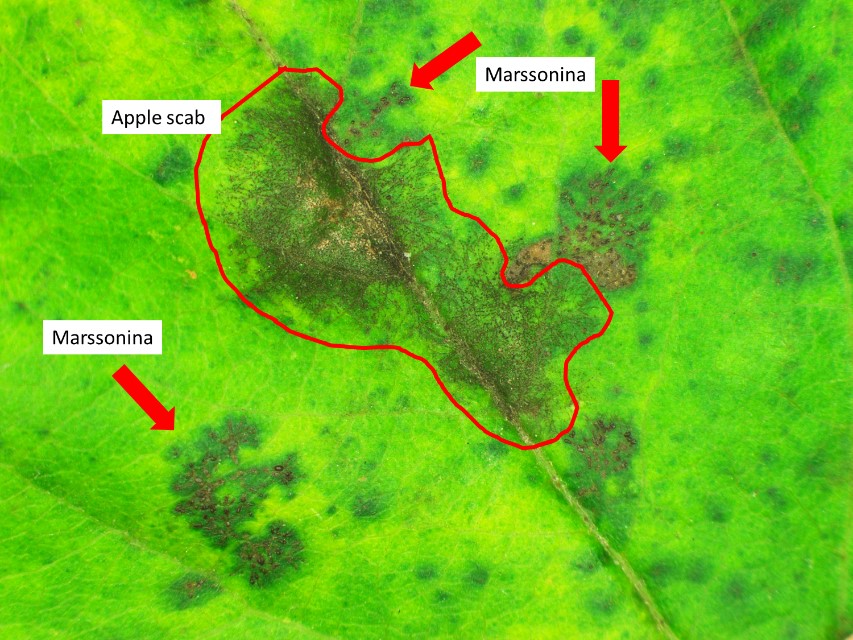
To distinguish this disease from scab lesions, the image below shows the two diseases on a mature leaf. Apple scab lesions are more web-like and do not contain the black bumps.

Photo: Kari Peter, Pennsylvania State University

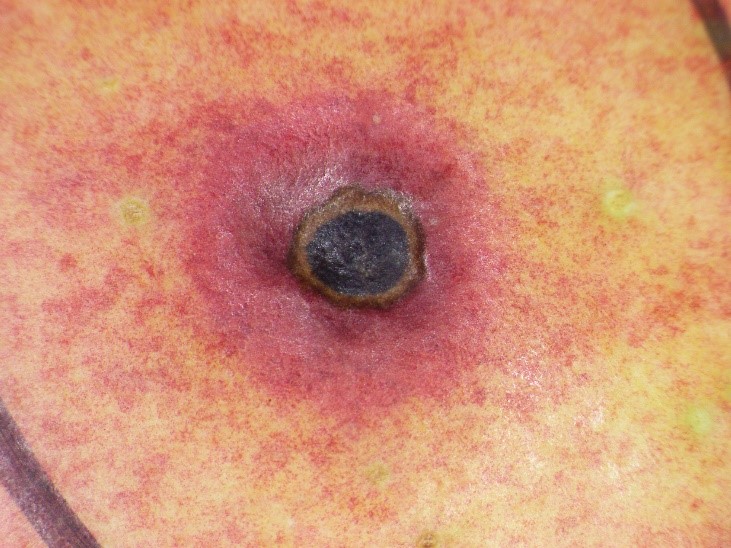
Fruit lesions are less common but can be found on trees with severe foliar infection. Fruit spots are small, dark brown/black and stay on the fruit surface with minor indentation.

Photo: Kari Peter, Pennsylvania State University

How Can It Be Managed?

This fungus overwinters in infected leaves in the orchard. Sanitization is important in limiting the disease, reducing the inoculum for disease occurrence. This includes fall and/or spring urea application and flail mowing.

There are no registered fungicides in Canada, however research shows that Marssonina (Diplocarpon) blotch is susceptible to most conventional apple scab fungicides. Captan and mancozeb have shown excellent efficacy against this disease, but both have been recently re-evaluated and application numbers reduced, which could lead to an increase of this disease in Ontario.

Cultivars differ in their susceptibility to Marssonina (Diplocarpon) blotch:

Table 1. Apple cultivar susceptibility based on observations and research in Pennsylvania experimental orchard (Kari Peter, Penn State University)
Cultivar Susceptibility (to date)
Rome Very susceptible1
Honeycrisp Very susceptible1
Empire Very susceptible1
Scab-resistant varieties Very susceptible1
Cameo Susceptible
Fuji Susceptible
Red Delicious Susceptible
Gala Susceptible to moderately resistant
Golden Delicious Moderately resistant
Stayman Moderately resistant
Cortland Moderately resistant
1 if no fungicides are applied early season


New Episode of What’s Growing ON?

Season 3 Episode 1: Neopestalotiopsis & Minor Use

In this episode, Kristy sits down with OMAFRA’s Erica Pate (Fruit Crop Specialist) and Katie Goldenhar (Plant Pathologist) to talk about an emerging pest issue in Ontario strawberries, called Neopestalotiopsis. For more information on identification and biology of this disease,  check out Pest Alert: Neopestalotiopsis – An Emerging Strawberry Disease in North America on the ONfruit blog. If you suspect this disease in your field,  contact Erica  (erica.pate@ontario.ca) or Katie (katie.goldenhar@ontario.ca).

Following,  we get a crash course on the Canadian registration process for crop protection products with OMAFRA’s Minor Use Coordinator, Josh Mosiondz (joshua.mosiondz@ontario.ca). For more information on the minor use system and product registration, check out the following resources:


Accessible format available upon request.

Music: Aspire by Scott Holmes

Have a question or a topic you’d like us to cover? Email us at ONhortcrops@gmail.com 

Click here for a list of previous What’s Growing ON? episodes.


Ontario Apple Growers Virtual Summer Tour

The Ontario Apple Growers are pleased to share with you the next videos for their 2021 Virtual Summer Orchard Tour. Links to all four videos in the series are below.

NEW RELEASE! New Orchard Advancements

NEW RELEASE! Life Without Group M

The Joys of Thinning – Grower Perspectives

The Joys of Thinning – Research Update

The Ontario Apple Growers would like to thank the sponsors listed in each video for their continued support as well as all those involved in assisting with this year’s “tour”.


New Episode of What’s Growing ON?

Season 2 Episode 9: Strawberry Viruses & Pesticide Rainfastness

In this episode, OMAFRA’s Fruit Crop Specialist, Erica Pate sits in the horticulture hotseat to talk about the importance of strawberry aphid management to minimize incidence and impact of insect-vectored viruses. Following,  Kristy dives into the waters of pesticide rainfastness to look at some general guidelines around insecticide and fungicide wash-off and how these can assist in decision-making when it comes to what to do following a rain.

For more information on strawberry aphids and their management, check out the following resources:

For more information on insecticide and fungicide rainfastness, check out the following resources:


Accessible format available upon request.

Music: Aspire by Scott Holmes

Have a question or a topic you’d like us to cover? Email us at ONhortcrops@gmail.com 

Click here for a list of previous What’s Growing ON? episodes.