Apple Update: May 31, 2016

Crop Stages

Apple buds are at full bloom to petal in Eastern Ontario and Grey County and at petal fall to 10 mm for Southwestern Ontario.

Production

Growers have started to apply thinners in Southwestern Ontario and it is definitely on the minds of growers in the rest of the province.  Most growers have had a fairly heavy bloom.
With the heavy bloom, hot days and warm nights has prompted many conversations about carbohydrate deficits. Carbon deficits occur when the demand from the fruitlets for carbohydrates is greater than what the leaves can produce.  According to the Cornell Apple Carbohydrate Thinning Model http://newa.cornell.edu/index.php?page=apple-thin , locations in New York have had enough of a carbon deficit to recommend reducing chemical thinners or not to apply thinners, depending on the day.

Diseases

Warm temperatures and high humidity have made for ideal conditions for fire blight infection. For most regions, the fire blight risk maps are predicting high to extreme risk of infection for at least the early part of the week. While petal fall is well underway across the province, growers should be aware of flowers still open and monitor closely for secondary, or rat tail blossoms. Removing or protecting these open blossoms from infection will be critical during times of high risk. Antibiotics will break down quickly in high temperatures, likely only providing 24-48 hours of protection before a re-application would be required.

While most regions have over 90% apple scab ascospore maturity, there has been little rain to distribute these spores. This may result in a significant scab infection period during the next wetting event as massive amounts of ascospores could be released. Growers should keep a good protectant program in place if rain is in the forecast.

Now is the time to begin looking for the development of scab lesions from previous infection periods in order to detect and prevent secondary infection from being established. The first lesions are generally found on the lower leaf surface as spores are splashed from the orchard floor during rain events. These start out as velvety brown to olive green with indistinct margins that darken with time. If lesions are detected, a good protectant spray program should stay in place following the primary scab infection period. For resistance management, do not use Group 3, 7, 9 or 11 fungicides if lesions are present.

IMG-20130627-00212
Early scab lesions typically appear first on the underside of leaf as velvety brown to olive green with indistinct margins.

The dry, hot and humid weather has also been ideal for powdery mildew development and early symptoms have been observed in many orchards across the province. Some key points to remember:

  • Unlike scab, mildew thrives in dry weather. So, protectant sprays may still be required during these periods when there is little risk from apple scab.
  • Fullback, Nova, Aprovia and Luna Tranquility do not provide good control of fruit scab and should be tank-mixed with a compatible protectant fungicide.
  • Vivando is no longer registered for control of powdery mildew on pome fruit.
  • Powdery mildew is fairly susceptible to developing fungicide resistance. Rotation amoung fungicide groups is very important.
  • Be aware of rotating with pre-mix products that contain multiple fungicide groups, such as Pristine (7+11), Luna Tranquility (7+9) and Inspire Super (3+9).
  • Factor in any scab resistance that may be present in the orchard when making fungicide decisions. While scab may not be the spray target at the time, the population will still be pressured if present.

Insects

Petal fall insecticides continue to be applied in most areas. The spray window for oriental fruit moth will be over in most early regions by mid-week. Some growers selected insecticides with good efficacy on mullein bug, spring feeding caterpillars, European apple sawfly and/or apple leafcurling midge if monitoring had indicated they had reached threshold or had high pest pressure.

Low numbers of codling moth have been found in traps in most regions across the province, while obliquebanded leafroller has been caught in Essex. San Jose scale has also been trapped in all monitoring orchards in the province. Spray timing for scale crawlers is predicted for the end of June.

Spring feeding caterpillar activity seems to be extended this season likely due to the cooler weather in April slowing things down. Both small and mature caterpillars can still be found in clusters or rolled up in leaves. Significant levels of feeding on blossoms has been observed in some orchards as well as suspected green fruitworm damage to developing fruitlets.
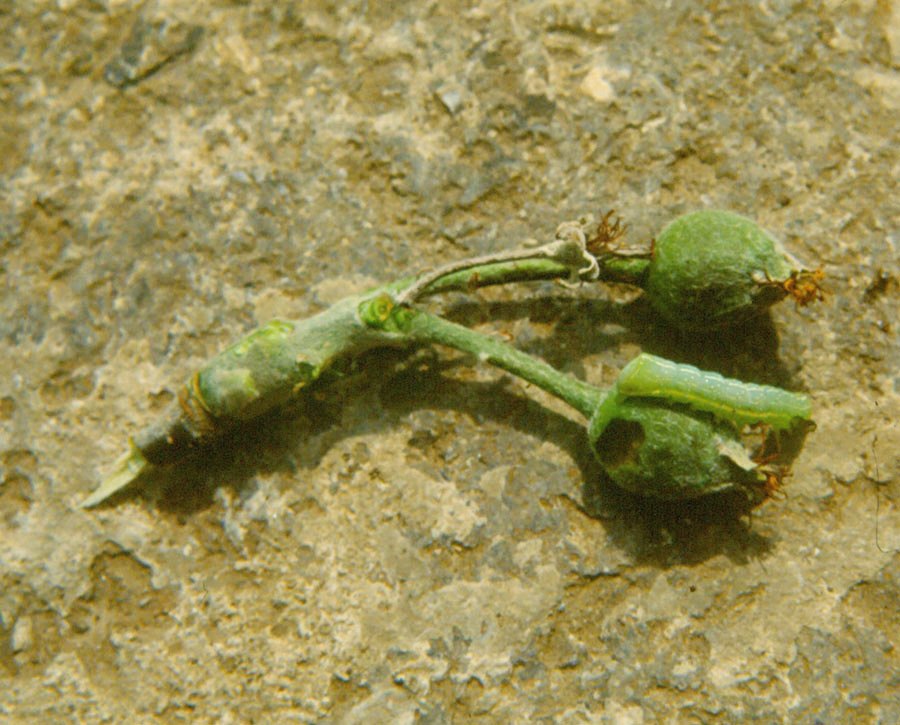
apples_green-fruitworm_03_zoom
Green fruitworm damage to developing apple fruitlet.


Apple leafcurling midge damage continues to increase across the province. Newly hatched midge larvae can now be found in tightly rolled leaves. In some earlier regions, these larvae are beginning to turn orange, which indicates the later stages of maturity.

Early miticides, such as Apollo, Agri-Mek or Nealta will be applied over the next couple of weeks in orchards with high mite pressure. Refer to Table 3-9. Activity of Miticides Registered on Apples and/or Pear in Ontario in 2016-2017 Publication 360, Guide to Fruit Production for more information on registered miticides.

  • Apollo is primarily an ovidicide, which means it targets the egg stage or newly hatched nymphs (typically no later than 14 days after petal fall). Therefore, populations should be monitored to determine the number of eggs present before Apollo is applied.
  • Agri-Mek should be applied within 21 days of petal fall. Since oil is required, do not apply Agri-Mek within 14 days of captan or sulphur fungicides.
  • Nealta is a miticide that needs to be applied as populations build, so an earlier application is ideal. Include an adjuvant to improve performance.


Apple Update: May 25, 2016

Crop Stages

Apple buds are at full bloom to petal fall across the province. The warm weather over the long weekend has sped the bud development along.

Production

Growers have been applying Apogee to trees that have 1-1.5” of terminal growth. Some growers have been applying bloom thinners at full bloom; exercise caution with applying bloom thinners at high temperatures.  Growers at a more advance bud stage will be starting to apply fruitlet thinners. There were few nights of frost warnings in Middlesex, Norfolk, Elgin, Northumberland and Grey Counties and Durham Region. The Ottawa Valley experienced temperatures of -1 to -2 one night, last week.

Diseases

Based on the fire blight prediction maps, a high to extreme/exceptional risk of infection is predicted for most apple growing regions in the province from May 24 to 26 in orchards with open blossoms.  Growers should monitor their orchards closely and take necessary action to protect open blossoms prior to a high risk event. A reminder, the prediction maps will be updated Wednesday and Friday of this week. In earlier regions, Streptomycin and/or Kasumin was applied at the beginning of last week. Those running prediction models noticed some discrepancy between MaryBlyt and Cougar Blight recommendations. While MaryBlyt was predicting a low infection potential based on conditions needed for infection to occur, Cougar Blight was predicting high risk. Many growers that have had fire blight in the past chose to err on the side of caution and put on a cover.

There are still no signs of apple scab lesions yet from earlier infection periods. Some regions experienced another scab infection early last week, though other regions were too cold for the length of wetting required. Based on degree days from bud break, 70-90% of ascospores have matured. With the forecasted rain in the coming week, growers are applying protectant fungicides to prepare for the potentially large ascospore release during the next infection period.

Insects

Petal fall insecticide programs are on many growers’ minds right now. Table 3-8. Activity of Petal Fall Insecticides Against Orchard Pests in 2016-2017 Publication 360: Guide to Fruit Production may be of some help to determine the best insecticide for control of pests listed on the product label, while managing resistance  and avoiding unnecessary sprays for non-target pests. Efficacy will be based on rate used.

Oriental fruit moth spray timing is quickly approaching in the earlier regions of the province, but exact timing will depend on product choice. Codling moth biofix has not been set yet. European apple sawfly and San Jose scale have been caught in traps in orchards monitoring for these pests. Petal fall spray timing will be critical for areas with sawfly pressure. Delaying this spray may result in extensive damage. Degree days for San Jose scale have begun to be accumulated and crawler emergence (summer control timing) is predicted mid- to late June.

ALCM adult flight continues to be high. Egg counts are increasing and can be found near leaf folds or margins of young, developing leaves. Leafcurling caused by cream colored larvae can be found in orchards with high midge pressure. This damage is expected to increase in the next week or two.

Spring feeding caterpillars are active in most orchards, with terminal and cluster damage as well as small caterpillars being observed. Some orchards have reached threshold and growers will be applying a petal fall insecticide with activity on these pests.

Mullein bug and tarnished plant bug continue to be tapped out in many regions. A small number of aphids can also be found on tapping trays in some orchards.

Plum curculio adults have been reported in a number of areas, signaling the beginning of movement into orchards.


Apple Update: May 17, 2016

Crop Stages

Apple buds are at king bloom to full bloom in Chatham-Kent, Middlesex, Essex, Lambton, Elgin and Norfolk counties  and Niagara Region; full pink to first bloom in the GTA and Simcoe county; tight cluster to pink in Grey County and east of Toronto to Ottawa. There is 1.5 inches of growth on the terminal shoot in Essex County.

Production

Pruning and tree planting is wrapping up in orchards. With 1.5 inches of growth on the terminal shoot in Essex County, some growers will be applying Apogee. Temperatures dropped between 0 and 1 degree over the weekend in areas of Norfolk, Chatham-Kent and Niagara.  Rainfall ranged between 15 to 35 mm across Ontario’s apple growing areas last week. Eastern Ontario continues to be very dry. Essex County has been receiving plenty of rain over the last two weeks.

Disease

The risk of fire blight infection was high to exceptional in Essex, Lambton, Waterloo, Wellington, Durham, Northumberland, Quinte and Ottawa regions over the weekend. Growers in southern regions of the province that had open blossoms were applying antibiotics (Streptomycin, Kasumin) in preparation for a potential infection period. The fire blight prediction maps indicate a relatively low risk of infection occurring for the remainder of the week. However, the possibility increases if weather becomes warmer and wetter in regions with open blossoms. Growers are encouraged to monitor conditions over the next few days and be prepared to take action should blossoms open and risk of fire blight infection increases. The fire blight prediction maps will be updated again Wednesday and Friday of this week.

Many regions experienced a long scab infection period at the end of last week and into the weekend. Depending on when protectant fungicides were applied and how much rain occurred (expect reduced efficacy with 2+ inches of rain), some may have found themselves without adequate coverage by the end of the wetting period. Rapid ascospore maturation is on-going in most of the province at this time which means scab infection risk is high.

Foliage is growing rapidly now. Tight cluster to petal fall is a critical time to apply systemic fungicides, such as Group 3, 7 and/or 11 for scab and powdery mildew control. For good resistance management and improved protection against fruit scab, these products should be tank-mixed with a protectant fungicide.

Frog-eye leaf spot (black rot) has been observed on leaves in some orchards with infected branches and mummified fruit. Pruning out diseased material and dead wood is important to reduce the inoculum source within the orchard.

Insects

The oriental fruit moth biofix has been set in most of the southern regions of the province. Degree days are being accumulated to determine the appropriate spray timing window.

Codling moth and European apple sawfly traps have gone up in orchards.

Apple leafcurling midge has been caught in all regions monitoring for this pest. Eggs have been observed and leafrolling has begun in early regions. Some growers have applied a pre-bloom insecticide.

Spring feeding caterpillar, mullein bug, aphid and mite activity continues.


Apple Update: May 11, 2016

Crop Stages

Apple buds are at king bloom to full bloom in Essex County; full pink to king bloom Niagara Region, Chatham-Kent, Lambton, Middlesex, Elgin and Norfolk Counties; first pink to full pink in the GTA and Simcoe County; ½” green to tight cluster in Durham Region, Northumberland County and the Ottawa Valley.

Production

Pruning is still occurring in some orchards. Tree planting is still well underway. Frost occurred in a few spots in Central and Eastern Ontario, apple buds were not as developed in these areas affected and therefore should have been hardy enough to have withstood it. Eastern Ontario has been experiencing a dry spring. Bee hives are being placed into orchards that are at full pink to first bloom.

Diseases

Risk of fire blight still remains relatively low in most regions. However, based on the Ontario prediction maps, areas in Essex may see high to extreme risk of infection later this week if fire blight is active in the neighbourhood. Bacterial ooze has been observed on fire blight cankers.

Orchards that had an extended rain early last week experienced another scab infection period. Lesions may develop over the next week or two if exposed tissue was not covered during infection periods at the end of April. Many areas in the southwest have accumulated enough degree days to now be in a period of rapid ascospore maturity. It will be critical to apply a protectant fungicide prior to the next wetting event as the risk of infection will be high.

Many growers are switching from sulphur to systemic fungicides for powdery mildew in orchards that have reached pink. An aggressive powdery mildew program will be needed during periods of rapid growth in orchards that had issues last year.

Cankers caused by various pathogens, including black rot and Cytospora spp. are being reported in numerous orchards. This is likely a result of winter injury that occurred during the extreme cold periods of 2013/2014 and 2014/2015. For more information on some of the more common types of cankers, see Alert: Cankers in Apple Orchards.

Insects

Low numbers of oriental fruit moth continue to be caught in early areas. No biofix has been set yet. Codling moth and San Jose scale traps are going up in orchards that have reached pink growth stage.

IMG_20160509_130238
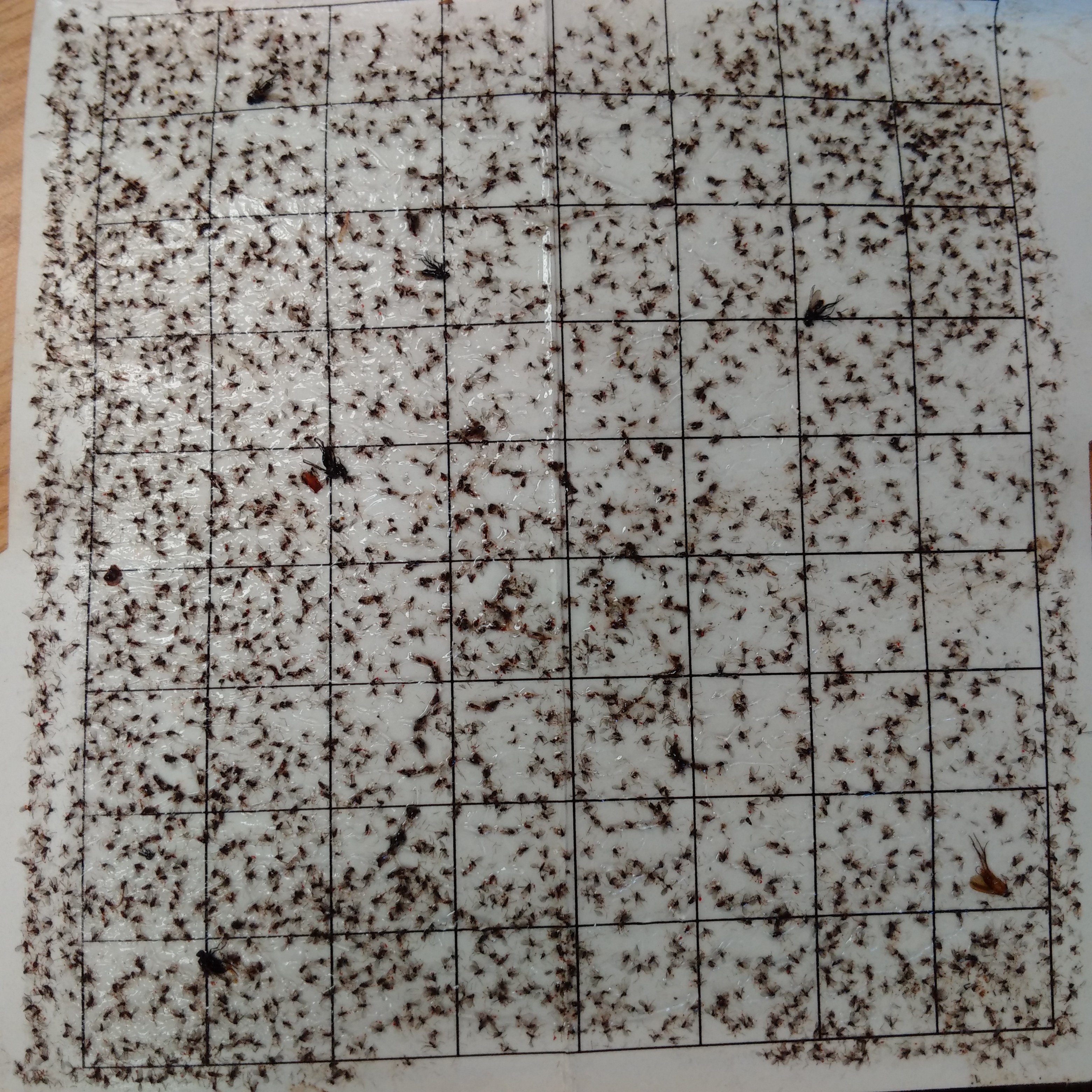
Adult apple leafcurling midge caught on sticky trap in Norfolk from May 2-9

Apple leafcurling midge adult flight  has spiked this week in monitoring sites in Norfolk County (see photo). Eggs have been found on new terminal shoots. Larvae will hatch in approximately 2-10 days after eggs have been laid, depending on temperature.

Small spring-feeding caterpillars are present on new terminal shoots, feeding on developing leaves and buds.

Mite eggs can be found in large numbers in some orchards. Some adult activity has been observed. Later regions may still have a small window of opportunity to apply oil, though the risk of frost in recent days has made this difficult.


Apple Update: May 3rd, 2016

Crop Stages

Apple buds are at tight cluster to pink in Essex County, Chatham-Kent, Elgin, Lambton and Middlesex; half inch green to tight cluster in Norfolk and Wentworth County, the GTA and in the Niagara Region; green tip to ½” green in Northumberland County and Durham Region; silver tip to ¼” green in Grey County; and silver tip to green tip in the Ottawa Valley region

Production

Pruning is close to being finished. Tree planting has been underway; many dry days have helped facilitate this to go smoothly so far.

Diseases

Fire blight risk predictions remain low for the next week based on the Cougar Blight model run by OMAFRA’s plant pathologist, Mike Celetti. The risk increases slightly for orchards that had fire blight in 2015. Prediction maps for the province are updated every Monday, Wednesday and Friday until the end of bloom (view maps here).

Most regions have experienced one or two scab infections already, with the exception of orchards in the east (Ottawa region). The rains at the end of this last weekend may have resulted in another potential infection period as well. Two to four protectant fungicides have been applied in many orchards so far.

Cankers, such as Cytospora and black rot are showing up in many orchards across the province, likely as a result of the cold winters in 2013/2014 and 2014/2015. Growers are pruning out what they can. Fungicide coverage will be important to prevent further spread to other branches and/or trees, as well as to prevent secondary infection.

Insects

Oriental fruit moth and apple leafcurling midge traps have been set up. Small numbers of both have been caught in traps in the earlier regions. No biofix has been set yet.

Oil has gone on in many of the earlier regions and continues to be applied in the later areas for mite control. With the nights dropping below freezing in recent weeks, it has been difficult to find an ideal window to apply dormant oil. However, the long-term forecast seems to be indicating a trend towards warmer nighttime temperatures.