Last Chance to Register: Berry & Apple Pick-Your-Own 2021 Round Table

Join us for a round table discussion on operating pick-your-own this season. After changing the way growers operate pick-your-own in 2020, this meeting is a chance to talk about what worked and what didn’t, ask questions, and share your experiences to prepare growers for a successful and safe 2021 season. This Zoom meeting will include an overview of the guidelines as well as a round table discussion. Dean Anderson, Strategic Advisor with WSPS, will also be joining to talk about safety plans, and will be available to help answer your questions. This round table is open for growers and staff of pick-your-own operations. Please feel free to send questions before the round table to Erica Pate (erica.pate@ontario.ca) regarding berry operations or Erika DeBrouwer (erika.debrouwer@ontario.ca) regarding apple operations for them to be addressed during the call.

When: May 18, 2021, 7:00 PM

Registration is required. Please register in advance here:  https://zoom.us/meeting/register/tJYrd–urTkvEt3j3kfBZ313efx5gQZX1zi1


July 3rd Berry Bulletin

In this bulletin:

  • Crop & pest update
  • Spotted wing drosophila
  • What’s Growing ON? Podcast

Strawberry & haskap harvest continues, raspberry harvest is beginning, and blueberry harvest will begin this week.

Berry Bulletin July 3rd

Strawberries:

Harvest continues on mid-season varieties and the first Valley Sunset are being harvested. Malwina is beginning to ripen. Demand remains strong and pick-your-own has been going very well from all reports.

Hot & dry weather continues and irrigation is needed in many areas. Rebecca Shortt has an article on our blog on How to Ensure You Are Getting the Most Crop Per Drop (URL: https://onfruit.ca/2020/06/30/how-to-ensure-you-are-getting-the-most-crop-per-drop/).

Day-neutrals are beginning to bloom for the next crop.

Insects: Spotted wing drosophila is active in many areas. After harvest renovate and mow the plants as soon as possible to reduce SWD populations building up if there are other berry crops or later strawberry varieties on the farm.  See more details on SWD management below.

Potato Leafhoppers: Leafhopper nymphs and hopper burn (leaf curling and yellowing) have been found in day-neutral fields. Monitor for nymphs on the underside of leaves in new fields and day neutrals. Cntrol may be necessary if there are 1-2 nymphs per leaf. In new strawberry plantings choose products that will control aphids and leafhoppers, such as Sivanto Prime, Assail, Admire, Cormoran, Cygon or Lagon.

Two-spotted spider mites: Spider mites can be found in day-neutrals and June-bearing fields.

Cyclamen mites: Consider cyclamen mite management as you plan for renovation. If you find mites or symptoms spray that entire variety or block. Check new fields as well – work in new fields first.

If a miticide is needed after renovation:

  • After renovation Vegol crop oil can be applied in a high water volume to ensure thorough coverage.
  • Agri-mek is registered for Two-spotted spider mite (TSSM) post-harvest. If you are applying agri-mek for TSSM you will achieve some efficacy on cyclamen mite.
  • Apply Agri-mek once there is new growth after mowing, which could be approximately 5 days after mowing. Apply Agri-mek at 225 mL/ha in 750-1000L water /ha, with a non-ionic surfactant at .1-.5%. Monitor the water pH.
  • Slow down and get thorough coverage of the plants and crowns.
  • Apply Agri-mek under slow-drying conditions to improve uptake into the leaves.
  • Do not apply sinbar after applying Agri-mek. Wait 5-7 days after Agri-mek before applying sinbar.
  • Avoid spreading cyclamen mites to new fields; work in new fields before moving to old, infested fields.

Disease:  Powdery mildew, angular leaf spot and anthracnose were reported this week.

Angular Leafspot can be found in June bearing fields, turning the calyx black and unmarketable. Powdery mildew infections can be found in over-wintered day-neutral fields. Check the lower leaf surface for white patches of the fungus. Once powdery mildew is found begin a regular spray program.

Anthracnose : Although the weather forecast is fairly dry it looks like there could be some rain today in some areas (eastern Ontario). Warm, wet weather during bloom favours anthracnose development, so make sure that as day-neutrals begin to bloom and ripen to maintain a fungicide when these conditions are present. Watch for brown, dried blooms and brown lesions on the berries.

Switch (9+12), Diplomat (19), Pristine (7+11), Cabrio (11), & Quadris Top (11+3) are registered for control of anthracnose. Anthracnose resistance to group 11s has been identified in Ontario. Rotate the use of group 11s with different groups, and tank mix with a group M fungicide for botrytis control to avoid developing resistance.

Raspberries:  

Raspberry harvest has begun in the southwest and is beginning in southern Ontario this week with pick-your-own beginning next week. Berries are ripening in eastern Ontario.

Raspberry cane borer has been found in a couple fields. This borer makes 2 rings around the top of the cane and leave the tips to wilt and die back.  Cut any affected primocane tips 2cm below the lower girdle.

Continue to watch for potato leafhoppers in raspberries, especially primocane fruiting raspberries. Monitor for nymphs on the underside of leaves in new fields and day neutrals. Spray when nymphs are present and symptoms are evident.

Blueberries:

Blueberry harvest will begin in the next next week in early areas. The crop is beginning to size nicely.

As management for SWD begins remember that sprays are needed when SWD is active and ripe fruit is present. If possible, do not spray late blueberry varieties until they are close to harvest. There are limited options for blueberry growers so if you can leave blocks unsprayed until necessary the more options you will have later on. Fruit is not susceptible to SWD until it is turning colour.

Spotted wing drosophila:

Spotted wing drosophila (SWD) has been identified in Essex, Kent, Elgin, Norfolk, Brant, Niagara, Oxford, Halton, Durham and Northumberland- many of these sites have found SWD for 2-3 weeks. The counts this year are similar to 2017, which was an early and challenging year for SWD management. Altough the forecast is hot and dry, which SWD doesn’t like, they are active and pressure could increase quickly.  Growers need to start managing for SWD now where ripe fruit is present.

Late June-bearing strawberry varieties may need to have an insecticide application this year. Exirel may be a good choice as Exirel will also control aphids, which should be managed regularly.

For strawberry growers:

  • Late season varieties could be at risk, depending on your location.
  • Encourage clean picking.
  • Renovate as soon as harvest is complete. Do not wait for late varieties to be harvested to renovate earlier blocks.
  • Overwintered day-neutral fields are more at risk compared to new plantings, because extra foliage and plant debris in older fields make clean harvest more difficult. As you drop fields at the end of the season, mow them or do something to destroy fruit.

Summer fruiting raspberry growers also need to spray for SWD. If harvest is beginning and SWD is present in your area, insecticides are needed. Regular, thorough and clean harvesting is very important for SWD management.

Growers can do a salt water test to evalute fruit quality. Check out this short video on doing a Salt water test (URL: https://www.youtube.com/watch?v=2X_F3bHiOSg).

Check the Onfruit.ca blog for full details on counts which will be updated weekly and a list of registered products.

What’s growing ON? Podcast:

Check out the new podcast What’s Growing On? The next episode coming next week covers anthracnose management in strawberries.  This podcast also includes episodes from other crop specialists, including vegetables, apples, and tender fruit. All episodes can be found under the Podcast tab on the blog homepage or at onfruit.ca/podcast.

You can also search for episodes on your favourite podcast app including Apple Podcasts, Spotify and Google Podcasts.


Pick-Your-Own Apple Orchard in 2020 Round Table

2020 has presented many unique challenges for growers this year, one of those challenges will be managing your pick-your-own orchard. On July 7th at 7:00 pm on Zoom we’ll be sharing guidelines for managing a pick-your-own orchard in 2020; we’ll hear from some experiences of pick-your-own strawberry operations; followed by an open discussion for the audience to ask questions and share some ideas or strategies.  

When: Jul 7, 2020 07:00 PM Eastern Time (US and Canada)

Register in advance for this meeting:

https://zoom.us/meeting/register/tJwrd-2rrzooHdP4I975KLushnYlS_3Oa2On

After registering, you will receive a confirmation email containing information about joining the meeting.


May 27 Berry Bulletin

In this bulletin:

  • Crop & pest update
  • Pick-Your-Own Roundtable, June 2
  • Pub 360 Print Versions

Berry Bulletin May 27

Strawberries:

A lot can change in a couple weeks! Nice to have some warmer weather this last week and see some action  in the fields. June-bearing strawberries that weren’t row covered this spring are in bloom and looking good- there has been a lot of growth over the last few days with the warm weather. Green berries can be found where row covers were used, and harvest should begin in a couple weeks. Day neutral harvest is quickly approaching.

Remove flower buds from new day-neutral plantings until there are 4-6 leaves present.

Tarnished plant bug (TPB): early instars are active now where bloom is present. More TPB can be found where row covers were used this spring. The threshold for control is an average of 1 nymph in 4 taps. There is a 2 minute video YouTube on Scouting for Tarnished Plant Bugs in Strawberries (URL: https://www.youtube.com/watch?v=88yzxn_G3Xs)

Clipper weevil: clipper weevils are also active. Look for clipped buds around the edge of fields. Border sprays can be enough to control clipper weevils- group 3 products (Mako, Matador) can be hard on beneficial insects and lead to a mite flare up.

Aphids: Insecticides are going on for aphid control. Check your new fields as well- it is important to protect these fields through the season. Cygon and Lagon can be applied before bloom and will also control TPB. Beleaf can be applied during bloom and will suppress TPB. Assail will also control both aphids and TPB. In new fields control aphids with a soil drench of Admire. Check out this article on strawberry aphid control options: What’s your plan for strawberry aphid control?(URL: http://www.omafra.gov.on.ca/english/crops/hort/news/allontario/ao0316a1.htm

Mites: cyclamen mites and two-spotted spider mites are active. Check your older fields in particular for cyclamen mite damage to determine if an application of Agri-mek is needed. Work in new fields first before moving to older fields to reduce the risk of spreading mites to a new field.

Disease: Apply fungicides for botrytis and anthracnose control during bloom. Warm wet weather during bloom favours anthracnose development. It’s warm and there is some rain in the forecast, so make sure to include a fungicide that will provide anthracnose control during bloom sprays. Captan, Maestro and Switch are registered for botrytis control and will also provide anthracnose control.

Raspberries:  

Raspberries fruit buds can be found. Ferbam or Tanos can be applied before bloom to control Anthracnose and spur blight.

Insects: watch for raspberry fruitworm and clipper weevil as flower buds develop. If there are no signs of beetles or leaf shredding an insecticide isn’t needed until after bloom.

Blueberries:

The first flowers on blueberries can be seen. Bloom is a good time to apply fungicides for anthracnose and botrytis. Use fungicides that control both these diseases. This is also a good time to control Phomopsis.

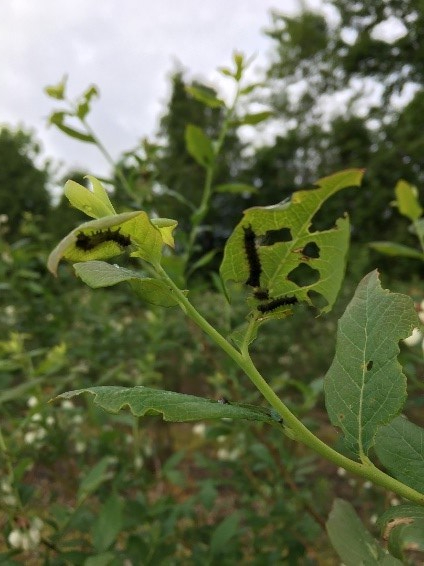
Gypsy moth: Gypsy moth larvae have been found in strawberries and blueberries. They are not usually a concern in berries but they do feed on foliage. Look in fields surrounded by woods and especially young plantings that can tolerate less damage. Bacillus thuringienesis products (Dipel, Bioprotec) applied for cranberry and cherry fruitworm will also have some activity on gypsy moth larvae. The picture (Figure 1) is from last year and are bigger than what has been seen so far this year.

gypsy moth larvae feeding and damaging blueberry leaves.
Figure 1. Gypsy moth larvae on blueberry leaves.

Pick-your-own:

With the Pick-your-own season quickly approaching join me for a PYO Zoom meeting and discussion on June 2nd: ‘Pick-Your-Own in 2020 Roundtable’.  This meeting will cover running PYO operations this season, and is also an opportunity for a roundtable discussion on different ideas and challenges to consider when preparing for the season.

When: June 2, 2020 07:00 PM Eastern Time (US and Canada)

Register in advance for this meeting:

https://zoom.us/meeting/register/tJckcO2gqjMqE9S0LZrNN52Plueov6MHNRif

After registering, you will receive a confirmation email containing information about joining the meeting.

This meeting will focus on strawberry, raspberry and blueberry operations but is applicable to other crops.

Pub 360 Print Versions

Print versions of Publication 360 can be purchased through Service Ontario. The publication has been split into Apples, Berries, Grapes, Tender Fruit and Tree Nuts.

Individual books are $10 each or $35 for the kit of all 5. The links below will take you directly to the site to order.

360A English – https://www.publications.gov.on.ca/300247

360A French – https://www.publications.gov.on.ca/300248

360B  English – https://www.publications.gov.on.ca/300251

360B French – https://www.publications.gov.on.ca/300252

360C English – https://www.publications.gov.on.ca/300255

360C French – https://www.publications.gov.on.ca/300258

360D English – https://www.publications.gov.on.ca/300259

360D French – https://www.publications.gov.on.ca/300260

360E English – https://www.publications.gov.on.ca/300263

360E French – https://www.publications.gov.on.ca/300264

Full Kit/Series English – https://www.publications.gov.on.ca/publication-360-series-crop-protection-guides-for-fruit-a-to-e

Full Kit/Series French – https://www.publications.gov.on.ca/publication-360-serie-guide-de-protection-des-cultures-fruitires-2020-21


Pick-your-own in 2020 Roundtable

With the Pick-your-own season quickly approaching join me for a PYO Zoom meeting and discussion on June 2nd: ‘Pick-Your-Own in 2020 Roundtable’.  This meeting will cover running PYO operations this season, and is also an opportunity for a roundtable discussion on different ideas and challenges to consider when preparing for the season.


When: June 2, 2020 07:00 PM Eastern Time (US and Canada)


Register in advance for this meeting:

https://zoom.us/meeting/register/tJckcO2gqjMqE9S0LZrNN52Plueov6MHNRif


After registering, you will receive a confirmation email containing information about joining the meeting.

This meeting will focus on strawberry, raspberry and blueberry operations but is applicable to other crops.