
Table of Contents
Managing Botrytis bunch rot
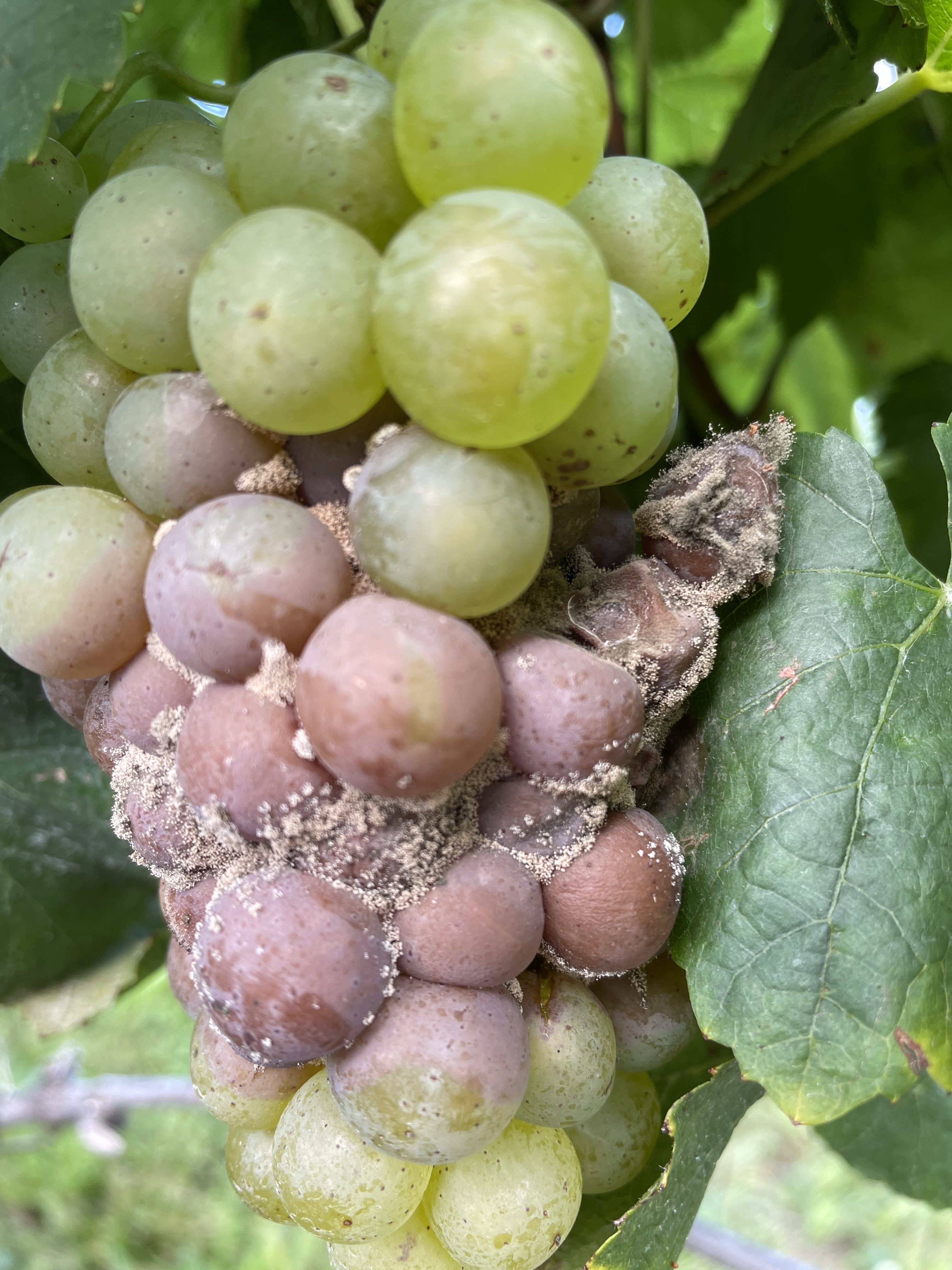
Berries become susceptible to direct infection by Botrytis once fruit reaches veraison. Under conditions of high humidity, a single berry infection can quickly spread to involve the entire cluster.
Cultural management should be your first step toward managing Botrytis bunch rot. Optimize drying conditions through canopy management and crop thinning to avoid clumped clusters. Maintain management of insects such as grape berry moth or wasps that can create wounds in the fruit that allow Botrytis to enter berries more easily. Avoid application of late season nitrogen applications. Research at Cornell showed foliar N applied post veraison to increase YAN resulted in increased Botrytis bunch rot. Thin clusters so that they are not in close contact to reduce cluster-to-cluster spread.
To reduce the risk of fungicide resistance, if sporulating infections are present, I recommend drying up the infections first with a fruiting zone spray of MilStop (potassium bicarbonate) followed by one of the products with Botrytis activity (see table below). MilStop will increase the pH, which may reduce the effectiveness of a Botrytis fungicide so check with the company to confirm whether a tank mix is recommended. I’ve heard reports that Folpan or other WP fungicides may also dry up Botrytis infections and these can be tank mixed with a Botrytis product unless specified otherwise on the label. Be aware of preharvest intervals when considering a desiccating tank mix partner.
Make sure that you consider fungicide group rotations and avoid using products from the same group in back-to-back sprays.
Fungicide | Group | Botrytis | Maximum Applications | REI | PHI |
Elevate 50 WDG | 17 | 4 | 3 | 5 days (leaf pulling) | 7 days |
Kenja | 7 | 4 | 3 | 12 hr | 14 days |
Scala | 9 | 4 | 3 | 24 hr | 7 days |
Intuity | 11 | 4 | 3-4 (2.631 L/ha) | 12 hr | 10 days |
Switch 62.5 WG/Impala | 12 | 4 | 3 | 48 hr | 7 days |
Inspire Super | 3+7 | 4 | 2 (3 L/ha) | 7 days | 14 days |
Luna Tranquility | 7+9 | 4 | 2 | 24 hr | 45 days |
Miravis Prime | 7+12 | 4 | 2 | 12 hr | 14 days |
Diplomat 5 C | 19 | 2 | 3 L/ha | When dry | 0 days/12 hrs1 |
Allegro 500 F | 29 | 4 | 2 | 9 days (leaf pulling) | 21 days |
ProBlad Biofungicide | BM1 | 3 | 5 | when dry | 0 days |
Serenade OPTI | BM2 | 3 | not specified | when dry | o days |
Serifel | BM2 | 3 | not specified | 4 hrs | 0 days |
Stargus | BM2 | 1 | not specified | 4 hrs | 0 days |
Botector | NC | 2 | 4 | 4 hrs | 0 days/4 hrs1 |
Double Nickel | NC | 2 | not specified | when dry | 0 days |
Oxidate 2.0 | NC | 1 | 8 | 4 hrs | 0 days |
Timorex Gold | NC | 3 | not specified | when dry | when dry |
MilStop | NC | 2 | 10 | 4 hrs | 0 days/4 hrs1 |
Regalia Maxx | P5 | 1 | not specified | when dry | 0 days |
1 Machine/hand harvest
Waxy grape berries are difficult to wet. Some research suggests that the use of wetters (a type of adjuvant) may improve late-season control of botrytis. Read the product label or ask the chemical supplier as most product formulations already contain adjuvants and too much wetter added to the tank mix can result in less chemical being deposited on bunches.
Managing Sour rot
Sour rot is caused by acetic acid bacteria and yeasts that reside on the outside of the fruit. Infection frequently starts in the centre of the cluster where berries are squeezed as they swell. Drosophila spp (“fruit flies”) are excellent vectors of these organisms and can rapidly spread the disease throughout a vineyard.
Research in Ontario and New York has shown that applications of antimicrobials such as potassium metabisulphate (KMS at 5 kg/1,000 L) or peroxide (Oxidate) in combination with insecticides were the most effective way to manage the disease.
Manage insects as well
It is critical to manage not just the yeasts and acetic acid bacteria that cause sour rot, but also the Drosophila flies (spotted wing Drosophila as well as the common “fruit fly) that can carry and spread them.
Wasps or yellow jackets are attracted to the juice that leaks from damaged berries. They also have mouthparts that are capable of puncturing berry skins to get to the sweet insides.
Earwigs seemed to be present in almost every cluster I examined last week. While they don’t damage clusters, some research in Europe found that wine made from Pinot noir contaminated with 10 earwigs/kg of fruit was described as reductive, acidic and vegetal. I don’t know that we’re at that level of infestation yet.
The most effective labeled treatments for SWD (and common fruit flies) are Delegate and Success and they both have activity vs wasps and earwigs, but not MALB.
Insecticides | SWD | Wasps | MALB | Earwigs | Applications | REI | PHI |
Malathion 85 E | 1 | 1 | 4* | 3 | 1 | 4 days | 3-4 days2 |
UP-Cyde 2.5 EC, Ship 250 EC | 3 | 4* | 4* | 3 | 2/31 | 12 hr | 2-7 days2 |
Delegate | 4* | 3 | 0 | 3 | 3 | 12 hr | 7 days |
Entrust | 3* | 3 | 0 | 3 | 3 | 7 days | 7 days |
Success | 4* | 3 | 0 | 3 | 3 | 7 days | 7 days |
Harvanta | 4* | 0 | 0 | 0 | 3 (4.8 L/ha) | 12 hr | 7 days |
* Labeled for the pest on grapes. 1 Maximum applications for hand/mechanical harvest. 2 PHI for machine vs hand harvest
Is it worth it to keep spraying?
There will be seasons when we must accept that very favourable weather for botrytis can undo our best efforts in the vineyard. A season-long spray program may not be enough to control botrytis when the risk of disease is very high.
In wet seasons, it can be very tempting to keep on spraying as long and as much as possible; however, once botrytis becomes highly visible in the vineyard and the weather forecast is for ongoing rain, it sometimes can be more cost-effective to do nothing and harvest as much as possible and as early as possible, if you have this ability. Under these conditions, spraying provides very little, if any, extra benefit relative to the cost (e.g. fuel, labour, fungicides). Maintain close communication with your processor regarding harvest timing and requirement for pesticide applications.
0 comments on “Pre-harvest pest problems in vineyards, 2024”