
Table of Contents
Multicoloured Asian Ladybeetle
There has recently been an increase in Multicoloured Asian Lady Beetle (MALB) populations in vineyards. The insects are looking for sugar food to help them overwinter and also looking for shelter. They often squeeze into the middle of clusters, especially overnight, and emerge when the sun is warm.
A threshold of 200-400 MALB per tonne of fruit has been suggested. MALB that are dead for 3 days or more do not result in taint, whereas live MALB or those dead for only 1 day may result in taint. However, many processors have much lower thresholds so please contact your buyer/processor directly to determine if controls are required to meet buyer needs.
Wasps
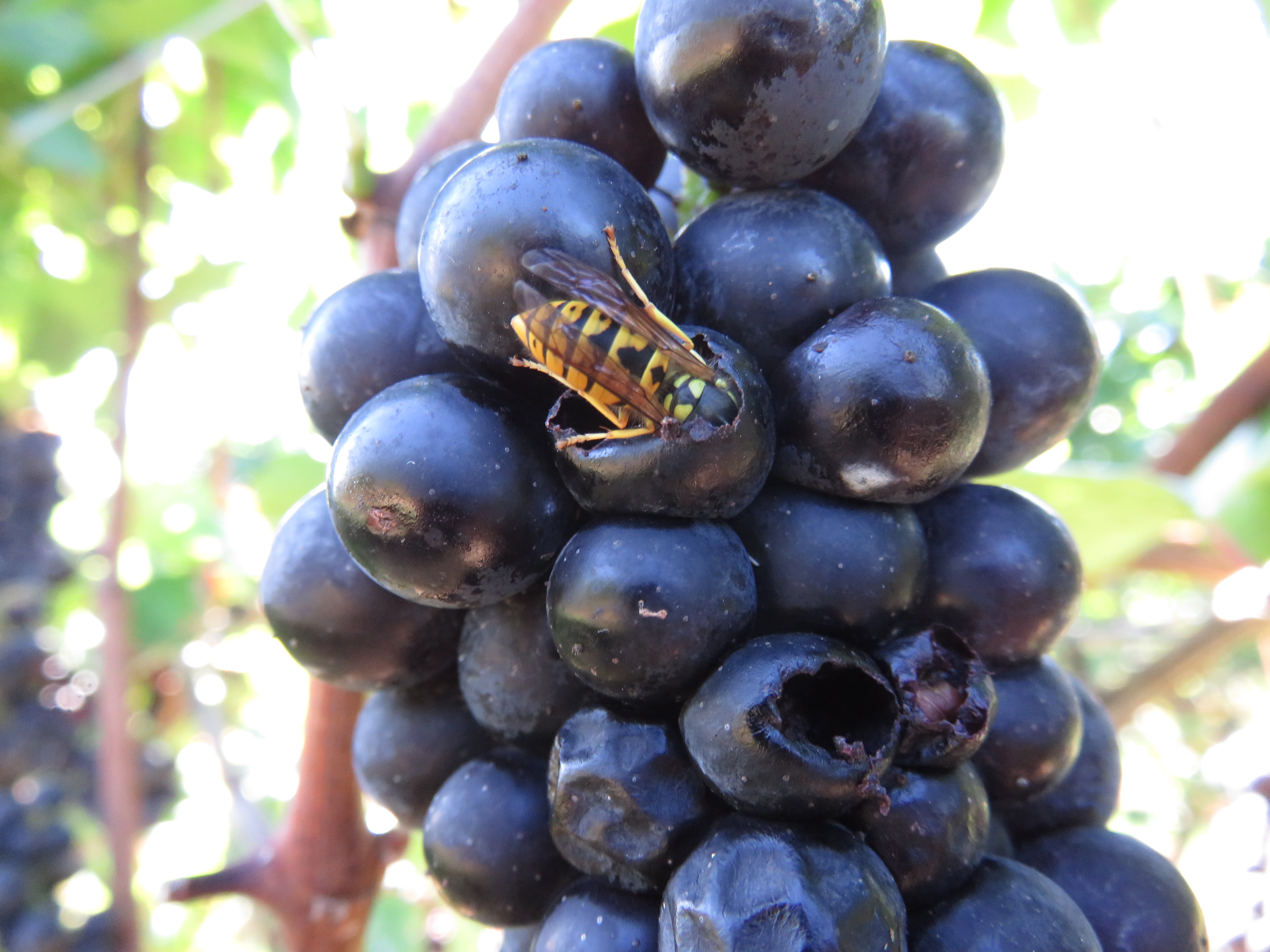
Wasps can pierce the skin of berries with their mouthparts to feed on the sugary juice. Problem one is that the leaking juice becomes a food source for sour rot pathogens which can continue to multiply and infect at temperatures as low as 10°C. Problem two is the hazard to workers in the vineyards and wineries.
The most effective way of managing wasps/hornets/bees in the vineyard is to manage the crop to reduce injury that attracts the insects. While wasps, like yellow jackets, can feed directly on sound grape berries, they are usually attracted initially to damaged fruit, meaning healthy grapes are less susceptible. This can be done by minimizing injury caused by birds, other insects, and diseases. Also, removing overripe and already damaged fruit from the grapevines can eliminate attractive sources. They also make hand work very challenging.
Drosophila
All species of Drosophila can transmit the pathogens that cause sour rot. They are attracted to grape berries as they ripen. Spotted wing drosophila can create wounds in the skin of berries during egg laying. These allow juice to leak out which attracts more flies. Berry squeeze can accomplish the same thing. Management of them can help with reducing the spread of sour rot in the vineyard.
Earwigs
Earwigs also lover hiding in the middle of grape clusters. While they don’t damage clusters, some research in Europe found that wine made from Pinot noir contaminated with 10 earwigs/kg of fruit was described as reductive, acidic and vegetal; however, in another study, wine made from Chasselas or Pinot noir contaminated with 5 earwigs/kg fruit was not distinguishable from uncontaminated fruit. I have yet to find a grape cluster with 10 or more earwigs. They do make hand work in the vineyard uncomfortable for workers, especially those who are familiar with a particular Twilight Zone episode…
Chemical management
When choosing a pre-harvest product for insect management, consider which pests you’re targeting while also making sure the pre-harvest interval suits your harvest.
Insecticides | SWD | Wasps | MALB | Earwigs | Applications | REI | PHI |
Malathion 85 E | 1 | 1 | 4* | 3 | 1 | 4 days | 3-4 days2 |
UP-Cyde 2.5 EC, Ship 250 EC | 3 | 4* | 4* | 3 | 2/31 | 12 hr | 2-7 days2 |
Delegate | 4* | 3 | 0 | 3 | 3 | 12 hr | 7 days |
Entrust | 3* | 3 | 0 | 3 | 3 | 7 days | 7 days |
Success | 4* | 3 | 0 | 3 | 3 | 7 days | 7 days |
Harvanta | 4* | 0 | 0 | 0 | 3 (4.8 L/ha) | 12 hr | 7 days |
* Labeled for the pest on grapes. 1 Maximum applications for hand/mechanical harvest. 2 PHI for machine vs hand harvest
Alternatives to insecticides for MALB
Glemser et al. (2012) found that an application of potassium metabisulfite (KMS) significantly reduced the number of MALB on grape vines. This suggests that KMS is an effective repellent against MALB and may be suitable for use in vineyards to control this pest if applied immediately before harvest. KMS (5 g/liter) applied to Riesling grapes at 2 wk, 1 wk, 3 d, or 1 d before harvest did not affect free sulfur dioxide in either freshly processed or settled juice.
MALB can rapidly move into harvested clean fruit in open-top bins in the field or at the winery. Ensuring a tightly fitting lid that is not removed until sampling at the winery will prevent MALB from contaminating loads of fruit.
Some new harvesters offer an optional destemmer that separates the berries from the stems, roller sorting tables and an air cushion that blows out any Material other than grapes (MOG), including MALB.
Optical sorters employ a combination of destemmers, shaker tables and high-speed cameras and image-processing software to quickly scan and sort destemmed grapes to remove almost all MOG, including MALB and earwigs.
Shaker tables are effective at separating MALB from the fruit, thus preventing extraction of MPs from the beetles during grape processing. The shaking motion forces beetles through the mesh into a collection and disposal area below. On sorting tables, make sure to inspect the interior of clusters as much as possible as they tend to be very good at hiding in the middle of clusters.
Alternative to insecticides for Wasps
Dr. Rufus Isaacs, Michigan State university entomologist, recommends perimeter trapping in midsummer, to get rid of as many wasps as possible before harvest. He said tests where he and his team placed traps around the perimeter of a vineyard — about 10 traps per acre — reduced the number of wasps by an average of 50 percent. Trapping in early spring can eliminate the queens responsible for establishing new colonies. Food-based traps can be effective in eliminating small numbers of insects, but the attractant needs to be kept fresh by replacing on a regular basis.
The traps were simple plastic containers with holes in them, baited with protein at first, then apple cider or apple juice later in the season. Chemical baits might work well, too, as well as water and soap, since cider and juice tend to get sticky, he said.
Alice Wise, viticulture researcher and grape guru at the Long Island Horticultural Research and Extension Lab in Riverhead, NY, reports excellent results controlling birds AND yellow jackets using exclusionary, fine mesh nets.
0 comments on “Preharvest plague: Managing vineyard insects in the preharvest period”