

Production and pest update brought to you by the OMAFA Apple Team:
Erika DeBrouwer, Tree Fruit Specialist and Kristy Grigg-McGuffin, IPM Specialist
Table of Contents
Grower Grind
A glimpse of warm weather has progressed apples quickly across all regions. Thinners have been applied amongst all districts, where growth staging ranges anywhere from 5mm to 18mm, location to location. Variance in fruitlet sizing within clusters and even between kings and laterals, has been noted across the province.
Growth Stages
Fruitlets have been pushed quickly with the few days of heat over the past week.
- Essex & Chatham-Kent – Fruit set (14-18mm)
- Lambton, Middlesex, Elgin – Fruit set (14-18mm)
- Norfolk – Fruit set (10-14mm)
- Brant, Wellington – Fruit set (8-12mm)
- Niagara – Fruit set (8-12mm)
- Grey – Fruit set (8-12mm)
- Durham – Fruit set (8-12mm)
- Northumberland and Quinte – Fruit set (5-8mm)
- Ottawa Valley – Fruit set (5-8mm)


At the Simcoe Research Station, king fruitlets and terminals are sitting at the following:
Honeycrisp | Ambrosia | Gala | |
|---|---|---|---|
King Fruitlet Size | 14.9mm | 12.5mm | 14.9mm |
Terminal Growth | 7.9cm | 7.4cm | 10.6cm |
Cull Me Maybe?
How to do Thinning Assessments
Are you wondering what your thinner efficacy is like? Be sure to follow up with data driven information to help you in future chemical thinner applications.
Tagged Cluster Monitoring
- Select 5 trees per block
- Tag 5–10 representative limbs per tree
- Count and measure fruitlets (diameter in mm) before and 7–10 days after application
- Calculate % fruit drop
Note that this method may be less time consuming, but will be delayed in showing thinner efficacy in comparison the the fruitlet growth rate analysis.
Fruitlet Growth Rate Analysis
- Select 5 trees per block
- Mark and number 15 clusters per tree
- Number each fruitlet within each cluster
- Measure fruitlet diameter daily or every 2 days after application
- Fruitlets that stop growing are likely to abscise
Any tree stress will escalate thinner efficacy, for example – dry conditions
Keepin’ It Kingly
Chemical thinner efficacy is nuanced, as there are multiple factors at play. Given the current weather conditions consider the following:
- Solar Radiation: a critical factor. Low solar radiation after application significantly increases fruit drop. Cloudy conditions enhance thinning efficacy.
- Temperature: lower than <18°C decreases chemical thinner efficacy.
- Rainfall: Can wash off thinners if it occurs within a few hours post-application.
Remember that temperature, light and fruit diameter all play a factor in the efficacy of a chemical thinner application.
Below is a table of chemical thinners permitted to be applied with the current staging across the province.
Chemical Thinner Overview
Active Ingredient(s) | Tradename | Application Timing |
|---|---|---|
1-NAA 1-naphthaleneacetic acid | Maintain, Fruitone-L | Bloom – fruitlet sizing, bloom to 30 days after bloom |
6-BA 6-benzyladenine | Cilis Plus, Maxcel | Petal fall – fruitlet sizing, up to 20mm |
1-ACC 1-aminocyclopropanecarboxylic acid | Accede | Bloom – 25mm |
Carbaryl | Sevin XLR | Petal fall to 25 days after bloom |
Moist Above, Dust Below
The weather has been variable across the province, with drizzly days, but dry soils, high winds, and recently smoke in the air. Below are articles to aid in mitigatory measures for the conditions.
Spray resources:
- Pesticide Drift from Ground Applications
- How Weather Conditions Affect Spray Applications
- Six Elements of Effective Spraying in Orchards and Vineyards
High wind resources:
Irrigation resources:
- Using ET Data to Make Irrigation Decisions
- Drip Irrigation Scheduling
- 3 Secrets of Irrigation Water Taking Permits Revealed
Smoke resources:
- Map: Ontario’s Air Monitoring Stations, AQHI
- It’s Up in the Air: Concern about the Impacts of Smoke from Wildfire on Horticultural Crops
- Air Quality Health Index (AQHI)
The combination of cool wet weather, followed by warm sunny days has lead to a flush in growth. Be on the look out for growth cracks – particularly in Ambrosia – and take precautions with fungicide applications effective against fire blight and canker-causing pathogens.

Fungus* Amoung Us (*And Bacteria)
Fire blight
Unfortunately, the cool weather didn’t keep fire blight completely at bay. With the increase in daytime temperatures, signs of both blossom and shoot blight have started to be reported across the province.
Continue to follow the Ontario Fire Blight Prediction Maps for predicted risk in your region.
Blossom blight
Of particular concern this year is the staggered or irregular bloom in some cultivars. With different bloom stages occurring within an orchard (or even on a tree), the window of fire blight infection risk is extended until the last blossom falls.

Take necessary action to remove or protect open blossoms from infection. Generally, continuing a protective program for a couple of weeks following petal fall will help ensure any late blooms are covered. Keep in mind, the antibiotics (Streptomycin, Kasumin) provide control for only 24-72 hours prior to a rain event. Also be mindful of preharvest intervals when using these products. For instance, Kasumin has a preharvest interval of 90 days.
However if there are a few days of dry weather and labour allows, it may be best to go through the orchard and pinch off the delayed blooms altogether since the fruit produced by the late blossoms are more of a risk than they are an asset.
Shoot blight
I don’t see signs of blossom blight in my orchard – guess I’m in the clear! Getting through bloom without infection, unfortunately, does not mean you are out of the woods.
Symptoms of shoot blight can develop without blossom infection occurring if the pathogen is present in or around the orchard.
Now that things are warming up, trees will be going through extensive growth with rapidly expanding leaves. During this time of rapid growth, microscopic tears in the leaf tissue can be enough of an entry point for fire blight bacteria to get into the shoot and cause an infection.
Shoot vigour can be managed with prohexadione-calcium (Apogee/Kudos). Some products registered for summer fire blight control or suppression can be used to desiccate infected tissue. This may help slow spread of any infection currently out there.
For a full list of registered products, see Fire Blight on the Ontario Crop Protection Hub.
However, once the bacteria is in the tree, it will continue to move until terminal growth stops. In highly vigorous or young trees, this movement can happen very quickly. It’s best to remove strikes as they develop to prevent more severe infection from occurring.
Trauma blight
The unsettled weather we are experiencing may continue to bring hail, strong winds or heavy rains that could trigger trauma blight. These could be very isolated events, occurring in one area but not another nearby. Assess for signs of damage in all blocks following any storm.
Be sure to apply Streptomycin (PHI 50 days), 0.5-0.8% Cueva, or Oxidate as soon as possible after the trauma event (ideally 4-12 hours after), especially if foliage damage is extensive or fire blight is known to be active in the orchard (ie., cankers, etc). Anything applied later runs the risk that the bacteria will have already established and begun to grow, reducing the efficacy of the product.


Powdery mildew
Despite the rains, powdery mildew has still had a chance to develop in some orchards that have had historically high pressure from this disease. With this warm and humid weather, continue to protect susceptible cultivars like Gala, Honeycrisp, Cortland, Idared, Crimson Crisp, Goldrush, Fuji and Spy.
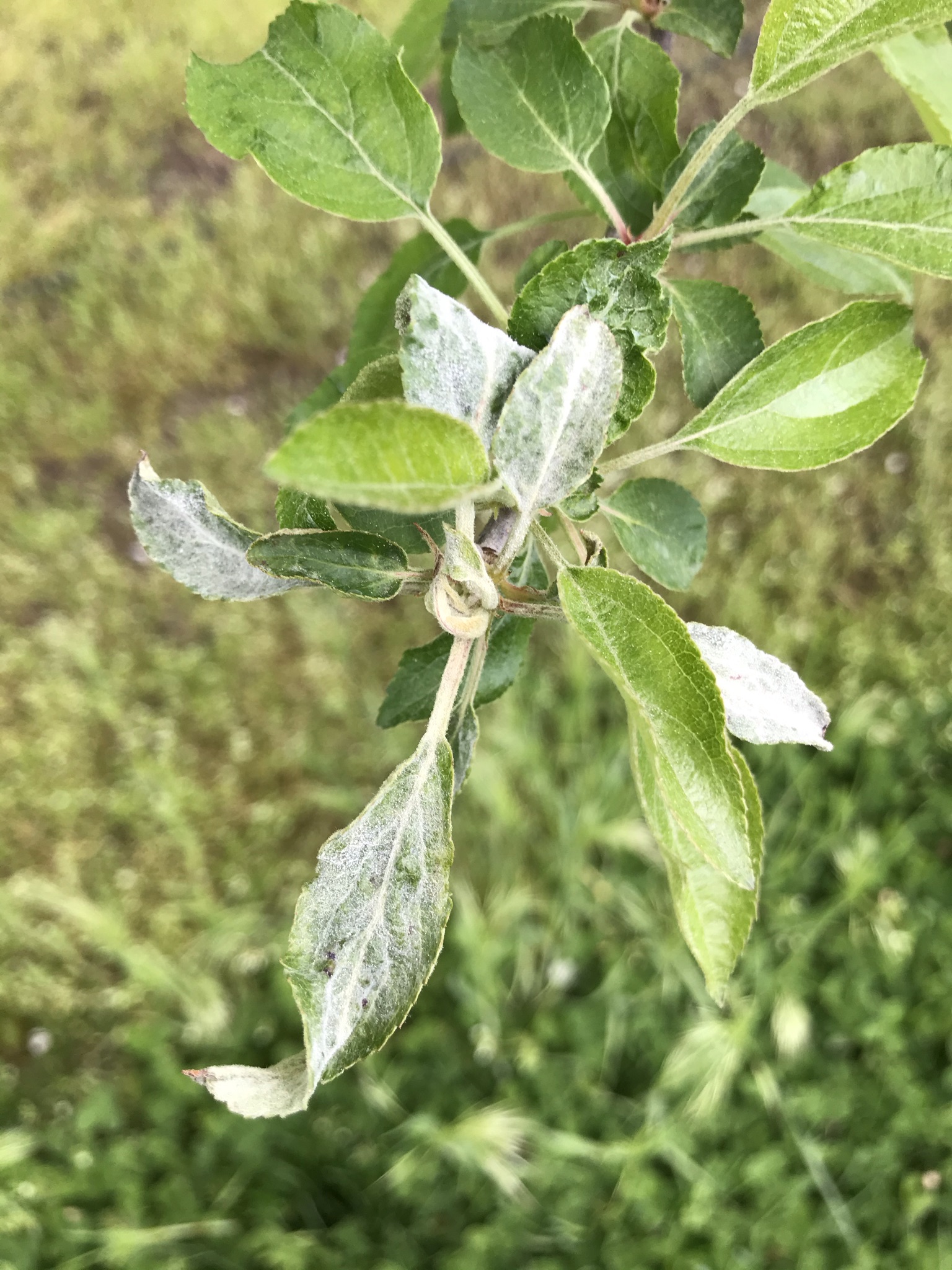
Mildew thrives in dry weather and high relative humidity. In fact, rain deters powdery mildew development by washing off spores. So, protectant sprays may still be required during dry periods when there is little risk from apple scab. Be careful how long the interval between sprays become, especially in mildew susceptible blocks.
Some key points for effective powdery mildew control to consider:
- Powdery mildew does not invade mature leaf tissue, so spread of mildew stops when trees reach terminal bud set.
- Getting good mildew control following an outbreak will take several seasons.
- Mildew infected white shoots from last year’s failure will persist through the season, but does not indicate current fungicides are failing.
- The current season mildew program is designed to prevent spread that would lead to primary infection for next year.
- Infected shoots can be pruned or removed during other orchard activities; however, you can also wait until these infected terminals dry out and remove during summer or dormant pruning to prevent inoculum for next season.
For more information on products with efficacy against powdery mildew, see the Powdery Mildew Efficacy Table on the Ontario Crop Protection Hub.
Bugs Behaving Badly
Don’t be surprised to see insect activity take off now that we are seeing warmer temperatures.
Pay close attention to scouting reports and be prepared to pivot or adjust control timings, where needed, based on pest activity.
Mullein bug
The start to “mullein bug season” has been delayed; however, numbers being tapped out are slowly creeping up in orchards. Controls are warranted when threshold reaches 7-9 nymphs per 25 taps. Low levels of damage have been found.
Growers that are seeing numbers above threshold are applying (or planning to apply) insecticides with activity against this pest particularly on susceptible varieties such as Red Delicious, Spartan, Spy, Ambrosia, Empire, Cortland, Gala, Jonagold and Golden Delicious.
For more information on products with efficacy against mullein bug, see the Mullein Bug Efficacy Table on the Ontario Crop Protection Hub.
It’s recommended to continue monitoring after the insecticide has been applied to determine if a follow-up spray is required. Delegate, Minecto Pro, Altacor and Exirel do not have efficacy on this pest.
Good news! Quite a few mullein bugs can be found in leafcurling midge rolls. These have seemed to be quite the voracious predators of midge in previous years. So, for those sites with leafcurling midge issues, it is possible if there is enough other food available in the orchard, it can keep the mullein bug from feeding on developing fruitlets.

Caterpillars
The spray window for oriental fruit moth is on-going this week in many of the earlier regions of the province.
Codling moth and European apple sawfly trap catch still remain quite low.
Plum curculio
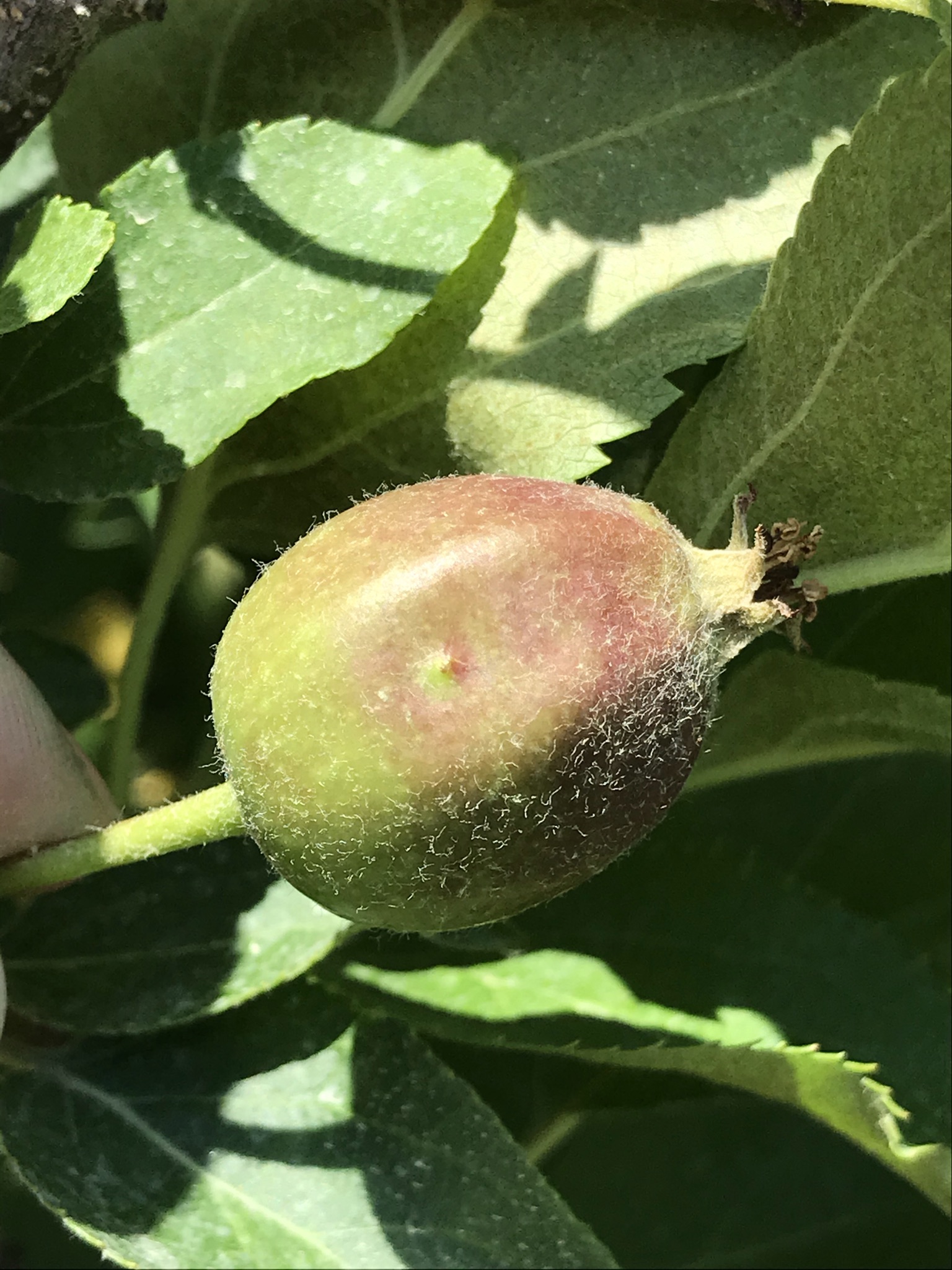
Warmer temperatures may increase activity of plum curculio into the orchard. During cooler weather, these weevils tend to move slower, opting to crawl in from surrounding woodlots; however, on warmer days, they’ll fly in which is often when there is an increase in observed damage during these periods.
We have seen an increase in oviposition damage on fruitlets this week. The images below show signs of fresh injury and trigger the need for controls to be applied. Pay particular attention to trees along the perimeter of a woodlot.


Degree (Days) of Separation
Scale
The warmth this week has moved degree day accumulation along and early regions are now approaching management timing for first generation San Jose scale crawlers.
For more information on registered products or those with efficacy against scale, see the San Jose scale on Ontario Crop Protection Hub.
San Jose scale degree day accumulations based on March 1st biofix and base temperature 10C
Region | Current Degree Day Celsius (DDC) | Predicted Crawler Emergence (278 DDC) |
Harrow | 278 DDC | Today |
London | 172 DDC | June 16 |
Delhi | 191 DDC | June 14 |
Grimsby | 186 DDC | June 17 |
Clarksburg | 120 DDC | >14 days |
Durham | 145 DDC | >14 days |
* as of June 5, 2025 |
Once crawler activity (ie., movement to new shoots and developing fruit) begins, this will continue for 4-6 weeks. Registered products including Closer and Sivanto Prime should be applied at the beginning of crawler activity and reapplied 10-14 days later due to the extended generation. Movento is a slow-acting product and should be applied at least 1 week prior to predicted crawler emergence, again followed up 10-14 days later. Depending on the product, this timing may also have efficacy on woolly apple aphid and/or leafcurling midge.
Oystershell scale
For orchards dealing with oystershell scale, timing of crawlers for this species is typically a week earlier than the predicted timing for San Jose scale.
Apple leafcurling midge
Apple leafcurling midge infested terminals are becoming quite apparent in many orchards. Larva inside are turning from cream to orange indicating later development stage.
Earlier regions of the province will start seeing adult flight for the second generation kicking off within a couple of weeks. Emergence predictions for the 1st and 2nd generation are summarized below. See May 23rd What The Crop?! for management options.
Predicted emergence date of first generation adult apple leafcurling midge, by region (biofix March 1st, base 9C)
Region | 5% Gen 1 (76 DDC) | 50% Gen 1 (132 DDC) | 95% Gen 1 (235 DDC) | 5% Gen 2 (430 DDC) | 50% Gen 2 (556 DDC) | 95% Gen 2 (701 DDC) |
|---|---|---|---|---|---|---|
Harrow | Passed | Passed | Passed | June 14 | >14 days | >14 days |
London | Passed | Passed | June 8 | >14 days | >14 days | >14 days |
Delhi | Passed | Passed | Passed | >14 days | >14 days | >14 days |
Grimsby | Passed | Passed | Passed | >14 days | >14 days | >14 days |
Clarksburg | Passed | Passed | June 16 | >14 days | >14 days | >14 days |
Durham | Passed | Passed | June 13 | >14 days | >14 days | >14 days |
0 comments on “What the Crop?! Apple Update: June 6, 2025”