

Production and pest update brought to you by the OMAFA Apple Team:
Erika DeBrouwer, Tree Fruit Specialist and Kristy Grigg-McGuffin, IPM Specialist
Table of Contents
Growth Stages
At the Simcoe Research Station, king fruitlets and terminals are sitting at the following:
Honeycrisp | Ambrosia | Gala | |
|---|---|---|---|
King Fruitlet Size | 40.2 mm | 30.1 mm | 33.1 mm |
Terminal Growth | 26.5 cm | 26 cm | 26.5 cm |


Throw Some Shade (The Good Kind)!
Considerations for a ‘Hot’ Orchard
With the recent heat wave, we aren’t the only ones feeling uncomfortable—it can also be physiologically stressful for trees. Visually assessing heat stress on trees is often found too late, resulting in leaf scorching, fruit sunburn, premature fruit drop and a reduction in growth. With this in mind, be sure to keep your orchard chill with protective methods listed below.
Irrigation Management
Frequent, shallow watering during heat waves helps maintain soil moisture near the root zone in high-density systems. Use drip irrigation for precision and efficiency. Consider pulse irrigation to avoid water stress midday.
Evaporative Cooling
Use overhead sprinklers or misters during peak heat hours to reduce canopy and fruit surface temperatures. Especially useful to prevent sunburn on fruit.
Sunburn Protection
Apply kaolin clay or calcium carbonate sprays to reflect sunlight and lower fruit surface temps. Maintain a balanced canopy to provide natural shade (avoid over-pruning in summer). For more thorough definitions of the various types of sun damage in apple – refer to this link. https://onfruit.ca/2024/06/21/what-the-crop-apple-update-june-21-2024/
Strategy | Definition & Use | Pros | Cons |
|---|---|---|---|
Evaporative cooling | Overhead irrigation that reduces air temperature due to water vapourization | – Water stains on fruit – Root flooding | – Expensive to install, maintain and operate – Access to water source during peaks |
Protective netting | Overhead netting that reflects/absorbs sunlight | – Can reduce effects of wind / hail damage – Colour of net can influence growth, colour and quality | – Expensive – Learning curve for deployment and removal – Colour of net can influence growth, colour and quality |
Sprayable protectants* | Application of materials on fruit to create a physical barrier | – Spot treatment | – Not as effective as other options – Reapplication often required |
Under Tree Mulching
Organic mulches (e.g., straw, wood chips, spray on mulches – paper fibre) help retain soil moisture and reduce surface temperature. Can also reduce competition from weeds for water and increase young tree growth.
Nutrient Support
Ensure adequate potassium and calcium to help with plant stress tolerance and fruit integrity. Foliar feeds may be used when uptake through roots is impaired.
Field Activity Adjustments
Delay non-urgent tasks like pruning or heavy equipment use to cooler periods. Avoid stress-inducing sprays during peak heat.
Monitoring & Record-Keeping
Use soil moisture sensors and weather stations to make timely decisions. Track GDDs and stress days to refine your response year to year.
Water You Waiting For?
Irrigation during dry periods is crucial in high-density apple orchards, where limited root zones and closely spaced trees increase vulnerability to heat stress. Consistent moisture helps maintain cell turgor, supports active photosynthesis, and prevents fruit shrivel and sunburn.
Timely irrigation not only preserves fruit quality and size but also enhances the trees’ resilience, ensuring they can withstand prolonged heat without compromising productivity.
For best management practices for irrigation management, practical calculations and drip irrigation information, check out the following links:
- Irrigation Management
- Drip Irrigation Scheduling
- Using ET Data to Make Irrigation Decisions
- Irrigation Scheduling for Fruit Crops
- Irrigation Timing in Fruit Crops
- 3 Secrets of Irrigation – Water Taking Permits Revealed
Too Hot To Handle (Pathogen Pressure)
Fire Blight
Check out ‘What the Crop?! Apple Update: June 20, 2025’ for strategies to manage fire blight once it’s in the orchard.

Key reminders:
- Consider products that:
- Surface sterilize such as Cueva or Oxidate
- Boost immunity such as Lifegard, Regalia or Double Nickel
- Dessicate infection such as Buran or Cyclone Plus
- Prioritize management and pruning out strikes:
- Focus on young and/or vigorous blocks (with few strikes) when weather is suitable.
- Delay pruning vigorous blocks with many strikes per tree, low vigour trees or blocks where prohexadione-calcium (Apogee/Kudos) has been used consistently – save this for after terminal bud set or during dormancy.
- If concerned about spread but labour is limited, cut tree a foot or two above graft union and leave attached to trellis wire to dry out.
- Do not prune in high temperatures and humidity – active fire blight shoots will be oozing and highly susceptible to spread.
- Ideal conditions are several cooler (low 20s) days with humidity <60% (if possible in Ontario!).
- Unsettled weather may bring hail, strong winds or heavy rains that could trigger trauma blight.
- Apply Streptomycin (PHI 50 days), 0.5-0.8% Cueva or Oxidate as soon as possible after a trauma event (ideally 4-12 hours).
- Prohexadione-calcium (Apogee/Kudos) can provide protective benefits when applied now (ie., thickening of cell walls to prevent infection) but this action will take 10 days from application.
- Manage sucking insect pests such as aphids, leafhoppers, and plant bugs which can transmit the bacteria through the wounds they create while feeding.
Summer Disease
Now is the time to start considering summer disease management. While symptom development doesn’t really start to appear for fruit rots, fly speck and sooty blotch until later in the summer or into the fall, infection actually happens now.
We have had ideal bitter rot infection conditions over the last week with the hot, humid weather followed by rain. With hand thinning beginning, be sure to toss thinned fruitlets to the row middle and mulch. These fruit have been known to cause infection of remaining fruit on the tree by splashing spores during rain events.
Infection timing for fly speck and sooty blotch should also be considered. In wet years, infection typically begins 2-3 weeks after petal fall but can be delayed in areas that have not seen much rain since bloom.


The efficacy table for bitter rot, black rot, fly speck and sooty blotch on the Ontario Crop Protection Hub summarizes activity of fungicides that could be used for summer disease control.
Residual protection will vary depending on the product used. For example, Pristine/Merivon can provide reasonable residual control of summer disease up to 3 weeks at the labelled rate in ideal conditions; however, captan should not be pushed further than 14-days between sprays particularly since it is not as strong on fly speck and sooty blotch as other control products. In all cases, reduce interval to 7 days during times of hot, wet weather but be mindful of the preharvest interval (PHI). These values can be found under View Details for each product in the Ontario Crop Protection Hub.
Important cultural management recommendations include:
- Prune and thin clustered fruit to facilitate drying and improve fungicide coverage.
- Remove potential sources of inoculum such as dead branches, fruit mummies (where possible), infected fruit on the orchard floor and alternate hosts including brambles (blackberry, raspberry) from surrounding hedgerows or woodlots.
- Toss pruning cuts and thinned fruit in the row middle and mulch.
- Reduce tree stress by irrigating and/or applying a sun protectant, especially ahead of a heat wave.
Jump Scare
Potato leafhopper are quite active though little hopper burn and leaf cupping have been reported. This damage is caused by a toxin in the leafhopper’s saliva that blocks vascular system flow, preventing normal movement of water and nutrients to the affected area.
In most high vigour blocks, leafhopper damage is manageable, particularly once terminals harden off. However, nursery trees and non-bearing blocks require control at first sign of injury since vigour and shoot growth can be significantly impacted. With the first cut of hay happening in many regions, there may be a flush of potato leafhopper moving into orchards in the coming weeks.
For more information on registered products or those with efficacy against leafhopper, see the Potato Leafhopper section on Ontario Crop Protection Hub.


Small But Mite-y
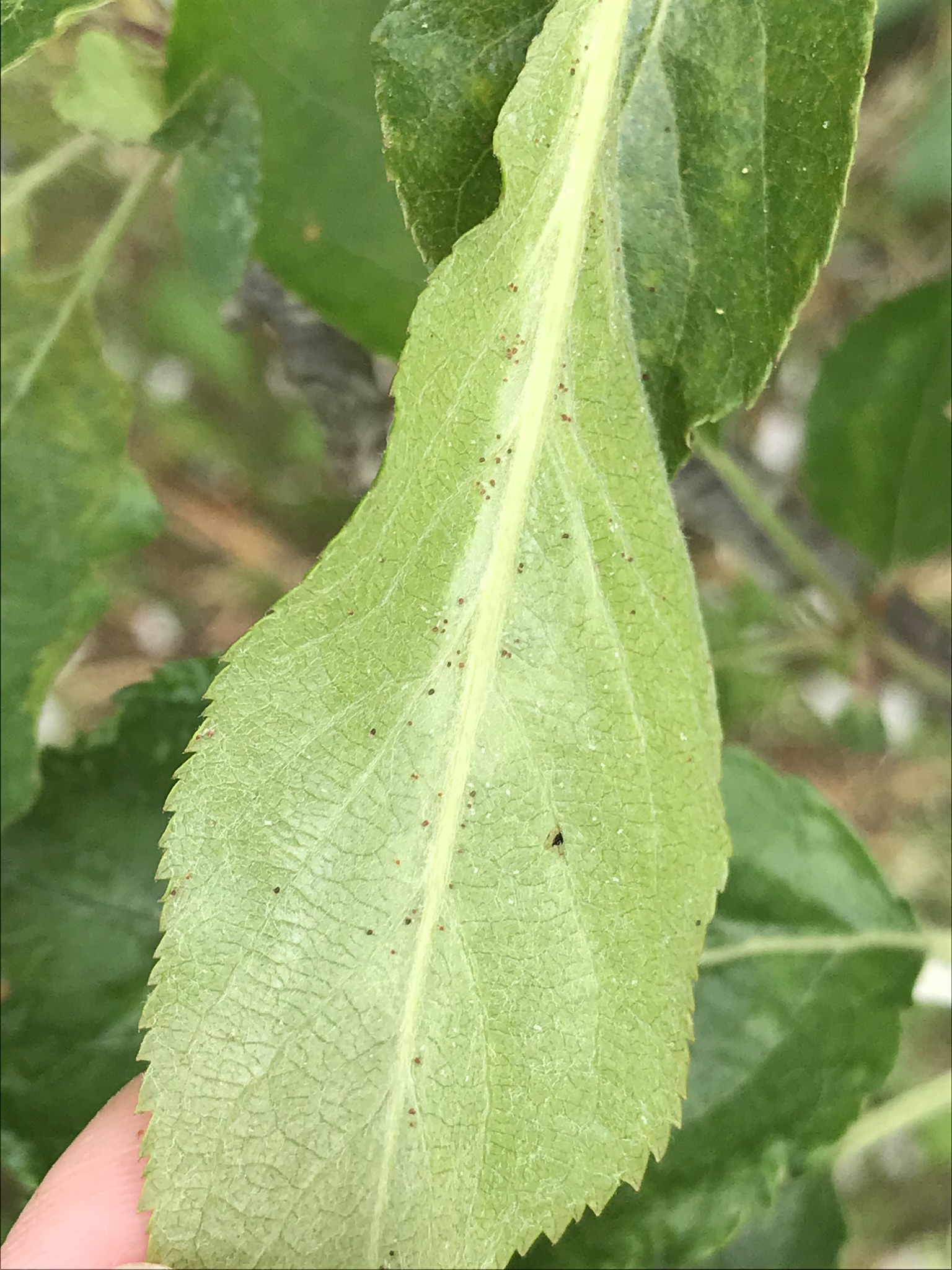
The hot, humid weather has resulted in an increased activity of European red mite (ERM) in some orchards. Those growers that are seeing populations reach threshold quickly are opting for miticides with relatively quick knock-down. Despite the lush, dense foliage this time of year, do not let mite populations cause extensive damage. Late-season mite pressure and leaf bronzing can result in poor fruit finish and reduce winter hardiness.
The table Activity of Miticides Registered on Apple and/or Pear in Ontario lists registered miticides for summer management. When choosing a product, consider the abundant life stages that are present in your orchard. For instance, if you are seeing mainly eggs, Envidor may be an option as it is slower acting. However, if the population is mainly nymphs or adults, you may opt for a product that offers a faster knock-down. Products like Nealta or Kopa should be applied as populations are building.
Degree (Days) of Separation
Scale
San Jose scale crawler activity for the 1st generation has begun. The heat has helped move development along quickly. To spot these small yellow-orange nymphs, you’ll need to get close to the trunk with a hand lens or use black tape (sticky side out) as you can see in the picture below.
This generation will be active, however, for 4-6 weeks as crawlers move to new shoots and developing fruitlets. Watch closely for signs of scale on fruitlets, which appear as small, reddish-purple rings or halos. Once attached and starting to feed, these immature scales will form waxy coverings that protect them from insecticides so early timing for management is important.

The table below highlights the predicted timings for various locations using the 14 day forecast for the respective regions. The second generation crawler emergence is predicted to begin at 806 DDC.
For more information on registered products or those with efficacy against scale, see the San Jose scale on Ontario Crop Protection Hub.
San Jose scale degree day accumulations based on March 1st biofix and base temperature 10C
| Region | Current Degree Day Celsius (DDC) | Predicted Crawler Emergence 1st Gen (278 DDC) | Predicted Crawler Emergence 2nd Gen (806 DDC) |
|---|---|---|---|
| Harrow | 507 DDC | Crawlers active | 14+ days |
| London | 395 DDC | Crawlers active | 14+ days |
| Delhi | 422 DDC | Crawlers active | 14+ days |
| Grimsby | 399 DDC | Crawlers active | 14+ days |
| Clarksburg | 306 DDC | Crawlers active | 14+ days |
| Durham | 341 DDC | Crawlers active | 14+ days |
| * as of June 25, 2025 |
Apple leafcurling midge
Early regions are entering into the second generation adult flight. Emergence predictions for the 2nd generation adults are summarized below. See May 23rd What The Crop?! for management options.
Predicted emergence date of second generation adult apple leafcurling midge, by region (biofix March 1st, base 9C)
Region | 5% Gen 2 (430 DDC) | 50% Gen 2 (556 DDC) | 95% Gen 2 (701 DDC) |
|---|---|---|---|
Harrow | Passed | Passed | July 4 |
London | Passed | July 3 | >14 days |
Delhi | Passed | June 30 | >14 days |
Grimsby | Passed | July 1 | >14 days |
Clarksburg | July 2 | >14 days | >14 days |
Durham | June 29 | July 9 | >14 days |
*as of June 25, 2025 |
Agrobotics Demo Day – Simcoe
See AgRobotics in action at the July 22nd Demo Day! REGISTER HERE
Join the AgRobotics Working Group and Innovation Farms Ontario for in-field demonstrations of robotic technology at the Ontario Crops Research Station – Simcoe (1283 Blueline Rd. Simcoe ON) on July 22, 2025 from 9:30 AM – 3 PM.
Lunch is provided to those who pre-register, so register today.
Confirmed robots in attendance: Vivid Machines, Oz, Finite Farms, HarvestCorp, Burro, Monarch Tractor, Upside Robotics.
0 comments on “What the Crop?! Apple Update: June 27, 2025”