
By Ken Slingerland (Horticultural Consultant), Laura Dobbyn (Fresh Grape Research Assistant) and Kathryn Carter (OMAFA, Project Lead)
Table of Contents
Background
New table grape varieties such as TimpsonTM, IvoryTM and StrawgrapeTM have attributes that are appealing to consumers (seedless, visually appealing and flavourful) and provide an opportunity to expand Ontario’s fresh market and compete with fresh grape imports. However, these new varieties require a shift in viticultural practices to maximize yield and fruit quality. Trellising and training systems directly influence vine architecture, balance, and canopy microclimate, which in turn influence fruit set, cluster quality, and winter survival.
In Ontario, table grape production typically relies on the use of the 4- or 6-arm Kniffen trellis systems with cane pruning. However, these systems are poorly suited to new cultivars such as TimpsonTM, IvoryTM and StrawgrapeTM as they do not adequately control vine vigour. This leads to excessive canopy shading and poor air circulation, resulting in reduced yields, poor fruit quality and increased disease pressure. To address these issues, the breeder recommended the adoption of an open-gable training system with angled arms (>120°), designed to improve light penetration and airflow within the vine canopy.
In 2025 the Ontario Fresh Grape Growers received funding for research that will help pilot competitive production strategies for Ontario fresh table grapes. The work will include evaluating the impact of new open gable training systems on yield and fruit quality for specific, promising new varieties of table grape in Ontario vineyards.
Methodology
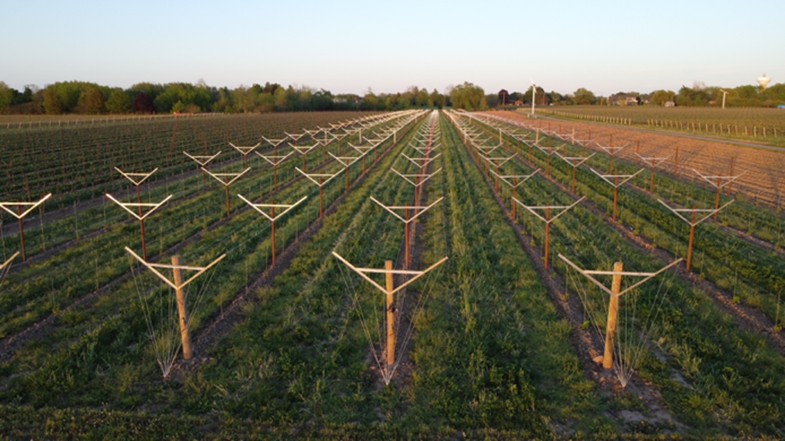
In 2024/25 a trial block was established at Smith’s Vineyards Inc. with TimpsonTM, IvoryTM and StrawgrapeTM cultivars. Vines planted with a spacing of 1.7 m (5.5 ft) between vines and x 3.8 m (12.5 ft) between rows for a vine density of 634 vines per acre[1]. Timpson and Ivory were planted as potted vines, while StrawgrapeTM was planted as dormant vines. An open gable trellis with an arm angle of ~ 110°[2] (Figure 1) was installed on the planting in the summer of 2025. The vines were planted in a section of the vineyard that already had a wind machine installed to mitigate cold injury.
In 2025, vine growth was monitored throughout the season and when the trunk of the vine reached the top of the trellis in the fall, all shoots on the trunk below 3-4 feet were removed.

Figure 1. Arial view of open-gable trellis-note the Y shaped trellis with angled arms, splits the vine canopy into two sides maximizing light exposure and airflow resulting in improved fruit quality and reduced disease pressure. (photo: Smith’s Vineyards Inc).
Observations of 2nd year growth
StrawgrapeTM – dormant vines had good, healthy growth (good quality wood and minimal disease) and reached the top of the 6 ft trellis in July (Figure 2), and the trunk was headed. The vines filled the trellis 2.1- 2.7 m (7 -9 ft) by early September. There were a considerable number of side shoots at the top of the trunk, and during dormant pruning 2 side shoots will be selected and trained to form the arms on the table wires. A small amount of fruit was produced on the vines. By early October, the trunks had hardened off and leaf senescence started.
IvoryTM – potted vines grew slower than StrawgrapeTM , but growth was healthy and vines reached the top of the trellis by September. The tip of the trunk was headed in the summer to encourage more side shoots near the top of the trellis. In early October, the trunks had hardened off but the leaves were still green, indicating that the vines might be more vulnerable to cold injury.
TimpsonTM – potted vines grew slower than StrawgrapeTM , but growth was healthy and vines reached 1.5 – 1.8 m (5 – 6 ft) by September. The tip of the trunk was headed in the summer to encourage more side shoots near the top of the trellis. In early October, the trunks had hardened off, but the leaves were still green, indicating that the vines might be more vulnerable to cold injury. The Timpson vines required more trunk support then anticipated, and in future plantings young vines will be trained to a 5-foot bamboo stake at planting to provide better trunk support.
StrawgrapeTM, which were planted slightly earlier as dormant vines demonstrated stronger growth and vigour through the 2025 season than the TimpsonTM and IvoryTM, which were planted slightly later as potted vines.

Figure 2. June 26th StrawgrapeTM plant growth. (Photo: Laura Dobbyn).
Discussion
Due to nursery availability in 2024, IvoryTM and TimpsonTM grape vines were planted in late spring of 2024 as softwood cuttings. This would have been a contributing factor which impacted their growth in 2025. Additonally, in 2024 Timpson and Ivory vines had a considerable amount of downy mildew infections, which also had a negative impact on the cold hardiness of the vines, resulting in increased cold injury. Minimal disease (particularly downy mildew) was observed in 2025
In 2026, data will be collected to evaluate the impact of the open gable training system on vine vigour, yields and fruit quality. Additionally, information will be collected on the labour, and economic costs of implementing the open gable trellis system. For details on the trellis components and additional information on the training system please contact Larissa Osborne larissa@ontariotenderfruit.ca.
Acknowledgements: The Ontario Fresh Grape Growers would like to extend their gratitude to Niagara Peninsula Fruit and Vegetable Growers Association (NPFVGA) and Smith Vineyards Inc. for their insight and support.

[1] This spacing was modified slightly from the breeder’s recommendation of 1.8 metres (5.9 feet) × 3.5 metres (11.5 feet) (642 vines per acre), to accommodate equipment.
[2] The arm angle was modified slightly from the breeder recommendations of arm angles of 120°-140° to accommodate equipment access.
0 comments on “Evaluating the open gable trellising system on productivity and fruit quality in table grapes”