

So far, it’s been a relatively cool season, which has helped keep fire blight risk quite low. However, that’s quickly changing. With the warmer temperatures, most regions are now at HIGH to EXTREME infection risk.
Add in windy days and increasing pollinator activity this week, and there’s a strong likelihood that bacteria have already been spread to newly opening blossoms, particularly in orchards (or neighbouring ones) where fire blight has been an issue in the past.
To support your decision-making, the Ontario Fire Blight Prediction Maps are available and continue to predict 7-day risk across the province.
While large amounts of rain aren’t expected until end of the week, don’t let your guard down. Even sporadic showers can trigger infection. Of more significant concern, however, is dew formation. Warm days followed by cool nights create ideal conditions for dew – and that thin layer of moisture is enough to wash bacteria into open blossoms.
Table of Contents
What is the risk?
The risk of fire blight infection is possible if the following conditions are met:
- Flowers are opened and/or are opening – There is no risk of infection if bloom is not present in the orchard despite the fire blight maps stating caution to extreme; however, keep an eye on any early signs of bloom as it can happen quickly.
- Enough heat units have accumulate based on forecasting models – The fire blight maps use Cougarblight but this applies to MaryBlyt as well. Similar to degree days, daily temperature is accumulated and must reach a certain point before risk increases.
- A wetting event is predicted – Any type of wetting event will wash the bacteria into the open bloom including rain, dew or even the artificial rain shower you create with the sprayer during critical infection periods.
What causes infection?
Fire blight bacteria multiply rapidly in a very short period of time when temperatures are above 18⁰C and relative humidity above 90%. Bacteria can be transferred to new blooms by rain, wind or insect. Bees and other pollinators are very active in the orchard right now and can easily spread the bacteria around.
Sudden, sporadic or isolated showers, heavy dew, fog or spraying can all provide enough moisture to wash bacteria into an open bloom. How much water is actually needed? If you look at the requirements for blossom blight infection based on the Maryblyt model, a wetting event is >0.01” (0.25mm) rain, heavy dew or fog sufficient to wet foliage and provide thin film on tissue surface or rain of >0.1” (2.5mm) the previous day.


When does blossom blight risk end?
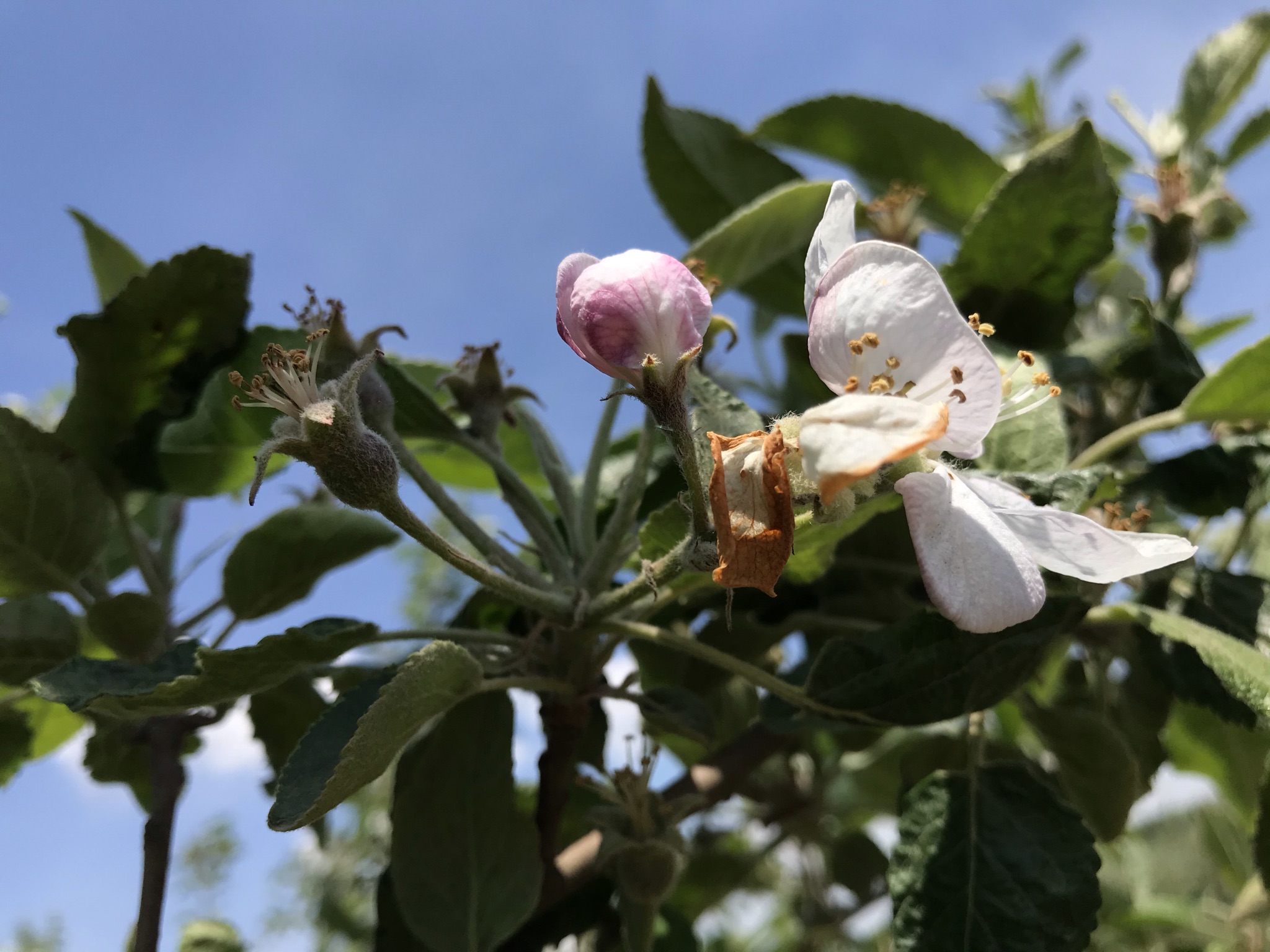
Blossoms become less susceptible to fire blight as they age and the calyx begins to close. Once petal fall is complete, blossom blight risk ends.
The staggered bloom that some growers are seeing this year within blocks (and even within an individual tree) will extend the risk until the last blossom falls.
Even in orchards nearing petal fall, delayed bloom, particularly young trees or secondary bloom (rat-tail bloom) can pose a serious risk. We have seen situations in previous years where these late blossoms can lead to unexpected and severe fire blight outbreaks.
If time and labour are available, it may be best to go through the orchard every couple of days and remove the rat-tail blossoms by hand. Be sure to remove blossoms in dry weather to prevent the spread of infection. For many operations, this practice is just not viable. Instead, continue to monitor infection risk and apply protectants if needed.
Blossom blight management
Antibiotics
During high to extreme risk:
- Frequent protective sprays may be needed.
- New blossoms are opening daily and will not be protected by earlier sprays.
- Antibiotics degrade rapidly in sunlight so are only active for 2-3 days MAXIMUM.
- Time applications as close to a wetting event as possible.
- Rotate between Streptomycin and Kasumin for resistance management.
If there are any concerns about missing a potential infection event, Streptomycin provides kickback activity but should be applied within 12 hours after the event.
Antibiotic alternatives
When risk is low to moderate, especially in orchards with past fire blight pressure, consider:
- Biologicals – eg., Blossom Protect, Buran, Serifel, Serenade, Cyclone Plus, Regalia, or Double Nickel
- Surface sterilant – eg., Oxidate
- Copper labelled for in-season use – eg., Cueva – note that copper and some fungicides are not compatible with certain biologicals. Check the label before use.
The early timing for biological products is important for a number of reasons.
- Firstly, because most of these products work by competitive exclusion, inhibiting growth or triggering a defense mechanism in the plant, they need time to colonize and become established. A good approach to timing for biologicals is when risk is coming in the next 3-4 days.
- Many of these products provide only limited control under high pressure or during certain environmental conditions.
- Using these suppression products when there are few blooms and risk is lower, allows you to save your uses of antibiotics like Streptomycin and Kasumin for peak bloom (50-80% bloom) and high infection risk events.
Postbloom management
Getting through bloom without infection, unfortunately, does not mean you are out of the woods! Shoot blight can occur without blossom infection, especially if bacteria are present nearby.
With the warmth and rains, trees will be going through extensive growth with rapidly expanding leaves. During this time of rapid growth, microscopic tears in the leaf tissue can be enough of an entry point for fire blight bacteria to get into the shoot and cause an infection.


Prohexadione-calcium, or Apogee/Kudos is an important management tool to help slow the growth of these vigorous shoots and reduce the spread of fire blight. King bloom petal fall is the ideal timing for applying these products (typically when growth is 2.2 – 5.5 cm long).
LifeGuard, a Bacillus product, can also be picked up again now that most orchards are out of bloom or hives have been removed. This product works by activating the tree’s defense mechanism and is most effective when it is applied before infection occurs. Some level of response can occur shortly after application but ideally 3-5 days are needed for maximum level of protection. It’s important to note that since this is a biological product, it should not be tank-mixed with antibiotics such as Streptomycin and Kasumin.
Take-home message
Fire blight risk has shifted quickly with warmer temperatures.
Dew alone can trigger infection – not just rain.
Staggered and secondary bloom will extend the risk window.
Stay proactive with monitoring and protectant strategies.
Plan ahead to balance biologicals and antibiotics effectively.
0 comments on “Fire Blight Risk Increases Across Province”