
By Kathryn Carter, Fruit Specialist (Tender fruit and Grape)
Table of Contents
Weather
This week there have been several days of warm, dry weather that has helped dry up the soils allowing for planting and cultivation. The forecast is calling for warm temperatures to continue, and possibility of rainfall on Friday and Saturday.
Tender Fruit
Tart cherry crops have been significantly reduced or lost as a result of cool extended bloom, and frost events. Sweet cherry fruit set is also lighter than average, and fruit set varies between location and varieties, with early season cherries having lower yields.
Peaches and nectarines are in the 1st growth phase and are approaching pit hardening. We are seeing some scaring on fruit, likely associated with thrip populations.

Peaches Niagara-on-the- lake (Photo: Henry Knafelc)
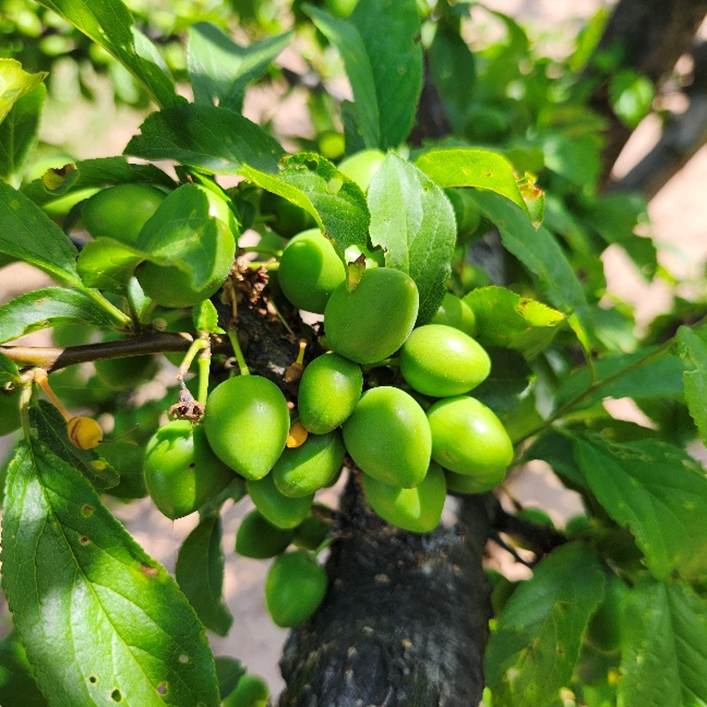
Fruit set varies between sites for Japanese and European plums. Some cultivars have excessively high fruit set while others have poor fruit set and are rapidly dropping fruit.

Plum trees with heavy and light fruit set, Lincoln, Ontario.
Apricot crop is light this year because of cold spring temperatures.
Pear fruit set is variable between cultivars, and many growers have already applied chemical thinners.
Activities
- GA sprays for tart cherry
Use Gibberellic acid (GA) sprays in tart cherry blocks that will not be harvested this year, to ensure trees will not overset fruit next year. Apply GA when daily high temperatures are above 21° C for two to three days if possible. Avoid applying when daily temperatures are below 16° C or there will be poor results. Higher rates of GA are used to prevent young trees from fruiting, while lower rates are used to balance vegetative and fruit production with mature trees. Apply GA sprays on bearing trees three to four weeks after bloom or when the trees have five to seven leaves, three to five fully expanded on terminal growth. For info on rates on the use of GA in tart cherries refer to Plant growth regulators | ontario.ca.
- Evaluating crop loads to determine hand thinning needs and commencement of early hand thinning to improve fruit size and fruit quality. Thinning usually begins after June drop (around mid June). Early season varieties are thinned first, to optimize fruit size. Generally fruit of most peach varieties should be spaced 6 to 8 inches (15 cm to 20 cm apart).
Wine Grapes/Table Grapes
Niagara: Shoot growth has increased over the past week. Fruit clusters have formed, but grapes are not in bloom yet. Growers are applying second cover sprays of fungicides. There are reports of cold injury in some blocks with cold sensitive cultivars (Merlot). Monitor grape vines to assess if primary buds have survived, as secondary buds result in reduced yields. There is cold injury in some table grape cultivars.
Lake Erie North Shore: With grape vines breaking buds, the extent of cold injury on grape vine trunks of vinifera vines is becoming more apparent, and some vineyards are reporting significant vine losses.
Prince Edward County: Vines have begun to break bud. There are reports of delayed and uneven bud break, particularly on vines that were buried to protect against cold injury. This variability is likely associated with the cool, wet conditions experienced this spring.
Activities:
- Grape vine planting continues.
- Weed populations that been thriving as a result of the rainfall we have received this spring. Early season weed control is important to manage weeds in young or newly planted blocks.
- Newly planted vines need adequate moisture, so be sure to irrigate as required.
- Fertilizer applications can be made in vineyards with adequate growth and development. In vineyards that have extensive cold injury reduce or eliminate N applications to help manage vigour.
- Continue to monitor vineyards to assess the impact of cold injury and evaluate potential yields.
- Starting to implement early season canopy management strategies

Vinifera grapes, Lincoln, June 3, 2026
0 comments on “What’s up? Tender fruit and grape update June 4, 2026”