

Production and pest update brought to you by the OMAFRA Apple Team:
Erika DeBrouwer, Tree Fruit Specialist and Kristy Grigg-McGuffin, IPM Specialist
Table of Contents
Grower Grind
Growers across the province continue to thin with early regions reaching or surpassing chemical thinning timing. The crop this year looks variable as the drought from last year, a cold winter, early and warm spring temperatures, followed by long cold nights – caused some winter and frost damage. Lower portions of trees have been seen to have little fruit set, which has been further emphasized in areas that struggled with poor pollination weather.
Growth Stages
Fruitlets have been pushed quickly with the heat over the past week. Variable fruit set and staging continues across the province. Watch for delayed or secondary bloom – this can be a problem for both thinning and fire blight management.
- Essex & Chatham-Kent – Fruitlet sizing (12-25 mm)
- Lambton, Middlesex, Elgin – Fruitlet sizing (10-18 mm)
- Norfolk – Fruitlet sizing (10-15 mm)
- Brant, Wellington – Fruitlet sizing (8-10 mm)
- Niagara – Fruitlet sizing (10-15 mm)
- Grey – Fruitlet sizing (4-6 mm)
- Durham, Northumberland and Quinte – Fruitlet sizing (4-6 mm)
- Ottawa Valley – Fruitlet sizing (4-6 mm)


Terminal Growth & Fruitlet Sizing
Terminals are growing at the Simcoe Research Station with the following measurements and growth stages.
Cultivar | Fruitlet Size (mm) | Average Terminal Measurements (cm) |
|---|---|---|
Honeycrisp | 17.5 | 14.7 |
Thinning
As a wise consultant said,
“It’s great weather for putting product on, but not so great for getting fruit off.”
- Sunny weather increases carbohydrate reserves, making thinning more challenging. Watch the weather and take advantage when you can.
- If you have a light crop load, trees will hold on to their fruit more, suppressing thinner efficacy. Consider your block crop load and make changes based on the average tree.
- Consider nozzle adjustments (off/on) based on crop load, especially if there is frost damage on lower portions of trees. Frost damaged regions of trees can be easier to thin, but if a lot of crop load is on top, be sure to adjust rates and coverage accordingly.
For information regarding thinning please refer to the article Chemically Thinning Apples, Bit by Bit. Here you will find information on weather implications, chemical thinning suppressors and promoters, along with a list of chemical thinning products available for apples.
If you have a window to thin, please use it to take off fruitlets incrementally.
Fungus* Amoung Us (*And Bacteria)
Fire blight
Unfortunately for some, signs of blossom blight have started to be reported in orchards with a history of strikes. The staggered, irregular, or rattail bloom still found in some blocks across the province remain at risk of infection. Keep an eye out for this delayed bloom.
Continue to follow the Ontario Fire Blight Prediction Maps for predicted risk in your region. High to extreme infection risk is predicted in most areas over the next week.
Remove or protect open blossoms from infection. Generally, continuing a protective program for a couple of weeks following petal fall will help ensure any late blooms are covered. Keep in mind, the antibiotics (Streptomycin, Kasumin) provide control for only 24-72 hours prior to a rain event. Also be mindful of preharvest intervals when using these products. For instance, Kasumin has a preharvest interval of 90 days.
However if there are a few days of dry weather and labour allows, it may be best to go through the orchard and pinch off the delayed blooms altogether since the fruit produced by the late blossoms are more of a risk than they are an asset.

Scab
Many regions have reached or are nearing the end of the ascospore maturation period. It looks like there may be rain in the forecast in the coming days which could bring the end of the primary infection period by releasing the last of the matured ascospores. However, it is important to wait a few weeks after the last infection event before backing off of a scab program.
If lesions are present, continue a regular protectant program to prevent secondary infection on developing fruitlets.
Seeing scab?
Now is the time to start monitoring blocks for signs of lesions. Take a good look at the top AND underside of leaves for velvety brown lesions with indistinct margins. Overwintering spores are coming from the orchard floor, so most early season infections typically start on the underside first. Things have also been fairly windy this season which could impact spray coverage, particularly in the upper canopy. Look at all parts of the canopy to ensure there are no escapes.


Powdery mildew
With the warm weather, powdery mildew has had a chance to develop in some orchards that have had historically high pressure from this disease. Continue to protect susceptible cultivars like Gala, Honeycrisp, Cortland, Idared, Crimson Crisp, Goldrush, Fuji and Spy. Powdery mildew requires actively growing tissue to complete its cycle so fungicides with efficacy against this disease should continue until terminal growth stops.
Infected shoots will not cause damage to fruit at this point in the season. Fruit damage is a result of early infection that occurred in the flower buds and during bloom. However, infected shoots will be the inoculum source for next year. Prune out any strikes that are present.
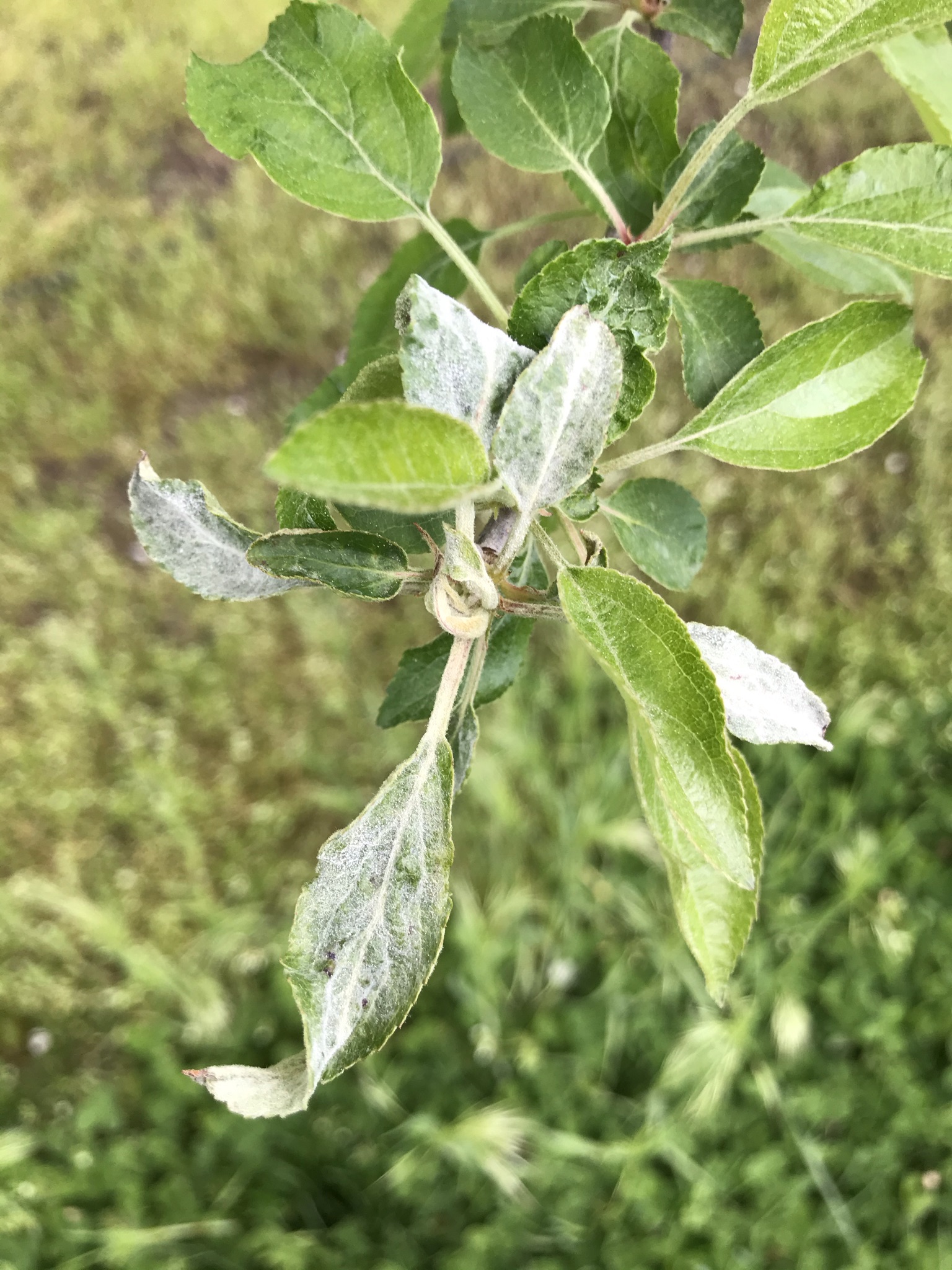
Mildew thrives in dry weather and high relative humidity. In fact, rain deters powdery mildew development by washing off spores. So, protectant sprays may still be required during dry periods when there is little risk from apple scab. Be careful how long the interval between sprays become, especially in mildew susceptible blocks.
Some key points for effective powdery mildew control to consider:
- Powdery mildew does not invade mature leaf tissue, so spread of mildew stops when trees reach terminal bud set.
- Getting good mildew control following an outbreak will take several seasons.
- Mildew infected white shoots from last year’s failure will persist through the season, but does not indicate current fungicides are failing.
- The current season mildew program is designed to prevent spread that would lead to primary infection for next year.
- Infected shoots can be pruned or removed during other orchard activities; however, you can also wait until these infected terminals dry out and remove during summer or dormant pruning to prevent inoculum for next season.
For more information on products with efficacy against powdery mildew, see the Powdery Mildew Efficacy Table on the Ontario Crop Protection Hub.
Black rot
A few signs of frog-eye leaf spot (foliar symptoms of black rot) have started to develop. Optimum temperature for leaf infection is 26⁰C with only 4.5 hours of leaf wetting needed. However, infection can occur any time above 10⁰C but will just require a longer leaf wetting period (more than 24 hours at 10⁰C).

If you are seeing frog-eye leaf spot now, you know inoculum is present in the orchard or coming from a sporulating nearby source such as dead or decaying wood in an adjacent woodlot.
Black rot produces 2 types of inoculum – ascospores (sexual spores), which are wind blown and conidia (asexual spores), which require a wet period and rain splash for release. Both begin to release shortly after bud break; however, the heaviest ascospore release occurs for a 4-6 week period following petal fall. In other words, if your protectant program considerations haven’t included black rot yet, now is the time!
For more information on products with efficacy against black rot, see the Black Rot/Frog-Eye Leaf Spot Efficacy Table on the Ontario Crop Protection Hub.
Bugs Behaving Badly
Things have been pretty quiet on the insect front this season. Don’t be surprised to see insect activity take off now that we are seeing warmer temperatures.
Pay close attention to scouting reports and be prepared to pivot or adjust control timings, where needed, based on pest activity.
Mullein bug
The start to “mullein bug season” has been delayed; however, numbers being tapped out are slowly creeping up in orchards. Controls are warranted when threshold reaches 7-9 nymphs per 25 taps. Low levels of damage have been found.


Growers that are seeing numbers above threshold are applying (or planning to apply) insecticides with activity against this pest particularly on susceptible varieties such as Red Delicious, Spartan, Spy, Ambrosia, Empire, Cortland, Gala, Jonagold and Golden Delicious.
For more information on products with efficacy against mullein bug, see the Mullein Bug Efficacy Table on the Ontario Crop Protection Hub.
It’s recommended to continue monitoring after the insecticide has been applied to determine if a follow-up spray is required. Delegate, Minecto Pro, Altacor and Exirel do not have efficacy on this pest.
Plum curculio
Low levels of plum curculio damage has been found on developing fruitlets. Often movement into the orchard follows a period of sustained warm weather and rain so be prepared with the upcoming wet forecast. Activity is believed to be linked to weather patterns and could be as long as 6 weeks during cooler, more dry conditions.
For more information on products with efficacy against plum curculio, see the Plum Curculio Efficacy Table on the Ontario Crop Protection Hub.
The images below show signs of fresh injury and trigger the need for controls to be applied. Pay particular attention to trees along the perimeter of a woodlot.


Aphids
Leaf curling and puckering typical of rosy apple aphid has been observed around fruit clusters. Activity has been surprisingly delayed this season even though aphids tend to thrive in cool, wet springs. Nonetheless, they can be found so be on the lookout for infested clusters.


While thresholds for green apple aphid are relatively high (400-600 aphids per terminal on 10% of terminals), the most serious rosy apple aphid damage occurs when a toxin found in its saliva translocates from the leaves to fruit, causing apples to remain small, deformed (pigmy fruit) and unmarketable. Control for rosy apple aphid is recommended if more than 5% of fruit clusters are infested with 20 or more aphids.
For more information on products with efficacy against rosy, green and woolly apple aphids, see the Aphids Efficacy Table on the Ontario Crop Protection Hub.
Degree (Days) of Separation
Scale
Based on current degree day accumulations, most regions of the province are reaching 1st generation San Jose scale crawler emergence (predicted emergence of 278 DDC) over the coming weeks.
For a full list of registered products, see San Jose Scale on the Ontario Crop Protection Hub.
Predicted emergence date of first generation San Jose scale, by region (biofix March 1st, base 10C)
Region | Current Degree Day Celsius (DDC) | Predicted Crawler Emergence (278 DDC) |
Essex | 299 DDC | Passed |
Lambton, Middlesex, Elgin | 198 DDC | June 11 |
Norfolk | 219 DDC | June 10 |
Wellington | 149 DDC | June 16 |
Niagara | 216 DDC | June 10 |
Grey | 167 DDC | June 15 |
Durham, Northumberland | 146 DDC | >14 days |
Ottawa | 164 DDC | June 14 |
Apple leafcurling midge
Apple leafcurling midge infested terminals have become more apparent in orchards this week. Larva inside are still quite cream in colour indicating early development. They will turn to orange when ready to pupate.

Earlier regions of the province will start seeing adult flight for the second generation kicking off within a couple of weeks. Emergence predictions for the 1st and 2nd generation are summarized below.
For a full list of registered products, see Leafcurling Midge on the Ontario Crop Protection Hub.
Predicted emergence date of first generation adult apple leafcurling midge, by region (biofix March 1st, base 9C)
Region | Current Degree Day (DDC) | 5% Gen 1 (76 DDC) | 50% Gen 1 (132 DDC) | 95% Gen 1 (235 DDC) | 5% Gen 2 (430 DDC) | 50% Gen 2 (556 DDC) | 95% Gen 2 (701 DDC) |
|---|---|---|---|---|---|---|---|
Essex | 356 | Passed | Passed | Passed | June 10 | June 18 | >14 days |
Lambton, Middlesex, Elgin | 244 | Passed | Passed | Passed | >14 days | >14 days | >14 days |
Norfolk | 264 | Passed | Passed | Passed | June 17 | >14 days | >14 days |
Wellington | 188 | Passed | Passed | June 9 | >14 days | >14 days | >14 days |
Niagara | 245 | Passed | Passed | Passed | >14 days | >14 days | >14 days |
Grey | 203 | Passed | Passed | June 8 | >14 days | >14 days | >14 days |
Durham, Northumberland | 178 | Passed | Passed | June 10 | >14 days | >14 days | >14 days |
Ottawa | 201 | Passed | Passed | June 7 | >14 days | >14 days | >14 days |
0 comments on “What the Crop?! Apple Update: June 5, 2026”