
By Kathryn Carter, and Stephanie Vickers, OMAFA
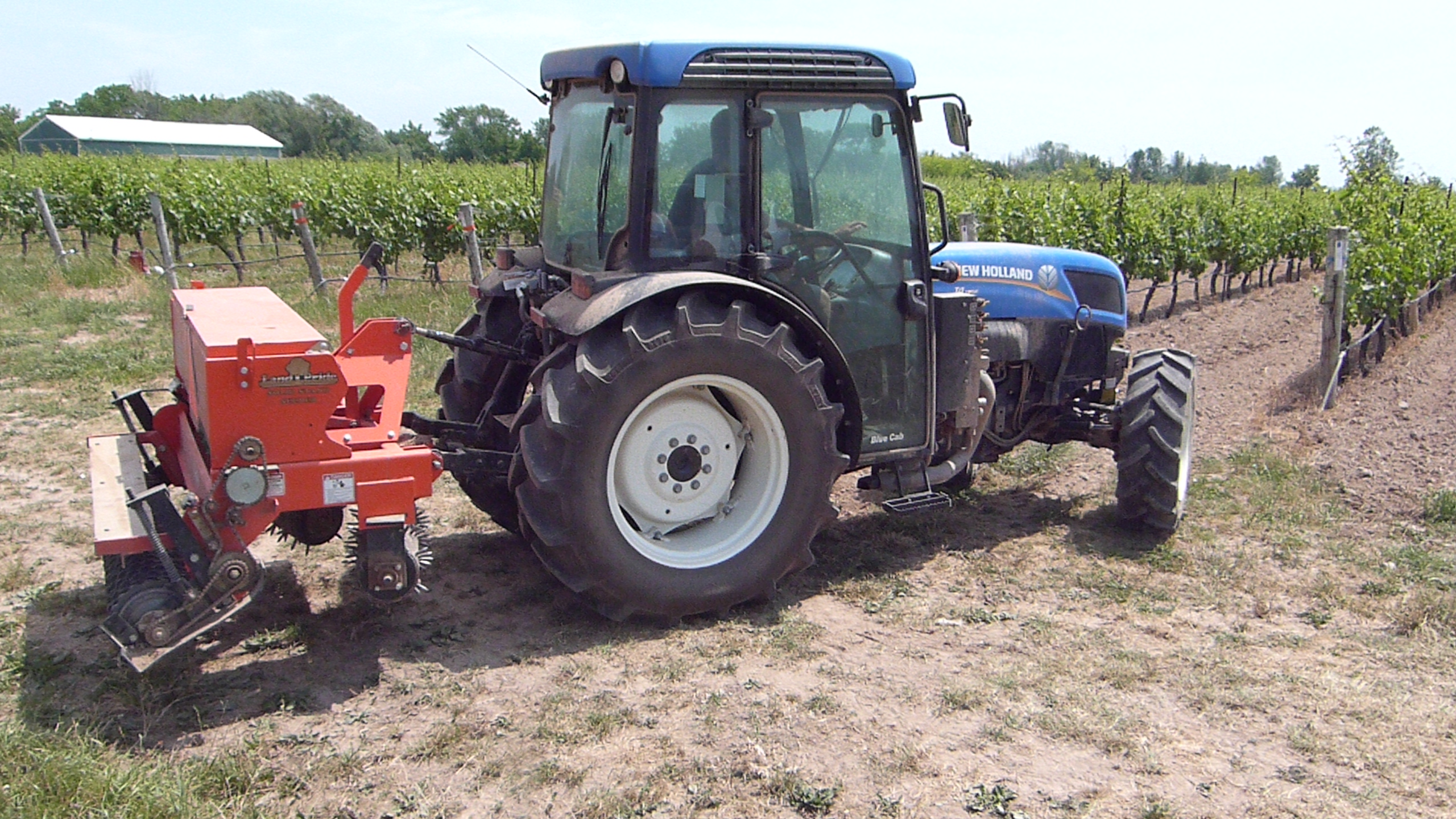
A cover crop is any plant that is intentionally grown in vineyard middles- and occasionally under the vines-that are not intended for harvest. These crops may be planted annually (spring or fall) or maintained as perennial plantings.
What are the benefits of using cover crops?
Improve soil structure: Cover crop roots help bind soil particles together, improving soil structure and traction for vineyard equipment. Root systems also loosen the soil, reducing compaction and enhancing air and water movement through the soil.
Protect against erosion and run-off: Cover crops help reduce wind and water erosion by anchoring topsoil with their roots. They also help protect the soil surface from the impact of raindrops, helping to prevent soil loss.
Soil biological activity and Organic Matter: Cover crops can increase soil organic matter, improving water holding capacity. They also act as a source of carbon to soil microorganisms, supporting nutrient cycling and soil structure formation.
Nutrient management: As cover crops decompose they can make nutrients more available to vines. Cover crops can also help reduce nutrient leaching by capturing and storing nutrients that might otherwise be lost during heavy rainfall.
- Legume cover crops (e.g., clover) can convert atmospheric nitrogen into forms that can be used the by vines (ammonia and nitrate) and release it to the soil when they die.
- Grasses are high nitrogen (N) users and help reduce nitrate leaching by scavenging excess N.
Weed management: Dense cover crop stands help limit weed germination and growth, reducing weed pressure in vineyards.
Increase biodiversity: Cover crops enhance biodiversity above and below the ground. Greater plant diversity can support beneficial insects and pollinators. Cover crops can increase soil microbial diversity, especially in the top (0-5 cm) soil layers (Abad et al, 2021). Earthworm populations are typically greater in soils where cover crops are used compared to herbicide managed systems. Multispecies cover crops can i enhance soil health and ecosystem diversity (Vrsic, 2011).
Greater resilience to climate change: By increasing soil organic matter, cover crops improve the soils resilience to drought, heat, heavy rainfall and flooding (Vanden Heuvel and Centinari, 2021).
Impact pest populations: Certain species of cover crops (e.g., mustard)can be used to suppress nematode populations. Cover crops can support beneficial insects, or act as a host for pest.
Influence grapevine growth: Cover crops that compete with vines for water and nutrients can be used to manage vine vigour. In low vigour sites, avoid selecting cover crops that that are too competitive for resources.
Selecting a cover crop species
Cover crops generally fall into three categories, each with specific properties that make them desirable in the vineyard ecosystem.
Grasses (wheat, barley, oats, annual ryegrass, pear millet):
- Have fine, fibrous root systems that are well-suited to holding soil in place, improving soil structure and reducing or preventing erosion.
- Do not fix nitrogen from the atmosphere, but they can scavenge nitrogen from the soil
- Some grass species can be fast-growing, cold-tolerant, drought tolerant and easy to terminate. Globally, Italian ryegrass (annual ryegrass) has developed resistance to multiple herbicide groups. As a result, weed scientists generally discourage its use as a cover crop species. In situations where it is used, mowing prior to seed set is critical to reduce the risk of further resistance development.
- Improve water infiltration, enhance soil tilth and increase organic matter.
- Can provide a substantial amount of biomass to increase soil organic matter.
- Are competitive with weeds, establish quick and can act as a nurse crop.
- Usually require mowing
Legume (clover, alfalfa) :
- Fix nitrogen from the air and release it to the soil upon decomposition. The amount of nitrogen fixed varies depending upon species, stand density and the length of growth.
- Can scavenge residual nitrogen from the soil reducing excess leaching.
- Tap root species (alfalfa or red clover) can alleviate subsoil compaction over time
Non-legume broadleaves (turnip, forage radish):
- Do not fix nitrogen, but they may absorb large quantities from the soil, helping to reduce nitrate leaching.
- Tap root species (turnip and forage radish) help alleviate soil compaction, reduce erosion, improve soil structure and water infiltration.
- Are typically not winter hardy. Do not allow these crops to go to seed, as volunteers can become problematic weeds.

Crimson clover in vineyard
Things to consider when selecting a cover crop
- Define your goals: Match species to vineyard objectives (see Table 1).
- Vineyard location, climate and soils: Select cover crop species that are able to establish within your growing season.
- Understand species traits: Consider annual vs. perennial growth, establishment timing, overwintering ability, soil type, and water requirements. For additional info see Soil management fertilizer use crop nutrition and cover crops for fruit production.
- Carbon-to-nitrogen (C:N) ratio:
Low C:N → faster nutrient release
High C:N (>20:1) → temporary nitrogen immobilization during decomposition
For info on C:N ratios on different cover crops species refer to For additional info see Quick Summary of Cover crop Characteristics for BC - Maintenance of perennials: Regular mowing may be needed to control excessive growth.
- Vine competition:
Vine roots avoid competition with cover crops by changing their horizontal or vertical distribution or both (French et al, 2025)
The impact of cover crops on vine vigour are influenced by vine age, location of the cover crop and the amount of competition for water. Inter-row cover crops have less impact on vine vigour than under-vine cover crops. Under-vine cover crops have a greater impact on vine growth in younger vines (<13 years old) than older vines. In drought conditions, cover crops that have high water requirements may have a negative impact on vine vigour. - Impact on fruit and wine quality:
Effects are indirect and related to canopy balance. Excessively small canopies may limit ripening, while well-managed cover crops can optimize leaf-to-fruit ratios and improve total soluble solids. - Impact on pests. Some cover crops may act as a host for the pathogens or pests creating issues in the vineyard. Do some research before trying cover crops.
The Midwest Cover Crops Council has developed a Decision Tool to consolidate cover crop information in the Midwest region. It includes Ontario counties and research and is a valuable tool to aid Ontario growers in selecting cover crop species/mixes tailored to their growing region and goals.
Table 1 Selecting a cover crop species based on function of the cover crop

1 Nematode suppression is specific to the variety of cover crop, the species of nematode and the management of the cover crop materials.
Source: Soil management, fertilizer use, crop nutrition and cover crops for fruit production | ontario.ca
Resources
Abad, J., de Mendoza, I. H., Marín, D., Orcaray, L., & Santesteban, L. G. (2021a). Cover crops in viticulture. A systematic review (1): Implications on soil characteristics and biodiversity in vineyard. OENO One, 55(1), 295–312. https://doi.org/10.20870/oeno-one.2021.55.1.3599 (Vrsic et al., 2011).
French, P., Swarts, N., Hardie, M., Barry, K. (2025) Cover crops in cool-climate viticulture: Effects on soil, vine productivity, and fruit quality. Agronomy Journal, 17 (5) .
https://doi.org/10.1002/agj2.70158
Vanden Heuvel, J., & Centinari, M. (2021). Under-vine vegetation mitigates the impacts of excessive precipitation in vineyards. Frontiers in Plant Science, 12, Article 713135. https://doi.org/10.3389/fpls.2021.713135
Vršič, Stanko. (2011). Soil erosion and earthworm population responses to soil management systems in steep-slope vineyards. Plant Soil and Environment. 57. 258-263. 10.17221/439/2010-PSE.
0 comments on “Sowing the Seeds of Soil Health in Vineyards: Cover Crops for Vineyard Floor Management”