
by Kathryn Carter and Dr. Wendy McFadden-Smith, OMAFA
Weather
Rain remains in the forecast for the rest of the week. Storm systems will bring showers to southwestern Ontario by Wednesday evening, with a risk of thunderstorms and heavy rainfall.
Windy, wet conditions will persist on Thursday with a risk of thunderstorms and high winds. Friday there is a chance of showers. The weekend is expected to be mostly clear during the day on Saturday and Sunday, although there is a chance of overnight rain on Sunday.
The remainder of June is expected to bring near-seasonal to slightly cooler-than-seasonal temperatures, with rainfall projected to be close to the seasonal averages across much of the region.
Tender fruit
Sweet cherries are starting to turn pink/red, and bird banger use has started. When using bird bangers, we sure to follow best management practices. As we approach harvest, there is an increased risk of fruit cracking on cherries as a result of rainfall prior to harvest. Some products can help provide protective coatings to minimize cherry cracking; however, no products can reduce fruit cracking under heavy or prolonged rainfall.
Growers continue to hand thin tender fruit crops, and fruit continue to size. Peaches are approaching the second stage of development (S2) also known as pit hardening, which typically occurs from approximately 30 to 66 days after bloom. During this stage, fruit growth slows while the pit hardens and lignifies. Since fruit growth is limited at this stage of development, irrigation demands are reduced compared to earlier stages.

Figure 1. Fruit growth curve of Dixiland peaches (Lombardo et al, 2011).
Thinning practices can significantly influence the incidence of split pits. Research has shown that heavily-thinned trees produce 58% more fruit with split pits compared with moderately or lightly thinned trees. Additionally, thinning peaches prior to pit hardening increases the amount of fruit with split pits by 23% as compared to with thinning during, or after pit hardening (Drogoudi et al, 2009).

Peaches in NOTL size is 33 mm (Photo: Henry Knafelc)
Grape
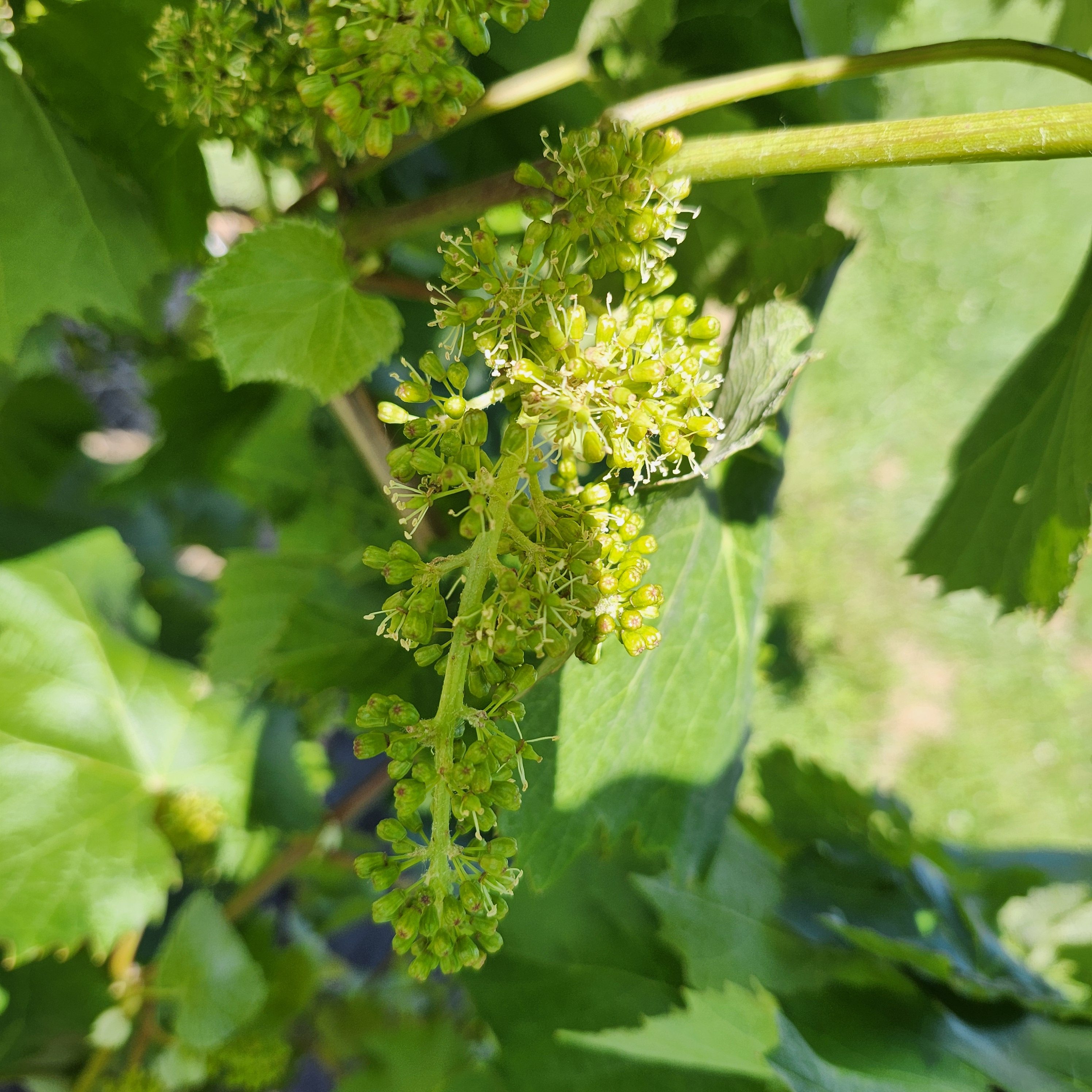
The warm weather and rains have significantly increased shoot growth. Growers are thinning shoots and managing canopies. Some grape varieties have started to bloom.
During bloom, all grape varieties are vulnerable to infection from fungal diseases such as black rot, phomopsis, powdery and downy mildew. The warm wet weather conditions this year have created a great environment for fungal diseases. Phomopsis leaf spot, as well as some early downy mildew and black rot foliar lesions has been found in Niagara. Grape berries are most susceptible to infection by powdery mildew, downy mildew and black rot in the post-bloom period. Post-bloom Botrytis can remain latent until veraison so, if a product for Botrytis wasn’t used pre-bloom, it would be a good idea to include a product with at least some activity in Botrytis-prone varieties (Riesling, Chardonnay, Pinots, Gamay). When possible, choose products that are locally systemic used at label rates and ensure complete coverage. Contact (non-systemic) fungicides will not stand up to heavy rains. Rotate among fungicide groups to reduce the risk of resistance. Due to wide-spread resistant populations, older Group 3 fungicides (Nova, Mettle) are not recommended for powdery mildew and Group 11 fungicides (Intuity, Sovran, Flint) are not recommended for powdery or downy mildew during this critical period for fruit infection. However, they are still effective vs black rot. Check out the Crop Protection Hub for fungicide selections and relative efficacy.
Cultural controls can also play an important role in reducing the risk of infections. For bunch rot susceptible wine varieties, fruit-zone leaf removal and around or shortly after bloom, can improve spray coverage and create fruit-zone conditions that are less favourable for the growth of fungal pathogens. Pre-bloom shoot thinning, will help balance vine canopies with yield, and will improve spray coverage. Managing weeds and keeping cover crop height low can increase air flow which helps reduce humidity in the canopy and improve drying time of the vine after rainfall. Implementing pre-bloom cultural practices in your vineyard can help reduce disease pressure and improve the efficacy of fungicides during bloom.

Timpson table grapes June 16, 2026 NOTL (photo: Henry Knafelc)

Inflorescence on Reisling grape vine (left) and Merlot grape vine (right) on June 16, 2026 Lincoln (Photo: Henry Knafelc)
0 comments on “What’s up? Tender fruit and Grape Update June 16, 2026”