
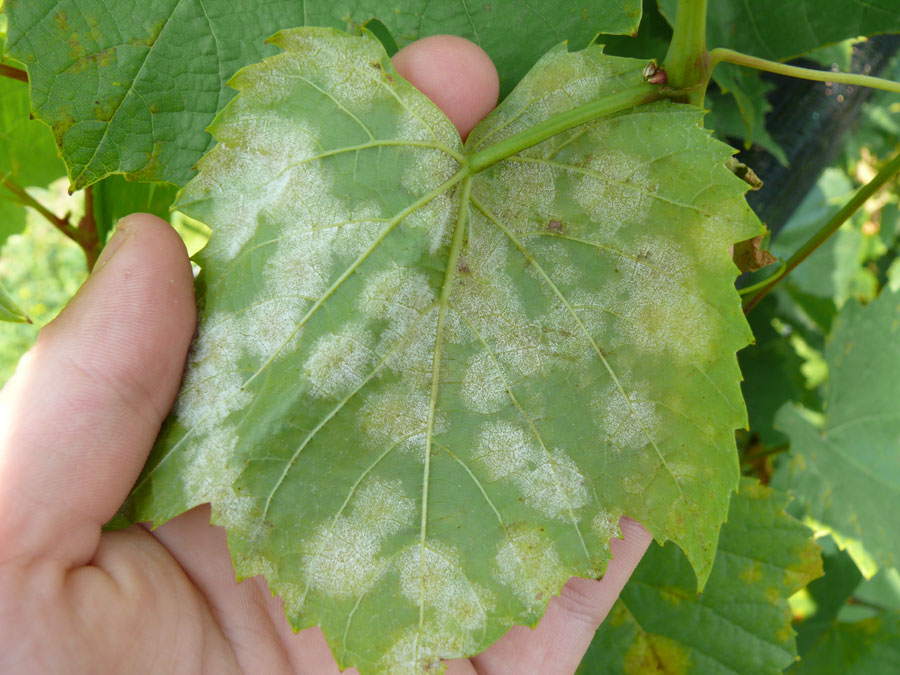
The rainy, cloudy weather we’ve been having is ideal for downy mildew infection. We’ve found sporulating lesions on leaves and developing fruit. Young leaves are susceptible to infection for about 40 days and berries are susceptible as soon as the caps come off and continue to be susceptible for about 5 weeks.
Frequent heavy rains will wash off contact fungicides. See a previous ONFruit post Rainfastness of fungicides. Locally systemic products are more resistant to wash-off. The table below shows the Fungicide Resistance Action Committee (FRAC) group, activity in the vine (contact, locally systemic or systemic) and the relative efficacy vs downy mildew.
Products | FRAC group | Activity in Vine | Downy mildew efficacy |
Ridomil Gold 480 SL | 4 | Systemic | 4 |
Flint, Flint Extra | 11 | Locally systemic | 1* |
Diplomat 5 SC | 19 | Contact | 3 |
Torrent 400SC | 21 | Locally systemic | 4 |
Allegro 500 F | 29 | Contact | 3* |
Forum | 40 | Systemic | 4 |
Revus | 40 | Locally systemic | 4 |
Timorex Gold | 46 | Contact | 2* |
Xivana Prime | 49 | Locally systemic | 4 |
Zampro | 40+45 | Systemic | 4 |
Pristine WG/Empire WG | 7+11 | Locally systemic | 1 |
Stargus | BM2 | Contact | 2 |
Guardsman Copper Oxychloride | M1 | Contact | 3 |
Copper 53 W | M1 | Contact | 3 |
Cueva Commercial | M1 | Contact | 3 |
Cobranza | M1 | Contact | 3 |
Copper Spray | M1 | Contact | 3 |
Kocide 2000-O | M1 | Contact | 3 |
Follow WDG | M4 | Contact | 4 |
Maestro 80 WSP | M4 | Contact | 4 |
Supra Captan 80 WSP | M4 | Contact | 4 |
Folpan 80 WDG | M4 | Contact | 4 |
Sharda Captan 48 SC | M4 | Contact | 4* |
Oxidate | NC | Contact | 2 |
Aliette WDG | P07 | Systemic | 4 |
Confine Extra, Rampart, Phostrol | P07 | Systemic | 4 |
LifeGard WG | P6 | Systemic/SAR | 3-4 |
LifeGard, which works soley by activating vine defence mechanisms, will not eradicate existing sporulating lesions and is best used before disease develops or once disease is controlled by other products.
Xivana is a new locally systemic downy mildew product in FRAC group 49. This gives us a new mode of action with which to rotate.
Surveys conducted in Ontario vineyards suggest that the gene for resistance to Group 11 fungicides (Sovran, Flint, Pristine) is very prevalent in downy mildew populations here. Therefore, these products are not recommended for downy mildew management in Ontario.
We also surveyed for resistance to Group 40 fungicides (Revus, Forum and ½ of Zampro) in Ontario. Although the gene for resistance was detected in most of the vineyards tested, resistance to Group 40’s is more complicated and warrants a separate blog post in the future. If these products are used BEFORE sporulating lesions are present, they should still provide good protection from downy mildew. Issues reported last year are likely due to trying to use these products as eradicants instead of protectants. Research in Europe suggests that solo Group 40 fungicides are best used early season and in a tank mix with another mode of action.
Researchers in the U.S. recently determined that downy mildew was not as susceptible to phosphorous acid products as previously found (See Resistance Management for Phosphorous Acid Fungicides in Grapevines). There were reports in Ontario that phosphorous acid products weren’t performing as well as they used to. However, phosphorous acids work in 2 ways: directly on the pathogen and by activating defence compounds in the vine. The U.S. research did not investigate SAR. This year, we are collecting downy mildew isolates in Ontario and testing them using both the published method and also looking at whether systemic acquired resistance activity is affected. Early applications of phosphorous acid this spring have resulted in oil spots without sporulation, even when incubated in the lab, which means it is working. Regardless fungicide resistance management strategies should be followed:
- The “burn-out” approach with sprays applied to sporulating lesions leads to resistance a lot faster. Site-specific fungicides should NOT be applied alone to sporulating lesions (and there are a LOT of those out there!) unless they are tank mixed with a fungicide from a different group, preferably a product with multi-site activity like copper, folpet, captan, Stargus or Timorex Gold.
- Alternate among fungicide groups for every application. Except for Groups M and BM.
- Do not use any product containing only 1 fungicide group more than twice in a season.
- Do not cut rates. Use full label rate and sufficient water volume to provide excellent coverage of both sides of the leaves and clusters.
Of course, the other fungal pathogens also flourish in this soggy weather and this is the peak susceptibility period so make sure to choose your products wisely. Check out the Grape Fungicide Efficacy page on the Crop Protection Hub.
0 comments on “The lowdown on downy mildew this summer, 2026”