

Production and pest update brought to you by the OMAFA Apple Team:
Erika DeBrouwer, Tree Fruit Specialist and Kristy Grigg-McGuffin, IPM Specialist
Table of Contents
Flooding in Niagara
The recent flooding events across parts of Niagara have caused significant damage and loss for many in the agricultural community, affecting orchards, vineyards, farm buildings, retail and office spaces, homes and roads. Our thoughts are with everyone navigating the aftermath.
For those looking for information on assessing damage and managing crops following flooding, OMAFA specialists Kathryn Carter, Steph Vickers and Wendy McFadden-Smith have posted the following resources on ONfruit:
Grower Grind
Some growers are hoping to start picking Sunrise this coming week in early regions with some cider apples having already been picked. Most growers have been thankful for the rain, although certain areas have experienced excessive rainfall over the past two weeks. Particular areas from Grimsby, Vineland, Beamsville and into St Catherines saw between 8 to 9 inches of rainfall in July. Growers in the area have noted that trees have been lost due to soft ground, hard winds and erosion.

Maps of current agroclimate conditions – Agriculture and Agri-Food Canada

Maps of current agroclimate conditions – Agriculture and Agri-Food Canada
Growth Stages
Fruitlets are sizing and with the rain, most areas are hoping for another push in size. Some growers have noticed more green growth in vegetation.
Be sure to utilize tools at your disposal to determine your optimal harvest timing based on your storage needs, check out this blog post for more information:
Last Bite
As harvest approaches, pest management decisions shift from protecting developing fruit to ensuring fruit quality and minimizing residues. Even though the bulk of your pest worries may have lessened, late season pressure from both insects and pathogens can still downgrade fruit and complicate storage.
Keep the following in mind over the next few weeks leading up to harvest:
The PHI Files
This is a critical time to double-check the preharvest interval (PHI) of any product you’re considering, or the minimum number of days between the last application and planned harvest. Spraying too close to harvest can lead to unacceptable residue levels which could result in:
- Detectable residue or compliance violations
- Rejected loads, especially for export or processing markets
- Loss of certifications (e.g., CanadaGAP)
- Regulatory penalties
Check the PHI of every product used between now and harvest. PHIs can vary between active ingredient, formulations, and market (domestic vs export). Note, PHI compliance is still required even if the fruit is going into long-term storage. You can’t wait out a PHI in the cooler – the harvest date is the legal reference point.
All PHI are listed on the product label and can be found under ‘View Details’ for each product on the Ontario Crop Protection Hub.
As harvest approaches, ask:
- Is the block within the PHI window already?
- Will weather or pest pressure force you to spray after that window?
- Will spraying a produce with a long PHI force you to delay harvest?
Plan sprays backwards from your expected harvest date. Build in a few extra days if the weather may accelerate ripening.
Different cultivars = different harvest dates = different PHI cutoffs
Early cultivars like Paulared or Ginger Gold need shorter PHI products, whereas late cultivars like Fuji or Cortland allow more time – but also more potential for late-season issues like pinpoint scab, codling moth or fruit rot.
No Worm Left Behind
Certain insect pests remain active well into the harvest window. The critical ones to manage are those that will cause direct damage to the fruit. At this point in the season, foliar insect pests can impact winter hardiness and tree vigour but are not priority for management.
Codling moth
Second or third generation larvae may still be tunneling into fruit. Keep tracking degree-days and watching for fruit damage though to the end of the season, especially for later cultivars. In blocks with ongoing pressure, prioritize protecting the remaining crop and be mindful of PHIs.
Apple maggot
It is not uncommon to see a flush of apple maggot flight mid to late August. Adults can be active right up until the first frost. Keep monitoring and consider controls if you’re still getting catch. Use this year’s trap catches and damage to identify blocks that may need closer attention next season.
Obliquebanded leafroller
The overwintering generation of OBLR larva will continue activity into September. A late flush can damage fruit surfaces. However, management of OBLR at this timing is tricky. Instead, shift focus to next season and be prepared for springtime emergence.


Fall webworm
Those big webs are hard to miss this time of year! Fortunately, they often look worse than they are as the tree can withstand late-season defoliation. Prune out and burn the limbs if you see them. Pay particular attention to young trees as this can affect their development.
Stink bug
In the fall, adults of species like brown marmorated stink bug move into orchards to feed and prepare for overwintering. Late season damage close to harvest can lead to internal browning and corking, often only visible post-harvest. Keep scouting, especially along orchard edges and near woodlots.


San Jose scale
Second generation crawler emergence is on-going in all areas of the province. This activity can continue well into September. Applying two consecutive sprays 14-days apart will extend the length of coverage to avoid this late-season damage. Also consider flagging any problem blocks that you notice during harvest and plan a more targeted program next season, including dormant oil and early-season management.
Woolly apple aphid
Keep scouting for those white-cottony colonies, particularly around pruning wounds, branch crotches and suckers. These will become easier to spot as they move to the outer canopy and can be quite a nuisance for harvest crews. Late-season management can be challenging, as many of the available products may not provide quick or consistent control. Unless populations are particularly high or causing significant concerns, a late-season spray may not provide enough benefit to justify application. Instead, flag problem blocks now and make early-season woolly management a priority next year.
European red mites
Seeing bronzing or eggs in the calyx end of the fruit? Before reaching for a miticide, take a closer look at population levels and the condition of the trees. At this point in the season, a late-season spray may provide little benefit to the crop and could be more revenge than management. However, don’t ignore a heavy infestation – significant mite feeding can reduce winter hardiness. If populations are low and trees are otherwise healthy, it may be better to leave the mites alone and focus on preventing a repeat problem next year.


Rot & Roll
Rain, humidity and heavy dews in late summer can trigger infection from a few key diseases, especially if fungicide coverage is lacking. Preventative fungicide applications are still warranted, especially in high-risk blocks (can anyone say Ambrosia?!), when rain is forecast and if harvest is still more than 2 weeks away.
Fly speck & sooty blotch
Risk increases with prolonged wetness and high canopy humidity. This infection can sit latent (aka no symptoms) until scab fungicide residues become minimal late season. As harvest approaches, consider exposure risk (fungicide interval length), weather and PHI. If symptoms are showing up despite a good program, take a closer look at canopy density, spray coverage and fungicide timing when planning next year’s program.
Black rot
Warm, humid weather can lead to fruit infections, especially on trees with or near cankered wood or following trauma damage (hail, bird, insect, etc). Enlarged lenticels are also prone to secondary infection by black rot and may appear in storage. After harvest, remove mummified fruit and dead or cankered wood to reduce the amount of inoculum going into next season.
Bitter rot
This one loves to sneak in late summer following a heat wave and thunderstorm. Often symptoms don’t develop until fruit comes out of storage. Keep a good protectant program until harvest if the heat and humidity continues into the fall.


Pinpoint scab
Even orchards that looked clean all season can show tiny black dots at harvest caused by pinpoint scab infection. Risk increases when fungicide coverage lapse near harvest. If possible, try to get a preharvest spray on that has good efficacy on scab.
Powdery mildew
This might come as a surprise but late season infection can occur on shoot where terminal bud set reverts and new growth is present. This won’t infect fruit but will increase overwintering pressure for next year.


Hygiene Matters
Even at harvest, orchard sanitation plays a role in pest management:
- Remove or mulch dropped fruit to prevent overwintering sites for pests such as rot or larva.
- Clean bins before bringing them into the orchard to avoid introducing pathogens or insects from other blocks or previous years.
- Minimize bruising and wounding during harvest to reduce postharvest rots.
Thanks For Coming!
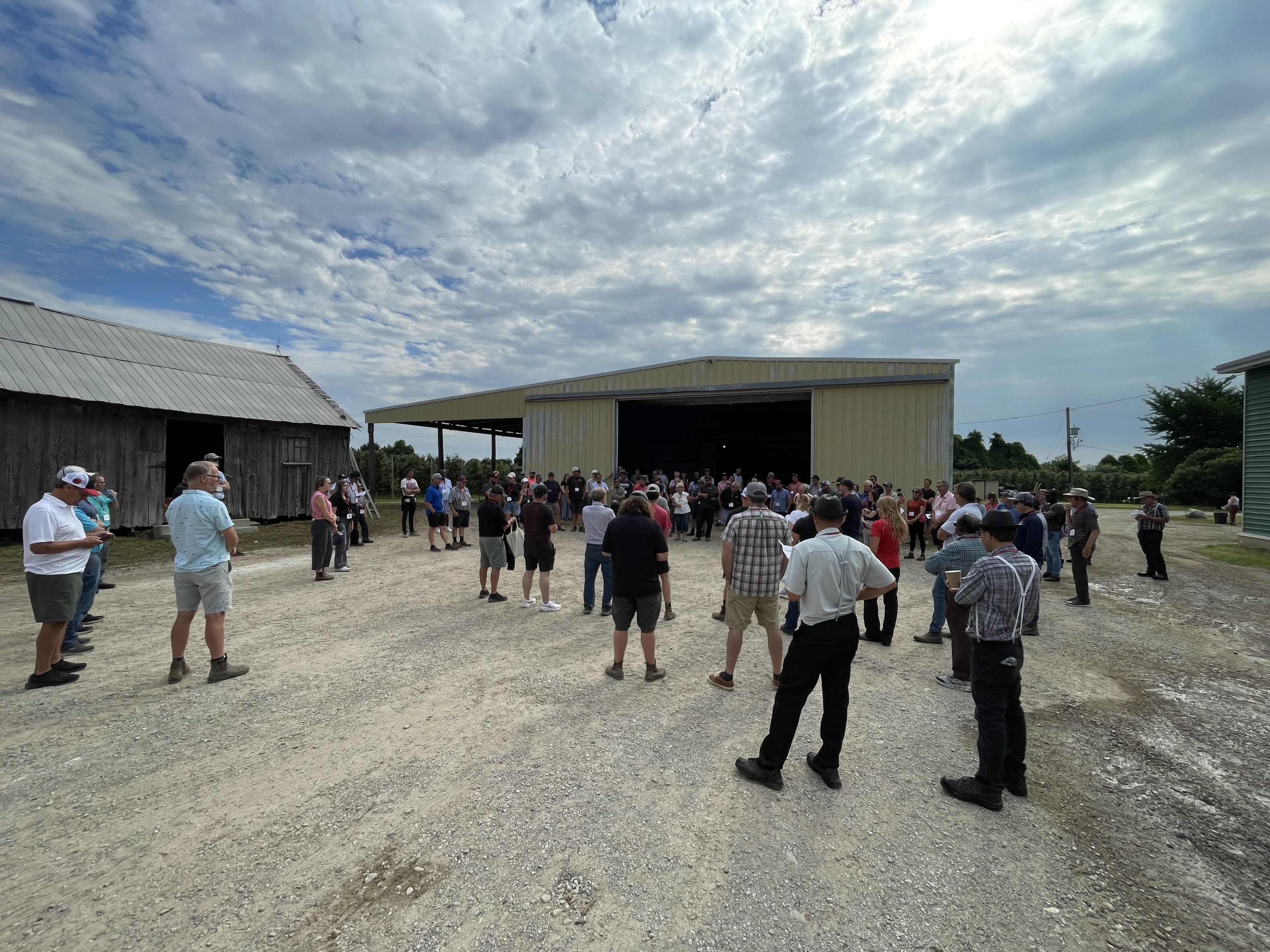
We want to thank everyone who joined the Ontario Apple Growers Summer Tour. We had an amazing (yet hot) day, filled many questions, greetings and excitement for harvest. We are truly wishing everyone the best in the home stretch of the season and appreciate your participation and attention.
A very big thank you to our tour hosts, Craig and Jesse Van Ymeren, and Joe and MaryAnne Van dee Gevel as well as all the organizers / speakers: Kelly, Larissa, Barb, Cathy, Marvin, Chris, Josh, Adrian and Owen, along with our OMAFA summer students, Amanda and Havanna for their pre-tour help and willingness to present, and Hannah and Ray for their huge help day of.
0 comments on “What the Crop?! Apple Update: August 7, 2026”