
By Laura Dobbyn, former OMAFA summer student
Cluster thinning (also known as fruit removal or dropping fruit) is the practice of removing grape clusters to achieve a desired crop load and fruit quality. While reducing crop load may seem counterintuitive, it is a widely used vineyard management strategy that helps balance fruit production and vine vigour, improve fruit quality, accelerate ripening, and reduce stress on the vine. The effectiveness of cluster thinning depends on timing, intensity of thinning and vine balance. Cluster thinning decisions should be tailored to vineyard objectives, cultivar, vine balance and growing conditions.

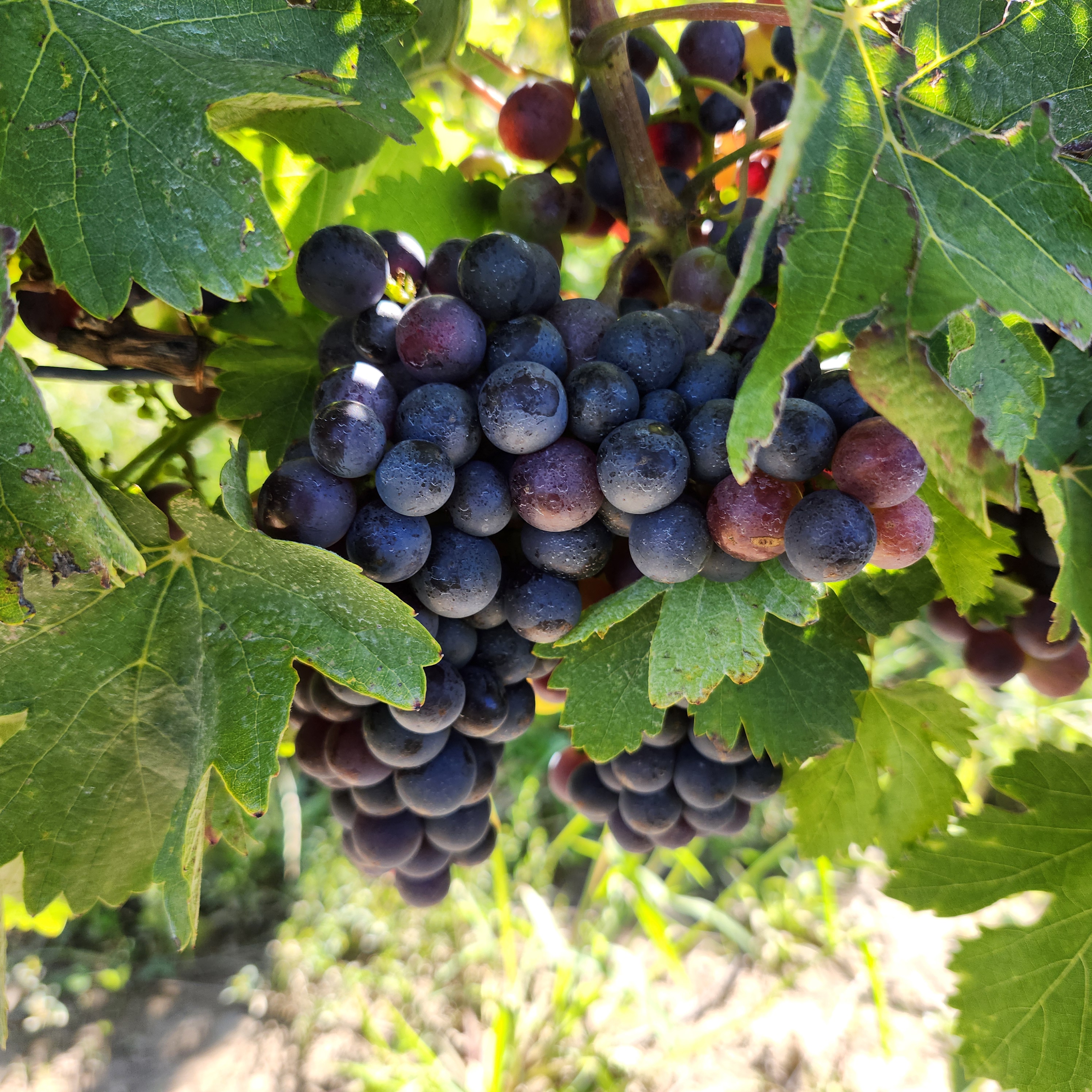
Figure 1. Before (left) and after (right) cluster thinning on Gamay grapes, thinned to two clusters per shoot. Photos by Brayden Lafleur.
What are the potential benefits of Cluster Thinning?
Cluster thinning is commonly used to manage crop load and improve fruit quality, particularly in cool-climate regions such as Ontario. When vines carry more fruit than they can ripen, thinning helps redirect resources to fewer clusters, promoting more uniform ripening, improved fruit composition and overall better vine health. However, cluster thinning is very labour- intensive practice, that increases production costs, leading many growers to question whether it is necessary.
Fruit Quality
Cluster thinning can improve fruit quality when used to correct excessive crop loads. Potential benefits include enhanced sugar accumulation, improved acidity balance, and greater phenolic development. These improvements are especially critical in cool-climate regions where shorter growing seasons and lower growing degree days (GDD) can limit fruit maturity.
However, cluster thinning doesn’t guarantee higher soluble solids (°Brix). When vines are already balanced, fruit removal often results in little or no improvement in fruit composition or wine quality. Responses of vines to cluster thinning are highly cultivar-dependent. For example, Riesling Chardonnay Musque and Syrah have shown increases in total soluble solids (TSS) (°Brix) by more than 1 °Brix after cluster thinning (Reynolds et al. 1996, Reeve et al. 2016, Talaverano et al. 2017), while Cabernet Sauvignon does not respond (Chapman et al. 2004, Luna et al. 2017, 2018, Wang et al. 2019).
Research suggests that thinning intensity has a greater influence on fruit composition than thinning timing. Moderate thinning (45% removal) produces the largest improvements in total soluble solids, pH, anthocyanins and phenolics. Excessive thinning can result in a slight reduction in Brix (Figure 2). Although timing generally has less influence than intensity, thinning at veraison produces the strongest responses in anthocyanin and phenolic accumulation.
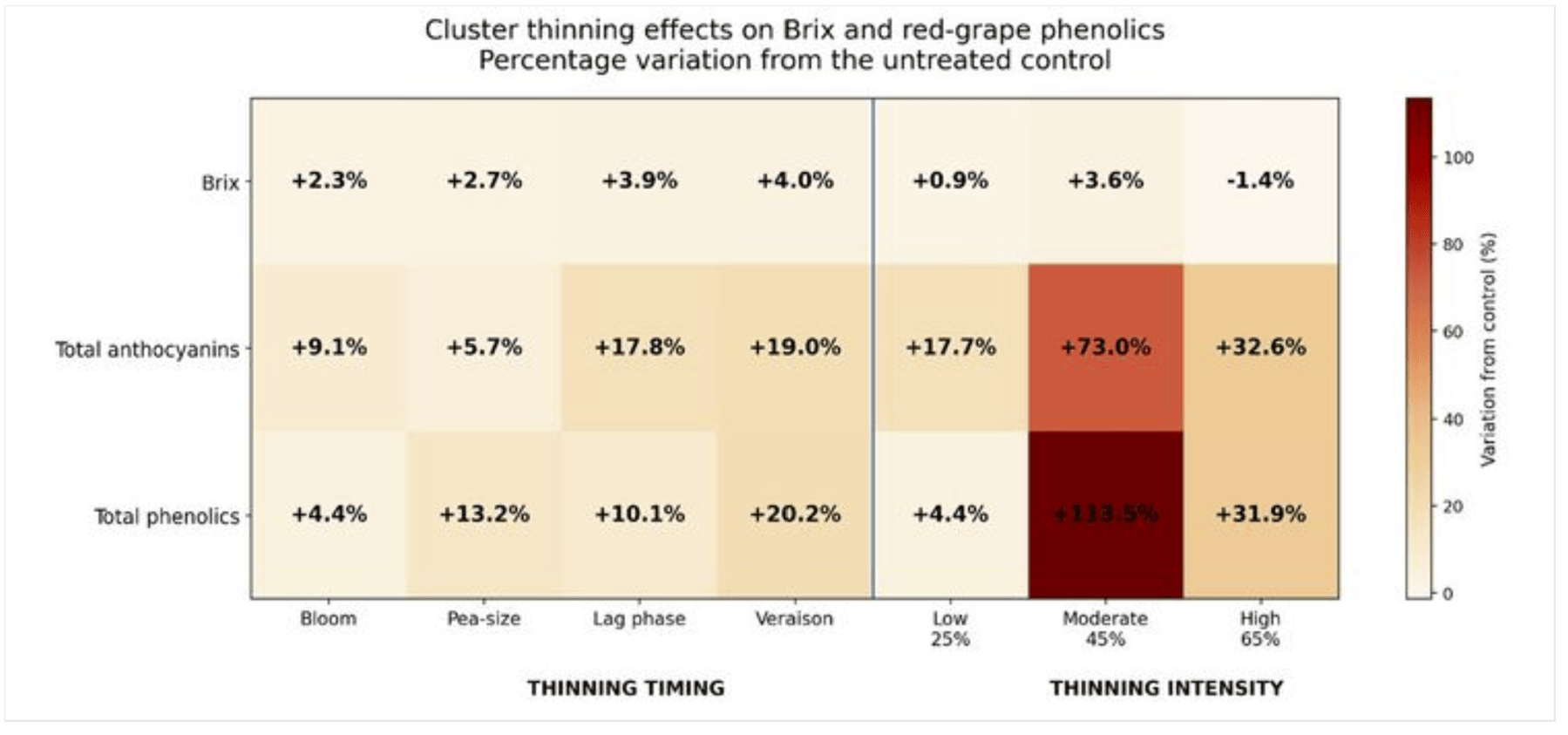
Figure 2 Heat map showing the percentage variation from the untreated control in Brix, total anthocyanins and total phenolics following cluster thinning in red grape cultivars (2010 to 2024). The first four columns summarize the effects of thinning performed at bloom, pea-size, lag phase and veraison. The final three columns compare low, moderate and high thinning intensities, corresponding to approximately 25%, 45% and 65% crop removal, respectively. Values are expressed as the percentage change relative to the untreated control. Positive values indicate an increase following cluster thinning, while negative values indicate a decrease. Darker orange and red colors represent larger positive changes relative to the control. (Sabbatini, 2026)
Managing Overcropping and Vine Health
Overcropping occurs when vines bear more fruit than they can adequately ripen, increasing the risk of delayed maturity and reduced fruit quality. Cluster thinning can be used to improve vine balance and reduce stress in vineyards with normal crop levels but vines weakened by cold injury or drought stress. Indicators that vines may be overcropped include high yields accompanied by weak shoot growth, delayed veraison, uneven berry coloration or a history of fruit failing to reach target maturity at harvest. Alternatively if vines lack adequate leaf area to support the fruit (approximately16-18 mature leaves per grape cluster). Cluster thinning can help restore a more favourable leaf area-to yield ratio and improve fruit ripening.
Late season crop thinning (around the lag phase of development), may be used to achieve target yields. This can be critical for long-term vine survival and productivity, especially in years following significant winter damage or during prolonged dry periods.
Manage Cluster Compactness & Disease Pressure
Compact-clustered cultivars like Chardonnay and Pinot Noir are particularly susceptible to bunch rot (Botrytis cinerea) due to poor airflow and high humidity within cluster. Cluster thinning performed at fruit set or during lag phase can be used to reduce cluster compactness, resulting in looser clusters with better airflow and lower disease risk. In contrast, early cluster thinning (3-4 weeks after fruit set) may increase berry size and cluster compactness, potentially increasing the susceptibility to bunch rot.
Late season thinning (pre-harvest) is costly but may be justified when disease incidence is high. Removing infected clusters can reduce disease spread within the vineyard and help lower inoculum levels for the following season. Cluster thinning should be integrated with canopy management practices like leaf removal, to improve airflow and light penetration into the canopy.
Intensity: How Much to Thin
As a general guideline, moderate-intensity thinning (36–55% of clusters removed) has consistently produced the most favorable improvements in fruit composition and vine balance (VanderWeide et al. 2024). In practical terms, this often corresponds to removing one cluster from shoots carrying three clusters or thinning vines to approximately one to two clusters per shoot, depending on the cultivar, vine vigour and crop level.
Conclusion
Cluster thinning remains an effective tool for managing vine balance and improving fruit quality, particularly in cool climates, high-yielding cultivars, and vineyards at risk of overcropping. The success depends on several factors, including the goal, timing, cultivar, vine vigor, and site-specific conditions.
Moderate intensity thinning has shown the most consistent improvements in fruit composition, while excessive thinning may unnecessarily reduce yield without improving quality.
As research continues to refine best practices, growers are encouraged to tailor their thinning strategies to align with specific vineyard goals and environmental conditions to achieve optimal results.
Sources
Reynolds, A. (2022). Impact of grape yield on wine quality. Ontario Ministry of Agriculture, Food and Agribusiness (OMAFA) https://www.ontario.ca/page/impact-grape-yield-wine-quality
Reynolds, A. G. (2013). OEVI 2P45: Grapevine Cultural Practices [Lecture notes]. Brock University.
VanderWeide, J., Nasrollahiazar, E., Schultze, S., Sabbatini, P., & Castellarin, S. D. (2024). Impact of cluster thinning on wine grape yield and fruit composition: A review and meta-analysis. Australian Journal of Grape and Wine Research, 2024, Article ID 2504396. https://doi.org/10.1155/2024/2504396
Making every cluster count: Crop adjustment for Michigan wine grapes – Grapes
0 comments on “From Assumption to Insight: Cluster Thinning in Ontario Vineyards”