
Research finds that soil texture sets the bar, while stacking soil-care practices makes measurable difference too
October 19, 2026
Contributed by: Heather White, Soils At Guelph Knowledge Mobilization and Communications Coordinator
GUELPH, ON – Recent study confirms that the impact of soil management practices on soil health can only be fully understood when the influence of soil texture is first taken into account.
From 2023 to 2025, Soils at Guelph worked with Ontario farmers, crop advisors, laboratories and other partners to test out a soil health test. The Soil Health Assessment and Plan (SHAP) uses 5-analytical indicators to assess soil health, including soil organic matter, active carbon, and soil respiration. More than 1,000 soil samples from over 330 farmers and advisors across Ontario were included in the pilot project.

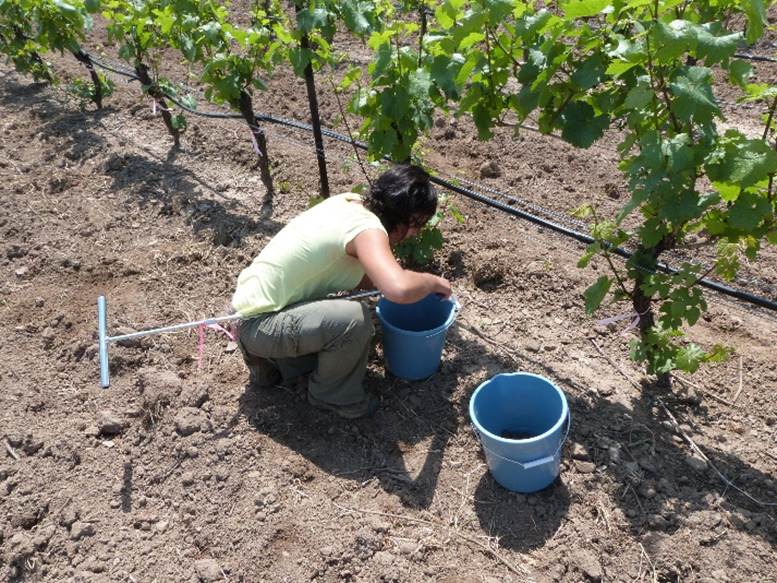
Photo 1 – Using SHAP sampling protocols, growers or advisors collect 15 soil samples from within a 3 m radius to a depth of 12 cm. The samples are combined in a clean bucket, mixed gently, and cleared of debris before a 500 mL composite sample is packaged, labelled, and sent to a laboratory for analysis.
One of the clearest findings was that soil texture matters. Clay soils generally had higher soil-health test values than coarse sandy soils. That means a healthy clay soil and a healthy sandy soil may not have the same benchmark value for what “healthy” looks like.
But texture wasn’t the whole story. Management mattered too.
Across soil types, sites where farmers had “stacked” or implemented several soil-care practices had better soil-health results than sites using few or none, regardless of soil texture. Soil care practices considered included: cover crops, reduced tillage, compaction-reduction strategies, keeping crop residues on the field, diverse crop rotations, and adding manure and other organic materials.
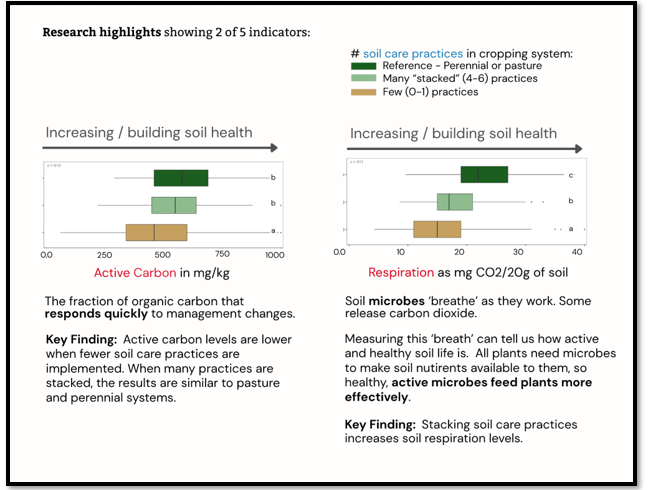
Photo 2 – These box-and-whisker plots show that soils managed with a greater number of soil care practices tended to have higher Active Carbon and Soil Respiration levels. While some variation exists within each category, part of this variability can be explained by differences in soil texture among samples.
“The findings reinforce what many farmers may already recognize intuitively. Now we have lab-based tools to quantify and monitor soil health changes over time,” says Dr. Laura Van Eerd, lead researcher on the project.
Not every farming system is the same
Stacking soil care practices was a driver of soil health. The relationship between soil management, soil texture and soil health makes sense. The cropping system was an important factor too.
“Historically, soil health research has focused more on field crops than perennial horticultural crops, creating an important knowledge gap for orchard and vineyard growers. Unlike annual crops, fruit trees and grapevines remain in place for many years and are managed under distinct production practices and constraints. Combined with differences in soil and site characteristics, this means that soil health principles and management strategies developed for field crops may not always translate directly to perennial fruit production systems,” says Kathryn Carter, Ontario Ministry of Agriculture Food and Agribusiness’s (OMAFA) tender fruit specialist. “While we are excited to have developed Ontario’s largest soil health database for orchards and vineyards, we still have much more to learn”.
The database was built around whole cropping systems rather than individual crops, reflecting the reality that farmers make management decisions at the system level, where each crop influences the performance of the next.
From a soil test to information farmers can use at scale
The project wasn’t only about measuring soil in a laboratory. It also explored how soil health results could be communicated and interpreted to support farm decision-making.
Farmers, crop advisors, laboratories, and OMAFA staff were consulted throughout the piloting process.
“Using a farmer’s own curiosity or goals to choose where to take soil samples can make the lab results much more meaningful, particularly when they know the management history of those fields,” says Heather White, Knowledge Mobilization Specialist with Soils at Guelph.
The findings have already re-shaped soil-health testing in Ontario. After reviewing the results as well as those from other soil health projects, the Ontario Soil Management Committee recommended that just three of the five SHAP indicators be included in the commercially available Core Soil Health package (soil organic matter, respiration and active carbon) making the suite more financially accessible. Other soil health indicators are available as add-ons.
Data continues to be analyzed by the Soils At Guelph team to determine which soil management practices are most effective at building soil health.
“There are so many questions that can be answered with this dataset.” says Van Eerd, a Professor at the University of Guelph, Ridgetown Campus and Charlotte Products Inc. Chair in Net Zero Soil Management. She is curious to explore how these practices influence soil carbon stocks and soil fertility too.
For more information, visit Soils at Guelph soil health testing. This research was funded by the Weston Family Foundation. A huge thank you to our farmer and advisor participants as well as project partners OMAFA, the Ontario Soil Network and Agriculture and Food Laboratory. Outreach activities were supported by the Ontario Agri-Food Innovation Alliance, a collaboration between the Government of Ontario and the University of Guelph.
0 comments on “Putting a soil health test to the test in Ontario”