Table of Contents
Dog(wood) Days of Summer
Dogwood borer (Synanthedon scitula) can be an easy pest to overlook — and it’s not just because it is a clearwing moth (insect joke!). Until a tree starts declining and you find larvae tunnelling into the base of the trunk, its presence in an orchard can often go unnoticed.
In high-density apple orchards, dogwood borer is particularly associated with burr knots, cankers, trunk injury (winter, mechanical, etc) and pruning cuts. These damaged or weakened areas of the tree provide an attractive site for females to lay eggs and an entry point for newly hatched larvae.
Once larvae enter the tree, they are protected from most insecticide applications. This makes timing critical — but dogwood borer biology does growers no favours when it comes to finding a convenient spray window.
One Long Flight
Dogwood borer has one generation per year in Ontario. But that doesn’t mean all individuals develop at the same time. Adults emerge over an extended period, laying eggs throughout the summer, and larvae remain inside the tree for much of the year. Research across five eastern states measured an average flight period of more than 22 weeks, with moth captures continuing into October in some locations. That’s a long time for a pest to be flying, mating and laying eggs!
In Ontario, adult emergence begins in late spring, or mid-June and can continue into September, with peak flight in July. Females lay tiny, oval, light-brown eggs singly on the bark surface, particularly around burr knots or damaged areas since larvae can’t chew through healthy, intact bark. Eggs hatch in approximately 8-9 days.
The newly hatched larva is the damaging stage for this pest. It quickly bores into the cambium and phloem layers and begins feeding within the tree, creating winding galleries. As larvae tunnel and feed, they push reddish-brown frass out of the feeding galleries – a useful sign when scouting (Figure 1). Larvae are cream-coloured with reddish-brown head capsules. They develop through multiple instars and overwinter inside their feeding tunnels, resuming feeding in the spring when temperatures raise above 7-10°C. Mature larvae pupate in a silken cocoon near the bark surface in spring. Another sign when scouting are the leftover brown pupal cases visibly protruding from the trunk after the adult moth emerges (Figure 2).


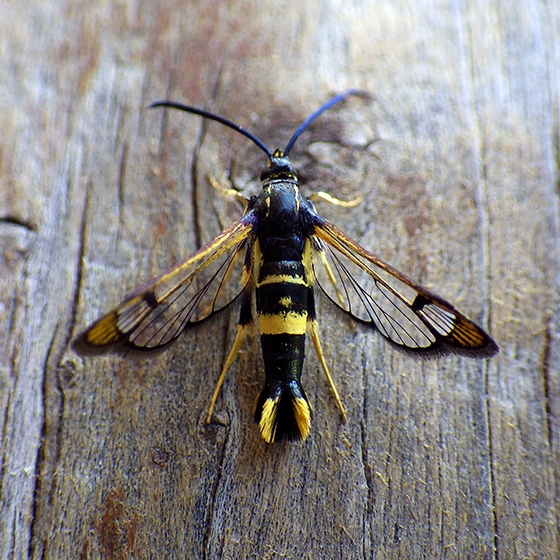
Adults are clearwing moths that resemble wasps, with a dark blue-black body and yellow banding on the abdomen (Figure 3). They are relatively short-lived, but a female dogwood borer can lay over 100 eggs in her lifespan.
And that is where the dogwood borer management challenge begins.
A Moving Target
Trunk applications can be effective, but they depend on getting the product to the pest when it is exposed and vulnerable. Once the larva has hatched and tunneled into the tree, it will remain protected from any sprays or winter exposure.
Current products registered for dogwood borer in Ontario differ in how they work and are tied to egg laying and hatch rather than simply the presence of adult moths:
- Pyrethroids (Perm-Up, Pounce) – These products act primarily by contact, with some secondary action by ingestion and have a fairly short residual. Application should be made at the beginning of egg hatch, or a shortly (7-14 days) following peak flight.
- Rimon – This product is an insect growth regulator (IGR) that must be absorbed by eggs to be fully effective. The optimal timing for this product is around 25-75% egg laying, or approximately peak flight.
- Delegate, Altacor – These products must be ingested by the larva in order to work; therefore, application should be made at the beginning of egg hatch, or shortly (7-14 days) following peak flight.
- Cormoran – This product is a premix of Rimon and Assail, which means activity can be through both absorption by eggs and ingestion of larvae. Application can be between egg laying (peak flight) and hatch (7-14 days after peak flight).
- With all products, a repeat application 14 days later is recommended.
Targeted sprays should be directed to the lower portion of the trunk, particularly the graft union and any pruning cuts. Many growers turn off upper nozzles and use the lower nozzles of their airblast sprayer to drench the trunk and lower branches.
Monitoring adult flight with pheromone traps helps narrow this spray window. In orchards with a history of dogwood borer, place pheromone traps early to mid-June, before the beginning of adult emergence and monitored regularly (at least once a week). Trap captures can help identify when the orchard population is increasing, when peak flight occurs, and on-going flight activity. Track weekly numbers for signs of this peak and any further emergence.
Since adult emergence can continue for weeks after peak flight, new eggs will continue to be laid after the initial spray window. This is why consecutive trunk applications, 14 days apart may be needed. And for blocks with recurring dogwood borer pressure, repeatedly trying to hit egg hatch with trunk applications can become an extremely labour-intensive and expensive strategy. Not to mention potentially disrupting the beneficial insect population established in the orchard that time of year, depending on the products used (hello mite flare ups).
This is where mating disruption deserves consideration.
Mated & Confused
Female dogwood borers release a sex pheromone to attract males. Mating disruption dispensers release synthetic pheromone throughout the orchard, creating a pheromone-rich environment that interferes with the male’s ability to locate females. The objective is not to kill adults or larvae. It is to reduce successful mating and therefore reduce the number of eggs produced and larvae entering the tree in the first place.
Think of it as turning down the tap rather than mopping up the floor.
Field research in several northeastern US states has shown that mating disruption can significantly reduce dogwood borer infestation. In Ontario, growers that have implemented this have seen great success in reducing the need for yearly trunk sprays. However, it is important to set realistic expectations: suppression develops over time and can be less effective than intensive trunk insecticide treatments, particularly when pest pressure is high or moths immigrate from surrounding untreated areas.
It’s best to view mating disruption as a long-term population management strategy, rather than a rescue treatment for a block already experiencing severe infestation. In other words, you won’t see results within the first year of using mating disruption.
Before Tying One On
There are several practical things to consider before committing to mating disruption.
Start before the moths start flying
Dispensers need to be deployed before adult emergence. For Ontario, this means planning for application by approximately the end of May rather than waiting for the first trap catch in June.
Once adult flight has begun, the opportunity to establish the pheromone environment before mating has already started has been lost.
Block size and shape matter
Mating disruption works best when pheromone coverage is sufficiently uniform across the treatment area. Small or irregularly shaped blocks (<4 ha) can be challenging, particularly where there is high pest pressure immediately outside the treated area.
This is because mating disruption does not stop a mated female from flying into the orchard and laying eggs. Research has demonstrated that movement of mated females from surrounding untreated areas can contribute to continued infestation even when male mate-finding is successfully disrupted within the treatment area. In other words, neighbours matter.
Where possible, treating contiguous blocks or coordinating with adjacent orchards can improve the likelihood of success.
Labour is still part of the equation
Dogwood borer mating disruption uses individual dispensers distributed throughout the orchard. The current Isomate DWB label specifies 250–375 dispensers/ha, with the higher rate recommended for the initial treatment year or areas with higher pressure. The rate can be increased around orchard borders, up to 500 dispensers/ha.
As a quick calculation, at 375 dispensers/ha, a 10-ha block means placing approximately 3,750 dispensers. Mating disruption may eliminate repeated trunk applications, but it does not eliminate labour. Instead, the labour is shifted to an early-season deployment task that needs to be completed before adult emergence. That said, once they are deployed, the dispensers provide season-long release, aka one-and-done.
For growers considering mating disruption, this labour requirement should be part of the cost comparison — not an afterthought.
Don’t expect an instant reset
Mating disruption is a population-management strategy, not a knock-down treatment. It reduces successful mating and therefore new infestation, but larvae already inside the tree are unaffected. This means growers should expect suppression to build over time rather than treating mating disruption as a one-season replacement for a trunk spray.
Which Strategy Makes Sense?
There is no single answer for every orchard! For a block with low pressure and a history of manageable dogwood borer, targeted trunk applications based on trap activity may remain a practical approach. For blocks with recurring pressure — particularly younger, high-density plantings with burr knot-prone rootstock, such as M9 or M26 — mating disruption may be worth considering as part of a longer-term program.
The strongest fit may be a combination approach:
- Monitor!
- Deploy mating disruption
- Monitor!
- Supplement with trunk sprays when necessary
- Monitor!
Mating disruption can reduce reproduction over time, while targeted insecticide applications can help manage existing or incoming pressure during the transition or where pest pressure is high.
Fatal Attraction
Dogwood borer management ultimately starts with understanding why the orchard is attractive to the pest.
Burr knots are a major risk factor, particularly on susceptible rootstocks like M9 or M26. Research in young apple orchards has shown that infestation can begin during the first season after planting and increase over subsequent years, with the amount of burr knot tissue strongly associated with infestation.
Important signs to look for:
- Burr knots around the graft union and exposed rootstock
- Larval feeding and frass around damaged bark
- Declining trees, particularly where the cause is otherwise unexplained
- Previous dogwood borer infestations in the block
- Pruning wounds, cankers and other damaged areas (e.g., winter injury) that could serve as oviposition sites
- Increasing adult trap catches during June through September
And remember: finding a larva early in the season does not necessarily mean eggs were laid that spring. Dogwood borer overwinters as partially developed larvae inside the tree, so larvae found during the early stages of summer flight are the overwintering generation.
A Doggone Good Plan
Dogwood borer is a good example of why IPM is more than finding the right product.
Its long adult flight period makes a simple calendar-based trunk spray difficult. Its larvae spend much of their development protected beneath the bark. And once a population becomes established, the damage can continue before the problem is obvious.
For orchards with a history of dogwood borer, monitoring flight activity is still essential — but consider whether the goal should be to repeatedly chase egg hatch with multiple trunk sprays or to reduce the population’s ability to reproduce.
Mating disruption will not be the right fit for every block. It requires advance planning, sufficient coverage, labour to deploy dispensers, attention to block size and surrounding sources of infestation, and patience while populations decline.
But where the conditions are right, it offers something a trunk spray cannot: a chance to manage dogwood borer by interrupting the problem before the larvae ever reach the trunk.
References
Bergh, J., Leskey, T, Walgenbach, J, Klingeman, W, Kain, D & Zhang, A. 2009. Dogwood Borer (Lepidoptera: Sesiidae) Abundance and Seasonal Flight Activity in Apple Orchards, Urban Landscapes, and Woodlands in Five Eastern States. Environmental Entomology. 38(3): 530-538.
Kain, D., Straub, R. & Agnello, A. 2004. Incidence and Control of Dogwood Borer (Lepidoptera: Sesiidae) and American Plum Borer (Lepidoptera: Pyralidae) Infesting Burrknots on Clonal Apple Rootstocks in New York. Journal of Economic Entomology. 97(2): 545-552.
Krawczyk, G. 2026. Tree Fruit Insect Pest – Dogwood Borer. PennState Extension.
Leskey, T., Bergh, J., Walgenbach, J. & Zhang, A. 2009. Evaluation of Pheromone-Based Management Strategies for Dogwood Borer (Lepidoptera: Sesiidae) in Commerical Apple Orchards. Journal of Economic Entomology. 102(3): 1085-1093.
Ontario Ministry of Agriculture, Food & Agribusiness. 2026. CropIPM – Dogwood Borer. King’s Printer for Ontario.
Rivera, M., Basedow, M., Van Zoeren, J. 2025. Dogwood Borer (Synanthedon scitula). Fruit IPM Fact Sheet. Cornell University.

Kristy Grigg-McGuffin
OMAFA Horticulture IPM Specialist