Few diseases generate more questions from apple growers than fire blight. From predicting infection to pruning strikes and managing spread, growers are faced with complicated decisions throughout the season.
The answers to these questions lie in understanding how the pathogen, host, and environment interact to drive development. In Part 2, we continue to look at a few of the most common fire blight questions I’ve heard over the years and the science behind best management practices. Refer to Part 1: Biology of Blossom & Shoot Blight in the Spring 2026 ONcore Newsletter (Volume 30, Issue 2).
Table of Contents
Pruning & Removal
When should I cut out strikes?
Unfortunately, there is no single answer. The decision depends on tree age, tree vigour, the number of strikes present, and whether weather conditions continue to favour infection.
Pruning fire blight strikes during the growing season can have two different outcomes:
- Reduce inoculum and prevent the spread of disease
- Increase shoot growth, making the tree more susceptible to fire blight.
Young, vigorous trees should generally be prioritized for strike removal. Fire blight can move rapidly from shoots into the leader, trunk, and rootstock, and infections can quickly kill the tree. Prompt removal of strikes can help prevent permanent structural damage and reduce spread to adjacent trees.
The decision becomes more complicated in mature orchards. In older vigorous trees with only a few infections, removing strikes may provide excellent control and help prevent disease spread. However, in older vigorous trees with many strikes, extensive pruning early in the season can stimulate a flush of succulent shoot growth, increasing susceptibility to further infection. In these situations, aggressive pruning may do more harm than good and major corrective pruning is often best delayed until dormancy.
Low-vigour trees behave differently. In slow-growing trees, or trees where shoot growth has been suppressed with prohexadione-calcium (ie., Apogee/Kudos), the pathogen is less likely to move rapidly into major limbs and trunks during the growing season. In these cases, cankers can be removed during dormant pruning rather than immediately.
When does the risk of spread stop?
Once terminal buds have set on apple trees, fire blight slows spread within infected trees. Summer pruning to increase fruiting wood in high-density orchards encourages new shoot growth and extends the susceptibility period for shoot blight. However, leaving the disease in the orchard may serve as a source of inoculum, and cause increased infections in the result of hail, severe storm, or high wind damage.
How far below a strike should I cut?
The fire blight bacterium often extends well beyond visible symptoms. Removing only the visibly affected portion of a shoot may leave infected tissues behind.
During the growing season, cuts should generally be made at least 30 to 45 cm (12 to 18 inches) below visible symptoms and preferably into second- or third-year wood (Figure 1). This reduces the likelihood of leaving systemically infected tissues in the tree.

When recommended cut distances are not possible without removing important structure, an “ugly stub” cut may be used. Leaving a short 10 to 12 cm (4 to 5 inch) stub away from structural wood allows the infection to remain isolated in sacrificial tissue that can be removed later during dormant pruning (Figure 2).

In young, vigorous trees where infection extends into structural wood, remove and destroy the tree. In older trees or if removal is unwanted, make the pruning cut well below the canker just above a suitably positioned lateral or renewal shoot to promote regrowth and allow selection of a new leader (Figure 3).

After making a cut, examine the cambium. Healthy cambium appears green (Figure 4A). If the cambium appears brown or discoloured, the infection has likely progressed beyond the cut and additional wood should be removed (Figure 4B).


Dormant pruning differs somewhat from summer pruning. Once the tree is dormant, the pathogen is largely confined to the cankered area and cuts can generally be made closer to visible symptoms.
Do I need to disinfect pruning tools?
Pruning tools can transmit fire blight bacteria when active infections or bacterial ooze are present. For this reason, many extension recommendations continue to advise tool disinfection during growing-season pruning.
However, recent multi-state research evaluating fire blight removal strategies found that tree survival was often similar whether pruning tools were sanitized between cuts or not. This suggests that factors such as timing, pruning distance and weather conditions may have a larger impact on management success than tool sanitation alone.
For young orchards, high-value blocks and situations involving active cankers or bacterial ooze, disinfecting tools remains a prudent practice. Growers should weigh the benefits against the practical limitations of slowing pruning operations.
If time permits, tools can be disinfected between cuts using 65-70% alcohol, a 10% household bleach solution, or disinfectant wipes.
Should pruning cuts be removed from the orchard immediately?
Where labour allows, infected pruning cuts should be removed from the orchard and destroyed/burned as soon as possible. Care should be taken to avoid brushing against healthy trees while transporting infected material. Some growers put pruning cuts directly in wagon or garbage bags to prevent ooze transfer (Figure 5).
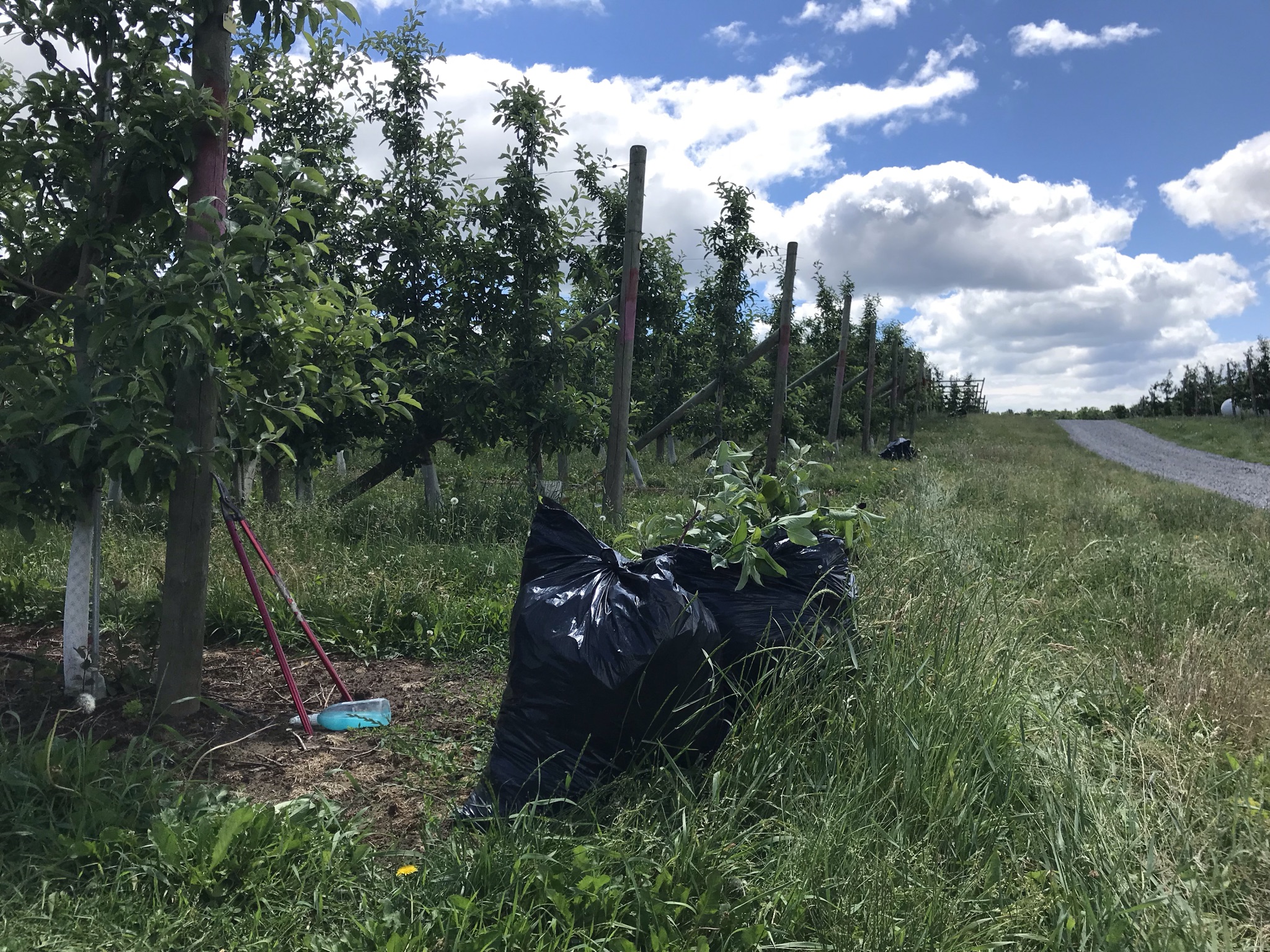
If dry weather is expected, prunings may also be left in row middles long enough to dry before being flail mowed (Figure 6). As tissues dry and bacterial activity declines, the risk of further spread decreases substantially.

Should I prune during an active outbreak?
Proceed with caution.
Every pruning cut creates a wound, and moving through infected trees can increase opportunities for bacteria to spread. At the same time, delaying removal may allow infections to move into leaders, scaffold limbs, trunks, or rootstocks.
Trees most at risk, particularly young vigorous plantings, often warrant immediate action. Older trees with widespread infections may benefit less from aggressive pruning, especially when warm temperatures and high humidity continue to favour disease development.
If possible, schedule pruning when there are two to three consecutive days of lower humidity and temperatures below 25°C. These conditions allow wounds to begin sealing without additional disease pressure.
Growers should also remember that summer pruning, including pruning intended to improve light penetration or increase fruiting wood, can stimulate new shoot growth and extend the period in which trees remain susceptible to shoot blight.
Tree & Orchard Factors
Which cultivars/rootstocks are most susceptible?
Susceptibility varies considerably among both cultivars and rootstocks. Cultivars such as Gala, Fuji, Honeycrisp and Pink Lady are generally considered highly susceptible, while cultivars such as Empire often exhibit lower susceptibility. However, cultivar response can vary with tree vigour, crop load, weather conditions and inoculum pressure.
Traditional dwarfing rootstocks such as M.9 and M.26 have demonstrated high susceptibility in numerous studies, whereas many Geneva rootstocks were specifically bred for improved fire blight resistance. No cultivar or rootstock should be considered immune, but choosing resistant rootstocks can substantially improve orchard survivability during severe outbreaks.
For fire blight susceptibility ratings of common cultivars and rootstocks, see Disease Susceptibility Ratings of Common Apple Cultivars and Insect and Disease Susceptibility Ratings of Common Apple Rootstocks on the Ontario Crop Protection Hub.
Does nitrogen increase fire blight risk?
The fire blight pathogen infects young, succulent tissues much more readily than mature tissues. High nitrogen programs promote vigorous shoot growth and delay terminal bud set, extending the period during which shoots remain susceptible to infection.
Balanced fertility remains essential for orchard productivity, particularly in young plantings. However, excessive nitrogen can create ideal conditions for shoot blight development. Fire blight management should therefore focus on balancing growth and productivity while avoiding excessive vigour. Practices that suppress growth, such as prohexadione-calcium (ie., Apogee/Kudos), may help reduce shoot blight risk in susceptible orchards.
Can young trees recover from fire blight?
Minor infections can often be managed successfully if detected early.
However, young vigorous trees are especially vulnerable because fire blight can move quickly into the central leader and rootstock. Once structural components become infected, recovery becomes much more difficult and tree death may occur quickly.
For this reason, young orchards should receive priority when time and labour for strike removal are limited.
When should a tree be removed rather than pruned?
Removal should be considered whenever infections have progressed into major structural wood, such as the trunk or rootstock.
In young vigorous trees, infections extending into structural wood are often best managed by removing and destroying the tree. Attempting to salvage severely infected young trees frequently results in continued disease issues and poor structure.
In older trees, more aggressive corrective pruning may be justified. Cuts can be made well below the canker to a suitably positioned lateral or renewal shoot, allowing a new leader or scaffold to be developed.
Tree removal should also be considered in orchard sections that experience severe infections year after year. In some situations, repeatedly pruning highly susceptible or chronically infected trees may be less economical than replacement.
Models & Forecasting
What does an infection event actually mean?
A fire blight infection event does not mean infection has occurred. It means all the biological requirements necessary for blossom infection are believed to be present simultaneously.
For blossom blight to occur, susceptible blossoms must be open, bacterial populations must build on flower surfaces, and moisture must allow bacteria to enter floral tissues. Forecasting models estimate when these conditions align and identify periods of elevated risk.
An infection warning should therefore be viewed as a risk prediction rather than a disease diagnosis. Infection can only occur if inoculum is present, susceptible host tissue is available and fungicide protection is lacking. Likewise, a forecasted infection event does not guarantee symptoms will eventually develop.
Why do different fire blight models give different predictions?
Different models use different biological assumptions and calculations.
- Maryblyt – incorporates factors such as flowering stage, bacterial population growth, wetting events, temperature and heat-unit accumulation
- CougarBlight – uses a different temperature-driven framework and incorporates orchard disease history when estimating risk
As a result, the same weather conditions may produce different risk ratings.
Differences in weather station location, forecast accuracy, bloom observations and local orchard conditions can further contribute to variation among model predictions. Forecasting systems should therefore be viewed as decision-support tools rather than absolute predictors of disease.
How accurate are forecasting models?
Forecasting models are among the most valuable tools available for fire blight management, but they are not perfect.
Models such as Maryblyt and CougarBlight have been extensively evaluated and generally provide useful guidance for identifying periods when blossom infection is biologically likely. However, studies have shown that predictive performance varies among regions, seasons and weather scenarios.
Their accuracy depends on reliable weather data, accurate bloom observations and an understanding of local orchard conditions. Models perform best when used in combination with scouting, orchard history, cultivar susceptibility and grower experience rather than as stand-alone decision-making tools.
References
Dougherty, K., Outwater, C. & Sundin, G. 2026. Fire Blight Moves Fast: Understanding Erwinia amylovora Migration During Shoot Infection. 2026 Fire Blight School (video).
DuPont, T., Cox, K., Johnson, K., Peter, K. Munir, M. & Baro, A. 2026. Managing Fire Blight Infection: Pruning, Summer Sanitation. 2026 Fire Blight School (video).
DuPont, T., Smith, T., Johnson, K. & Zhao, Y. 2024. Fire Blight of Apple and Pear. Washington State University.
Grigg-McGuffin, K. (2021). Put Out the Fire – Part 1: Managing Rootstock Fire Blight. Orchard Network Newsletter: 25(1), 10-13.
Grigg-McGuffin, K. (2021). Put Out the Fire – Part 2: Managing Blossom and Shoot Blight. Orchard Network Newsletter: 25(2), 15-21.
Sundin, G. 2012. Fire Blight: Pruning Shoot Blight Strikes. Tree Fruit Disease Management Series (YouTube). Michigan State University (video).

Kristy Grigg-McGuffin
OMAFA Horticulture IPM Specialist