(SWD) Monitoring Tools for Berry Growers
February 2026
Matteo Girardo, Summer research assistant; Hannah Fraser, Entomologist- Horticulture; Erica Pate Fruit Crop Specialist, OMAFA
Spotted Wing Drosophila (Drosophila suzukii), an invasive vinegar fly (Family Drosophilidae), can cause significant injury and yield loss in soft skinned-fruits, particularly berry crops. Fruits are at risk of infestation as they begin to ripen and through harvest. Regular monitoring is important for growers to time control measures, as initial SWD activity varies year-to-year. Baited liquid traps (drowning jars) are effective for tracking male and female SWD, but they are time-consuming to process, and some find them impractical for on-farm use. Recently, sticky cards baited with commercially available lures have been recommended, which are easier to use and require less maintenance than liquid traps. Both yellow and red sticky cards can be used. Though various commercial traps for this pest are available, there is contradiction surrounding which monitoring tools and sticky cards are most effective.
In trials in 2025 three monitoring tools were compared to determine which trap is more effective at identifying 1) first capture, 2) sustained capture, and 3) upswing in adult numbers.
Traps were placed at 4 farms growing raspberries, cv. ‘Nova’, ‘Prelude’, and ‘Algonquin’ (all early cultivars), across southern Ontario. Each site had 4 replicates, and each replicate contained one of each of the three treatments; red sticky card (TRÉCÉ Dual panel liner), yellow sticky card (TRÉCÉ Dual panel liner), and liquid trap. Each trap or card was paired with a commercial grade volatile lure (TRÉCÉ PHEROCON SWD PEEL-PAK Broad Spectrum lure). Cages (mesh size 5 mm) were placed around sticky cards to prevent large insect and small vertebrate bycatch, particularly birds, and help to keep the foliage away from the sticky card surface. Previous work done by OMAFA indicated cages do not affect SWD catch numbers. Traps and lures were placed at sites on May 27 (unopened buds) and were collected ~ twice a week until July 14 (harvest underway), with lures being replaced once on June 23. Males from each trap were counted following collection. While males are easily identified by a single black dot on their forewings, identification of females is often labour intensive, time consuming, or near impossible when desiccated on sticky cards.

There were no significant differences between traps for detecting initial field presence. Yellow sticky cards caught significantly more SWD males than both the liquid and red sticky traps, with liquid traps capturing the least (Fig. 2), and yellow sticky cards showed increased sensitivity to upswing in numbers, which occurred mid-June (Fig. 3). SWD males are also easier to see on yellow sticky cards compared to red sticky cards. All three trapping systems accurately predicted population upswing, although higher numbers captured on yellow sticky cards coupled with ease of use / contrast suggests these are the most user-friendly. Though we did not track females on sticky cards, they are relatively easy to identify on yellow sticky cards when freshly captured (not dessicated), as the ovipositor is visible using a hand lens or other magnification.
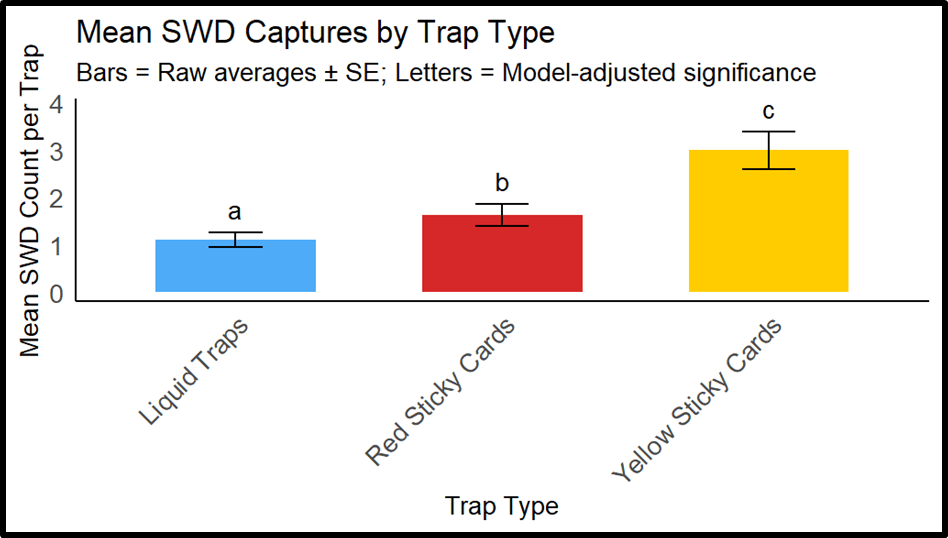

The use of SWD traps is critical for growers to time insecticide applications. Yellow sticky cards paired with a commercial lure such as the TRÉCÉ PHEROCON SWD PEEL-PAK lure used in this trial are effective, easy-to-use traps for Ontario berry growers and consultants to monitor SWD.
If possible, growers should have their own on-farm monitoring to time insecticide applications:
- Use 4-6 traps around your farm, placing the traps in the canopy of a ripening crop, near the fruiting zone.
- Focus on the earliest varieties / crop and move traps as required.
- Place 1-2 traps in wild hosts for early detection.
- Place traps during bloom or green fruit, before fruit ripening.
- Check sticky cards weekly.
- Replace sticky cards every 1-2 weeks.
- Replace lures after 4-6 weeks.
- Once SWD is identified and ripe fruit is present it is time to spray; traps can be removed as SWD will remain a threat to fruit through harvest therefore tracking numbers is no longer necessary.
Traps and lures can be purchased from multiple IPM suppliers, including:
- Solida (https://solida.quebec/?lang=en)
- Trécé Inc. (https://www.trece.com/)
- Plant Products (https://plantproducts.com/us-en)
- Great Lakes IPM (https://www.greatlakesipm.com/)
- Bartlett’s (https://www.bartlett.ca/) .
This assessment was funded by OMAFA. Thank you to Leah Ritcey-Thorpe who assisted with the data visualization as well as the grower participants who graciously let us use their sites to conduct treatments.