

Production and pest update brought to you by the OMAFA Apple Team:
Erika DeBrouwer, Tree Fruit Specialist and Kristy Grigg-McGuffin, IPM Specialist
Table of Contents
Grower Grind
The biggest focus this week has been the heat. With Environment Canada issuing extreme heat warnings day after day, orchards across the province have been under significant stress. If we’re feeling the effects, the trees are too — responding by conserving water and slowing non-essential growth processes to cope with the hot, dry conditions. Fruit drop is now becoming more apparent and terminal bud set has begun in some of the earlier regions. Hand thinning has kicked off, with some blocks still having fruit holding on while others requiring only spot thinning. As temperatures remain elevated, monitoring tree stress and maintaining adequate soil moisture will be key to supporting fruit sizing and overall tree health.
Our weekly What the Crop?! updates will take a brief pause next week as both Erika and Kristy take some time to kick off summer. Next update will be July 17th.
Growth Stages
Fruitlets made a noticeable drop this week after many seemed to be hanging on longer than expected. Overall, Ambrosia continues to appear light in many blocks, while Honeycrisp and Gala seem to have a decent crop load. Terminal bud set is on-going in some of the earlier regions, signaling a gradual shift from shoot growth toward fruit development and bud formation for next season.


At the Simcoe Research Station, king fruitlets and terminals are measuring the following:
Honeycrisp | Ambrosia | Gala | |
|---|---|---|---|
Fruitlet Size | 46.7mm | 39.6mm | 39.8mm |
Terminal Growth | 23.0cm | 27.4cm | 26.9cm |
Considerations for a ‘Hot’ Orchard
With the recent heat wave, we aren’t the only ones feeling uncomfortable — it can also be physiologically stressful for trees. Visually assessing heat stress on trees is often found too late, resulting in leaf scorching, fruit sunburn, premature fruit drop and a reduction in growth. With this in mind, be sure to keep your orchard chill with protective methods listed below.
Irrigation Management
Frequent, shallow watering during heat waves helps maintain soil moisture near the root zone in high-density systems. Use drip irrigation for precision and efficiency. Consider pulse irrigation to avoid water stress midday.
Evaporative Cooling
Use overhead sprinklers or misters during peak heat hours to reduce canopy and fruit surface temperatures. Especially useful to prevent sunburn on fruit.
Sunburn Protection
Apply kaolin clay or calcium carbonate sprays to reflect sunlight and lower fruit surface temps. Maintain a balanced canopy to provide natural shade (avoid over-pruning in summer). For more thorough definitions of the various types of sun damage in apple – refer to this link. https://onfruit.ca/2024/06/21/what-the-crop-apple-update-june-21-2024/
Under Tree Mulching
Organic mulches (e.g., straw, wood chips, spray on mulches – paper fibre) help retain soil moisture and reduce surface temperature. Can also reduce competition from weeds for water and increase young tree growth.
Nutrient Support
Ensure adequate potassium and calcium to help with plant stress tolerance and fruit integrity. Foliar feeds may be used when uptake through roots is impaired.
Field Activity Adjustments
Delay non-urgent tasks like pruning or heavy equipment use to cooler periods.
See Heat Check below for considerations when applying sprays during heat waves.
Monitoring & Record-Keeping
Use soil moisture sensors and weather stations to make timely decisions. Track GDDs and stress days to refine your response year to year.
Water You Waiting For?
Irrigation during dry periods is crucial in high-density apple orchards, where limited root zones and closely spaced trees increase vulnerability to heat stress. Consistent moisture helps maintain cell turgor, supports active photosynthesis, and prevents fruit shrivel and sunburn.
Timely irrigation not only preserves fruit quality and size but also enhances the trees’ resilience, ensuring they can withstand prolonged heat without compromising productivity.
For best management practices for irrigation management, practical calculations and drip irrigation information, check out the following links:
- Irrigation Management
- Drip Irrigation Scheduling
- Using ET Data to Make Irrigation Decisions
- Irrigation Scheduling for Fruit Crops
- Irrigation Timing in Fruit Crops
- 3 Secrets of Irrigation – Water Taking Permits Revealed
Heat Check
With daytime temperatures climbing into the 30s, careful consideration needs to be made when applying sprays. Making applications during the evening or overnight when temperatures are below 25C can reduce the risk of heat-related phytotoxicity.
To reduce the risk:
- Aim for 6-8 hours of drying time before temperatures begin to rise the next morning.
- Evening applications (eg., 9:00 pm – midnight) as temperatures begin to drop generally provide a greater safety margin than spraying just before sunrise.
- Keep tank mixes as simple as possible during periods of prolonged heat.
Heat does not automatically cause phytotoxicity. The risk increases when spray deposits remain wet as temperatures rise, trees are already heat- or drought-stressed, or products (especially captan, copper, or sulphur) are applied with penetrating adjuvants, crop oils or certain foliar nutrients.
Many systemic pesticides are generally well tolerated when applied according to the label. However, these products are absorbed most efficiently when the plant cuticle is hydrated. During prolonged hot, dry weather, uptake may be slower, making good spray coverage and appropriate application timing even more important.
Biological product efficacy may also be affected by prolonged hot, dry weather. Cooler evening temperatures and higher overnight humidity can improve survival and establishment of beneficial pathogens (ie., active ingredients in the biological products) on tissue surfaces, potentially enhancing their effectiveness.
A note on plant stress – Products that activate a tree’s own defense response, such as systemic acquired resistance (SAR) inducers, require the tree to divert energy toward defense rather than growth or stress recovery. During periods of prolonged heat or drought stress, when trees are already under physiological strain, consider whether the benefits of inducing defense outweigh the additional metabolic stress, particularly if disease pressure is low. Induced resistance works best when the plant has the resources to mount a defense response.
How does heat affect orchard pests? Check out How Hot Is Too Hot? in the June 12th What the Crop?!
Blight the Bullet
The summer heat has caused fire blight outbreaks in a number of orchards across the province. Now that fire blight is present, when should you prune it out? Unfortunately, there is no easy answer, since the severity of the infection and the weather conditions suitable for infection impact the decision.
Be mindful of where your management recommendations are coming from. In the northeast, we experience much more humid and wet conditions than that in the western part of North America. While more arid climates may be able to leave strikes to dry, doing so in our region may result is significant spread to adjacent trees or blocks.
Pruning the trees at this time of year can have two different outcomes:
- Reduce the inoculum and prevent the spread of disease.
- Increase shoot growth, making the tree even more susceptible to fire blight.
Pruning Triage
Older, Vigorous Trees
When dealing with older (especially >10 year old) vigorous trees that have MANY fire blight strikes, avoid pruning out shoot and blossom strikes early in the growing season. Extensive early pruning stimulates trees to produce succulent shoots, making them more susceptible to infections.
When dealing with high vigour trees that have only a FEW fire blight infections, pruning out the fire blight may help to provide complete control of this disease.
Older, Low Vigour Trees
In slow growing, low vigour trees or trees that have been sprayed recently with Apogee/Kudos, the bacteria generally doesn’t move into major limbs or trunks during the growing season. As a result, lesions can be pruned out when the tree is dormant. This may help to save time and money.
Young Trees
In comparison, young (<5 years) vigorous trees are very susceptible to fire blight and the bacteria may move rapidly into the trunk and down to the rootstock, killing the tree. As a result, pruning is recommended on young trees AS SOON AS INFECTION APPEARS to prevent the spread of the disease to adjacent trees.


When Does It Stop?
Keep in mind that once the terminal buds have set on apple trees, fire blight stops spreading within infected trees. Summer pruning to increase fruiting wood in high-density orchards encourages new shoot growth and extends the susceptibility period for shoot blight. However, leaving the disease in the orchard may serve as a source of inoculum, and cause increased infections in the result of hail, severe storm, or high wind damage.
Key Pruning Points
If you decide to prune out fire blight strikes, remember:
- Cut at least 30-45 cm (12-18 in) or more beyond the visible infected tissue, preferably into 2nd or 3rd year wood.
- Look at the cambium after your cut – if it appears brown, you need to cut further (but disinfect your pruner first!)
- Prune out strikes when there are 2-3 consecutive days of low humidity and temperatures below 25°C to allow pruning wound time to heal without conditions conducive to disease spread.
- If time and labour allow, disinfect tools between cuts by dipping them in a 65-70% alcohol solution or a solution of 1 part bleach to 5 parts water. However, timely removal of infected tissue is top priority so focus should be on making appropriate cuts where risk of cross-contamination is low.
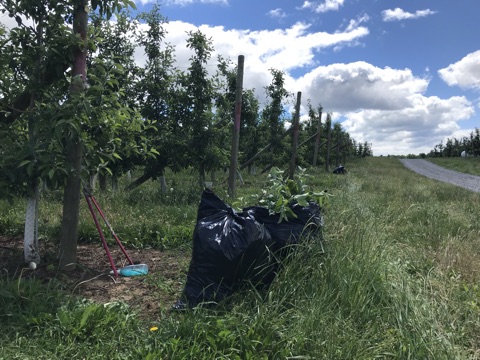
- Remove pruning cuts from orchard as soon as possible and burn – but be sure not to touch healthy trees along the way!
- If wet weather is not predicted, pruning clippings could alternatively be tossed into the row middles and allowed to dry before flail mowing.

Looking for more? Here are two great video resources worth a watch! Fire Blight: Pruning Shoot Blight Strikes and Managing Fire Blight Infections (Fire Blight Workshop 2026)
Other management practices to consider:
- Continue monitoring and managing insects in infected blocks that may spread the fire blight bacteria, such as aphids, leafhoppers and beetles.
- Manage excessive succulent growth, where possible.
- Prohexadione-calcium (Apogee/Kudos) can provide protective benefits when applied now (ie., thickening of cell walls to prevent infection) but this action will take 10 days from application.
- Consider products that:
- Surface sterilize such as Cueva or Oxidate
- Boost immunity such as Lifegard, Regalia or Double Nickel
- Dessicate infection such as Buran or Cyclone Plus
In sections where trees are severely affected or trees are continuously infected year after year, it may be more cost-effective to simply remove the whole tree.
A Bitter Turn
Now is the time to start considering summer disease management, especially bitter rot given this heat wave. While symptom development may not appear for fruit rots until later in the summer or into the fall, infection actually happens now!
Bitter rot risk has been high this week, as hot temperatures, high humidity and thunderstorms have created ideal conditions for infection. Rain events can splash spores onto fruit, while prolonged periods of warmth and moisture allow infection to establish quickly. Infection timing for fly speck and sooty blotch should also be considered now that we are several weeks after petal fall.
For a full list of products with efficacy on fruit rots and summer disease, see Bitter Rot, Black Rot, Fly Speck & Sooty Blotch on the Ontario Crop Protection Hub.


Residual protection will vary depending on the product used. For example, Pristine/Merivon can provide reasonable residual control of summer disease up to 3 weeks at the labelled rate in ideal conditions; however, captan should not be pushed further than 14-days between sprays particularly since it is not as strong on fly speck and sooty blotch as other control products. In all cases, reduce interval to 7 days during times of hot, wet weather but be mindful of the preharvest interval (PHI). These values can be found under View Details for each product in the Ontario Crop Protection Hub.
Important cultural management recommendations include:
- Prune and thin clustered fruit to facilitate drying and improve fungicide coverage.
- Remove potential sources of inoculum such as dead branches, fruit mummies (where possible), infected fruit on the orchard floor and alternate hosts including brambles (blackberry, raspberry) from surrounding hedgerows or woodlots.
- Toss pruning cuts and thinned fruit in the row middle and mulch.
- Reduce tree stress by irrigating and/or applying a sun protectant, especially ahead of a heat wave.
Degree (Days) of Separation
San Jose Scale
Crawler activity has increased over the last week in Norfolk County. Early signs of fruit damage can also be found in high pressure blocks. This activity will last for several weeks. However, hot weather can accelerate development, potentially shortening the crawler window and leading to earlier onset of the next generation.


The second generation crawler emergence is predicted to begin at 806 DDC, which is typically early to mid August. Current degree day accumulations for various regions are below. With this heat, we are accumulating an average of 90-100 DDC per week.
Predicted emergence date of second generation San Jose scale, by region (biofix March 1st, base 10C)
Region | Current Degree Day Celsius (DDC) | Predicted Crawler Emergence (806 DDC) |
Essex | 585 DDC | >14 days |
Lambton, Middlesex, Elgin | 447 DDC | >14 days |
Norfolk | 480 DDC | >14 days |
Wellington | 363 DDC | >14 days |
Niagara | 470 DDC | >14 days |
Grey | 384 DDC | >14 days |
Durham, Northumberland | 379 DDC | >14 days |
Ottawa | 415 DDC | >14 days |
Apple leafcurling midge
Adult flight for the second generation of apple leafcurling midge has begiun in all regions. Emergence predictions for the 2nd generation adults are summarized below. If leafcurling midge is an ongoing issue in your orchard, consider products that have efficacy for this pest. Ideally timing is between 5-50% emergence.
For a full list of products with efficacy on leafcurling midge, see Leafcurling Midge on the Ontario Crop Protection Hub.
Predicted emergence date of second generation adult apple leafcurling midge, by region (biofix March 1st, base 9C)
Region | Current Degree Day (DDC) | 5% Gen 2 (430 DDC) | 50% Gen 2 (556 DDC) | 95% Gen 2 (701 DDC) |
|---|---|---|---|---|
Essex | 668 | Passed | Passed | July 2 |
Lambton, Middlesex, Elgin | 516 | Passed | July 3 | July 13 |
Norfolk | 551 | Passed | July 1 | July 10 |
Wellington | 428 | July 1 | July 9 | >14 days |
Niagara | 542 | Passed | July 2 | July 11 |
Grey | 446 | Passed | July 9 | >14 days |
Durham, Northumberland | 437 | Passed | July 9 | >14 days |
Ottawa | 478 | Passed | July 5 | >14 days |
0 comments on “What the Crop?! Apple Update: July 3, 2026”