
By Henry Knafelc, OMAFA Summer Student
Introduction:
Peaches and Nectarines are considered stone fruit as they have a thin skin and fleshy inside surrounding a pit that encases a seed. Throughout their growing season they can develop defects that effect the quality, yield and health of the crop and tree. A few of these common defects are split pits, buttons and doubles.
What is a split pit?
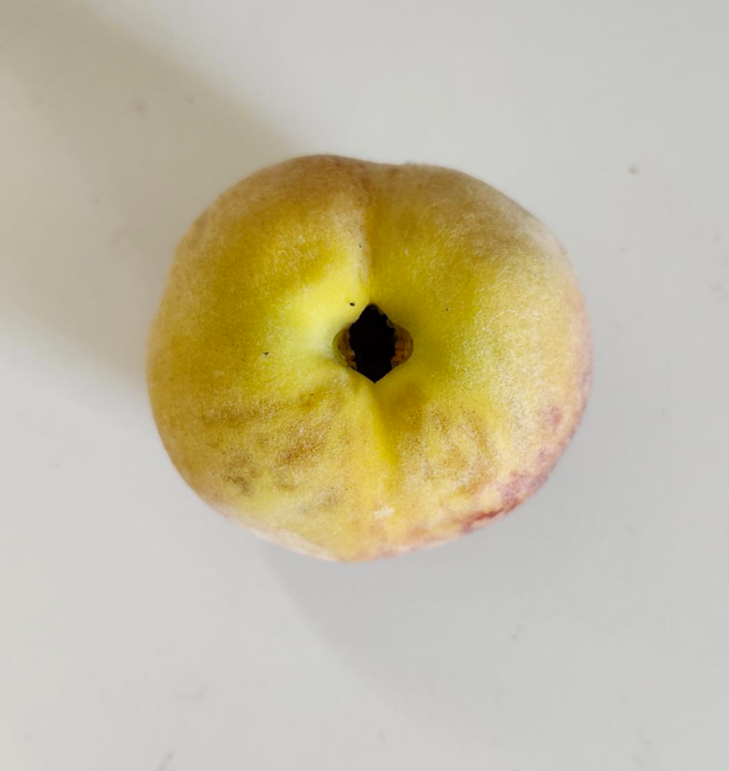
Split pits are a physiological problem that occurs when the pits that are broken into 2 or more pieces, creating a void or hollow center inside or around the seed. Split pits become more obvious at final swell (the third stage of fruit growth). Affected peaches are typically larger, misshapen, faster to ripen and have a dimmer yellow-green colour to them. Sometimes damage is not obvious until the fruit is cut open, but damaged fruit has a hole at the stem of the fruit (Figure 1a). The fruit is often more susceptible to rots and insects such as earwigs which can hide inside of the fruit cavity. Split pits affect the quality and yield of peaches and reduce customer satisfaction resulting in economic losses.

Figure 1 Left-Peach with a split pit-not the hole at the stem of the fruit. Right-the inside of peach with a split pit (H. Knaflec)
What causes a split pit?
Split pit is caused by rapid increase in fruit size during development, and the pressure of the expanding flesh results in pit cracking. Split pits can occur at two stages of development: 1) approximately 20 days after bloom when the pit is still soft and expanding or 2) after pit hardening which is the more common period for pit splitting. Fruit that grows rapidly during these stages are at the greatest risk of developing split pits.
Factor that affects split pits in peaches?
Cultivar: Early- maturing cultivars, particularly those that ripen before ‘ Red Haven’ are generally more prone to pit slitting because their pit hasn’t hardened fully when the final rapid fruit growth phase occurs. This expansion can cause the pit to break. Genetic factors also play an important role, as some cultivars are inherently more susceptible to split pit than others. Nectarines have a higher incidence of split pits than melting-flesh peaches, and yellow-flesh cultivars have a higher incidence of split pits than white flesh cultivars.
Thinning and pruning practices: Cultural practices that promote rapid fruit growth are often associated with split pits. Heavy thinning of peach trees, leaving fruit 20 cm apart, has been shown to increase split pit incidence by up to 58.2%. This is effect is likely due to greater availability of light, water and nutrients to the remaining fruit, which stimulates rapid fruit growth. The timing of thinning is also important. Thinning before pit hardening results in a higher incidence of split pits compared with thinning during or after pit hardening. Trees pruned after flowering have been reported to exhibit less pit splitting than those pruned earlier.
Fertilizer application: Excess nitrogen applications can increase the incidence of split pits by stimulating vigorous fruit growth.
Weather: Low temperatures or freeze damage during flowering and early fruit development may increase split pits. Excess rain approximately 30 days post bloom, or during the later stages of fruit growth can also result in split pits, especially if there were dry conditions prior.
What are buttons?
Buttons (or nubbins) are small, undeveloped peaches containing non-viable embryos that were not properly fertilized and will not fully mature. They typically don’t fall off on their own and will need to be thinned by hand.

Figure 2 Button/nubbin peaches (H. Knaflec)
What causes buttons?
Buttons can be caused by unfavourable conditions during pollination (cold and wet), or by spring freezes during bloom.
What are doubles?
Doubles, or twins, are a defect where a single peach flower develops into two fruits connected at the peduncle. These fruits are generally unmarketable and reduce overall packout and yield.

Figure 3 Double peaches or twins joined at the peduncle (H. Knaflec)
What causes doubles?
Double fruit formation is typically caused by stress during the flower-bud differentiation stage in the previous growing season. High temperatures and drought stress are the most commonly reported causes. Freeze injury can also contribute to double formation, as damage to developing floral tissues can split pistils, resulting in the development of twin fruit.
References
Analysis of the causes of Split Pit in peaches – PMC – NIH. (n.d.-a). https://pmc.ncbi.nlm.nih.gov/articles/PMC12193148/
Effects of crop load and time of thinning on the incidence of split pits, fruit yield, fruit quality, and leaf mineral contents in ‘andross’ peach: The Journal of Horticultural Science and Biotechnology: Vol 84, no 5. (n.d.-b). https://www.tandfonline.com/doi/abs/10.1080/14620316.2009.11512556
FRUIT DOUBLING OF PEACHES AS AFFECTED BY WATER STRESS. (2026). Actahort.org. https://www.actahort.org/books/254/254_53.htm
Impact of genetic and climatic parameters on split-pit incidence in Peach and nectarine – sciencedirect. (n.d.-c). https://www.sciencedirect.com/science/article/abs/pii/S0304423822000966
Nubbins and doubles on peaches: Potential causes. (n.d.-d). https://www.sacvalleyorchards.com/blog/nubbins-and-doubles-on-peaches-potential-causes/
Peach fruit disorders. (n.d.-e). https://www.uaex.uada.edu/farm-ranch/crops-commercial-horticulture/horticulture/ar-fruit-veg-nut-update-blog/posts/peachfruitdisorder.aspx
Secure Verification. (2026). Bg.ac.rs. https://aspace.agrif.bg.ac.rs/bitstream/handle/123456789/5800/bitstream_22822.pdf?sequence=1&isAllowed=y
0 comments on “Split pits, buttons and doubles: Everything you need to know”