
By Heather White, Knowledge Mobilization and Communications Coordinator, Soils At Guelph
July 2026
Soil health testing is an emerging management tool in agriculture. Unlike a soil fertility test, which helps determine a crop’s nutritional needs for the season, a soil health test helps track whether the soil itself is improving, maintaining its function, or declining over time.
Healthy soils are important for ensuring adequate yields and high-quality fruit, but they do more than just support the crop. They help crops better withstand extreme weather, make more efficient use of available nutrients, and improve resilience against insect and disease pressures. Additionally, healthy soils are better able to resist soil erosion – ensuring the soil asset is still present and productive for future generations.
Although the importance of soil health is well known, there is less information available on how to accurately measure and improve soil health.
Ontario’s 5-indicator approach to soil health testing
Measuring soil health is a bit like assessing a car- no one observation can indicate how a car will function, but a handful of key indicators can provide a good picture for how well the car is functioning.
In 2023, Ontario launched a soil health test using a suite of 5 analytical indicators: soil organic matter, active carbon, respiration, potentially mineralizable nitrogen and aggregate stability. The test compiles these chemical, biological and physical measures into a soil health report, ranking each indicator relative to soils of similar texture in the database. For more information about these indicators and what they can tell us, follow this link. The majority of data on soil health tests in Ontario have been taken from field crop systems; very little data is available for perennial crops which have different production goals and management.
Soil Health Study in Ontario Vineyards and Orchards
During the 2023-2025 growing seasons, grape and tender fruit growers from 191 different Ontario vineyards and orchards participated in a soil health testing program called the Soils At Guelph Soil Health Assessment and Plan (SHAP) Ground Truthing Project, creating the largest soil health dataset collected to date for Ontario perennial fruit production systems.
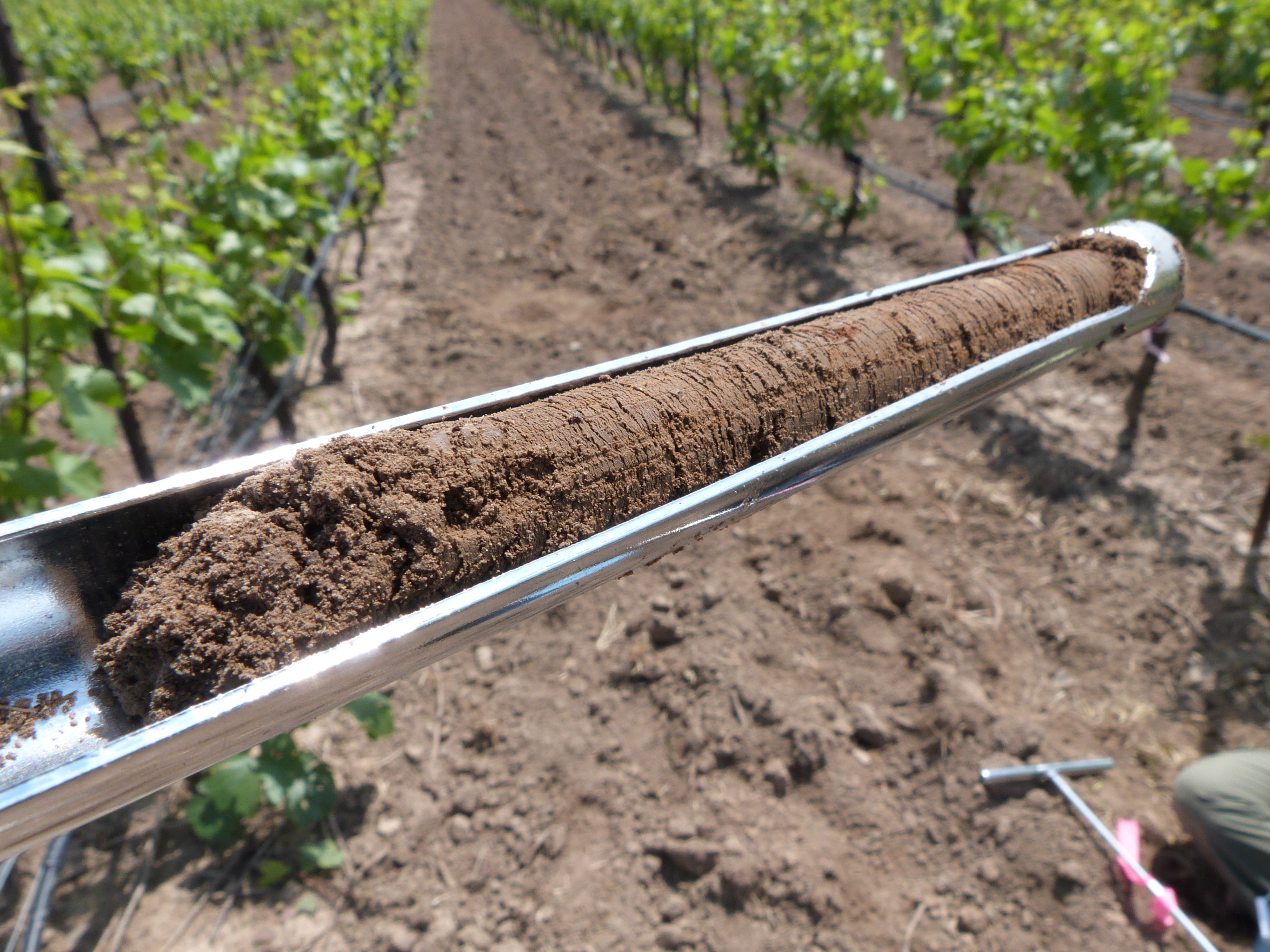
With farmer permission, soil samples were collected by staff and summer students from the Ontario Ministry of Agriculture, Food and Agribusiness (OMAFA), then analyzed by the University of Guelph Agriculture and Food Laboratory.
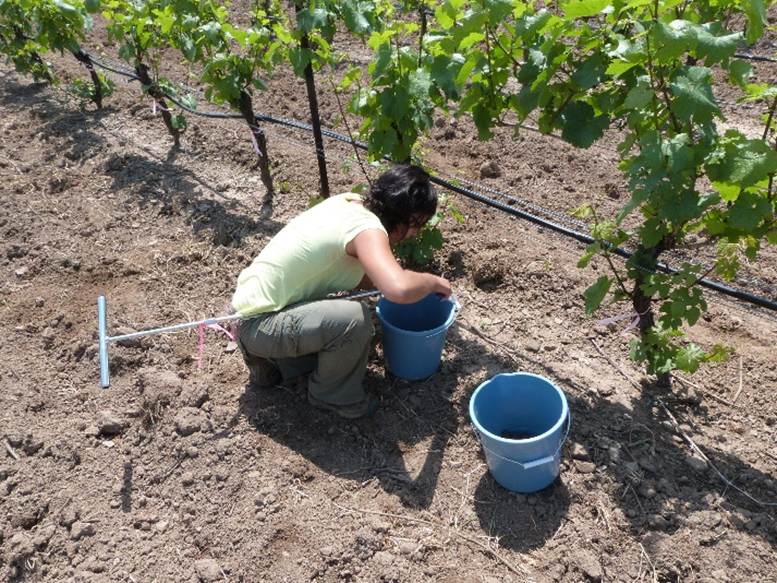
Soil sampling in a vineyard Photos from Kathryn Carter
The goal was to characterize baseline soil health conditions and evaluate variability within and among the sites.
The majority of the soils were from the Niagara region, with additional sites along the north shore of Lake Erie, Prince Edward County, and south of Georgian Bay (figure 1).
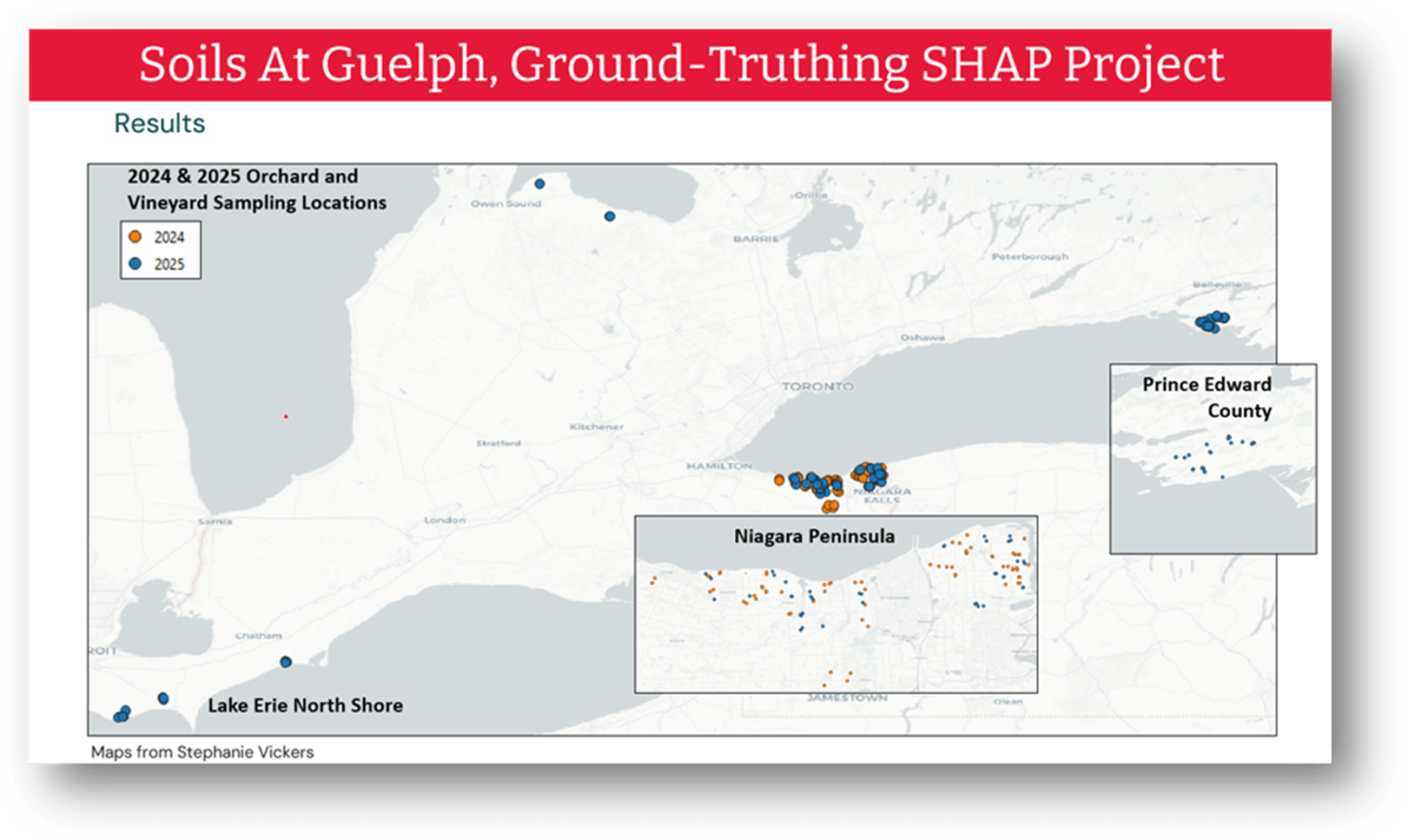
Figure 1- This map shows the locations of the orchards and vineyards that participated in the Soils At Guelph SHAP Ground Truthing Project.
Study Findings
Sample analysis indicated a good distribution across soil texture groups from the orchards and vineyards, meaning there were almost equal numbers of coarse (sandy), medium and fine (clay) textured soil samples taken for the study (figure 2). This variation indicates the variability of soils used in tender fruit and grape production, with tender fruit traditionally grown on sandier soils and grapes being grown on heavier clay soils. The data collected provides an adequate database for each soil texture, the significance of which will be discussed next.
Figure 2 – Soil texture triangle showing fine, medium and coarse texture groups, as well as the distribution of texture groups within the 191 samples.
The data also showed a clear relationship between soil texture and soil health indicators. Finer (clay) textured soils tended to have higher average soil health indicator values, like organic matter, active carbon, respiration, etc., compared to coarser- (sandy) textured soils (see figure 3). This is exactly what we expected to see in the data, which can give us confidence that the indicator values are reflecting real-world soil behaviour.
Figure 3 – Box and whisker plots showing the relationship between soil texture type (coarse, medium, fine) and soil health indicator values (organic matter, active carbon, respiration, potentially mineralizable nitrogen), as well as the soil health scores of the median value for each soil texture group.
Notably, the aggregate stability measurements did not respond to soil texture as consistently as the other indicators (not depicted in figure 3), indicating a less conclusive relationship between soil texture and soil analytical indicator, and, therefore, requiring further study. A new method for this indicator is being investigated.
The data also showed that most soil texture classes had low or very low average soil health scores across the four indicators (see the red and orange coloured “scores” in figure 3). This was unexpected and raises a few questions: what are the factors driving the lower indicator values? Are they tied to sample timing, soil management, or other soil characteristics inherent to orchard and vineyards? Will vineyard/orchard soil health scoring need to be distinct from other production systems? We are still analyzing the data to see what more can be understood, and which questions will require further study. Once completed, we’ll share the results on this blog.
As soil health testing continues to evolve, ongoing collaboration between growers, researchers, and industry partners will help ensure that the resulting benchmarks and recommendations are practical, relevant, and valuable to Ontario growers.
Want to learn more?
Soils At Guelph is an initiative that advances sustainable soil management in Ontario by making research accessible and facilitating knowledge exchange. For more information, visit: www.SoilsAtGuelph.ca. To stay up-to-date with us, follow us on X (@SoilsAtGuelph) or LinkedIn (soils-at-guelph). The SHAP Ground Truthing Project received financial support from the Weston Family Foundation’s Soil Health Initiative and The Ontario Agri-Food Innovation Alliance.
Information sessions will be held to disseminate project findings to interested growers. Stay tuned to the ON fruit blog for updates.
0 comments on “The Ground Truth on Soil Health: Insights from 191 Ontario Orchards and Vineyards”